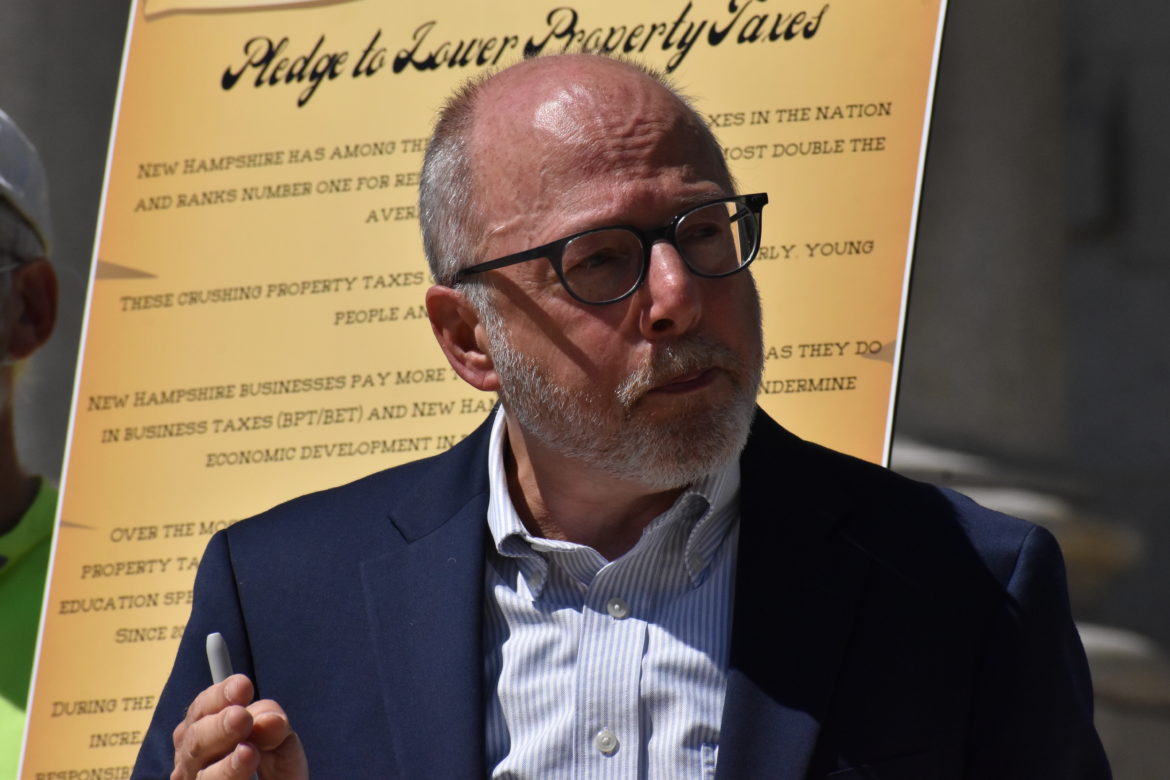
By ANDRU VOLINSKY
We need to protect our elections.
No, not the nonsense with the DNC and the First in the Nation Primary. That’s settled by statute. If the DNC really wants to change the order of state presidential primaries, it can change the law by helping NH win the state house, senate and governor’s office—something which the NHDP has not done for many years. Otherwise, it is to the Republicans’ advantage to have NH go first.
And don’t talk to me about a second unofficial primary supervised by the Democratic Party because the presidential candidates skip the real NH Primary for fear of party sanctions. An unofficial primary plays into Trump’s claims of voter fraud.
What is really at stake.
What I am talking about is Trump sending his thugs to interfere with our primary and general elections this year in an effort to prevent Democrats from taking Congress and, just maybe, the US Senate.
Shelby County v. Holder
The US Supreme Court reversed years of precedent and settled law to undermine portions of the Voting Rights Act that required states with long histories of electoral violence and discrimination to “pre-clear” proposed changes in electoral district boundaries. You’ll recognize those changes as “racial gerrymandering.” The key case is called Shelby County v. Holder (2013). A newer case that follows Shelby County, Rucho v. Common Cause (2019), allows “partisan” gerrymandering. Partisan gerrymandering is where legislatures claim they are only drawing election districts to favor Republicans in power, not to prevent Black and Brown voters from having a say in their governments. Trump has already used partisan gerrymandering to call for his brethren to re-district majority minority districts out of existence. A majority minority district is where a minority population has the majority of the vote based on who chooses to live near each other. Racist politicians overcome the minority’s dominance by cracking the district and attaching pieces to other electoral districts where the majority of voters are white folks. Louisiana and Texas accepted Trump’s challenge. Indiana rejected it.
Another portion of the Shelby County decision obviated the need for federal voting observers to ensure that elections were conducted without overt discrimination. The process for deploying observers required the US Department of Justice to send some of its own personnel and to request specially trained poll observers from the US Office of Personnel Management (OPM). Jurisdictions that were previously part of the responsibility of the Justice lawyers and OPM observers included North Carolina, Alabama, Mississippi, and Georgia.
The Supreme Court decisions have resulted in the US Department of Justice cutting back the resources formerly deployed to ensure fair elections. “In light of the Shelby County decision, the department [of Justice] is not relying on the [Voting Rights Act] . . . as a way to identify jurisdictions for election monitoring . . . This means that the department will be able to send fewer people than in similar past elections to watch the voting process in real-time.”
With depleted resources, you might think the Trump DOJ would focus its efforts to protect voting in places where there have been problems before. You’d be wrong in that belief.
“Hey, NH and Massachusetts, look out!”
Trump and his pals are coming to NH and Massachusetts instead.
According to the Democracy Docket,
President Donald Trump’s Department of Justice announced [June 30] that it will send federal election monitors to 15 jurisdictions in six states during the 2026 primary season, the same day the department sent letters to election officials nationwide threatening potential criminal prosecution over noncitizen voting.
In a video posted to social media, DOJ’s Civil Rights Division chief Harmeet Dhillon said monitors will be sent to jurisdictions in Arizona, Michigan, Massachusetts, Minnesota, New Hampshire and Virginia.
You can reach your own conclusion about why these states were selected.
NH already has good, robust election integrity laws in place, even though I don’t like their name, “Provisions for Election Purity.” These laws provide for challenges of persons not qualified to vote by challengers appointed by the political parties that are recognized by the state (Republican Party, Democratic Party and, occasionally, Libertarian Party). The designated challengers are permitted to locate themselves where they can see and hear registered voters checking in to vote and new voters registering. They can lodge challenges to a voter’s legal ability to vote and those challenges are heard by the moderator who is in charge of the polling place and election activities.
For decades NH voters have been able to count on the NH Department of Justice, led by the NH Attorney General, and the US Department of Justice, led by the NH US Attorney to play fair when it came to determining who could vote and what challengers could do. Both offices made their respective staffs available to answer questions about the law and proper procedures. When a Republican challenger was hassling a citizen attempting to register, you were relieved when someone from the Attorney General’s office showed up to sort things out.
My Experience
I’ve been an election protection lawyer for most of the last two decades. I took time off when I was an Executive Councilor and when I represented Sen. Bernie Sanders. I worked mostly in NH, but also in Massachusetts and Pennsylvania. I held the credentials of a Democratic challenger for all of this time and never challenged a single voter. If a person was legally qualified to vote, my job was to ensure the person was permitted to do so, even if I thought the person would vote against my preferred candidate. This was the orientation I was taught and this is what I taught other challengers to do.
My first stint as an appointed party challenger occurred in 2004 when John Kerry was running for president against George W. Bush. I received a call from my former public defender colleague Paul Twomey who ran the election protection program for the NH Democratic Party. The call came on the night before the election. Paul asked me to cover the polling location in Hanover where Dartmouth students voted. I told Paul that I was happy to help but I didn’t know election law.
Paul explained that he didn’t call because I was an election law expert. He solicited me because he considered me to be one of the most persistent and persuasive lawyers he knew. He actually used other descriptors that I can’t repeat here. He said that his team just learned that former Supreme Court Justice Chuck Douglas was planning to challenge every Dartmouth student who tried to vote and Justice Douglas was an even bigger persistent and persuasive lawyer than me.
Off I went to Hanover at 4:30 the next morning. This was before smart phones. My law firm had a bag phone and we used it for Paul to teach me election law as I drove north. The rumor was right. Chuck Douglas was in Hanover and he did challenge the students.
Hanover’s moderator was a retired elementary school teacher named Marilyn “Willy” Black and she knew her stuff. Chuck lost most every challenge.
Chuck wasn’t trying to keep the students he challenged from voting. It became clear to me that Chuck’s plan was to tie up the voting process and drive the line of people waiting to vote out the door and down the street. As much as Willy and I tried to expedite things, Chuck created the lines he wanted.
Why create lines?
Long lines depress the vote. People don’t like to wait in long lines.
Willy Black passed away in 2018 after a long teaching career and an equally distinguished second career supervising elections in Hanover.
What to watch for.
Will the assistant attorneys general and the assistant US attorneys continue to facilitate NH’s voting laws or will they do Trump’s bidding? Will we see unusually long lines at polling locations on Election Day? It won’t be the fault of the Democratic Party challengers.
It might be the doing of the military lawyers now seconded to the office of the US Attorney in Concord, NH with an assignment to “monitor” elections. We’ll see what role they play.
If you’re a lawyer, contact the NH Democratic Party. Volunteer to observe and support fair elections. If you’re a citizen, pay attention to what is happening and watch who facilitates voting and who obstructs it.
If you’re a voter, be patient. Your vote is important.
If there is a long line at your polling location don’t drive away. If you are near closing time, GET IN LINE. If you are in line when the polls close, you are entitled to vote.
Persist my friends, persist.