By GARRY RAYNO, InDepthNH.org
CONCORD — If state residents vote their pocketbooks, this may not be a good time to be a Republican running for office.
A new Granite State Poll done by the University of New Hampshire Survey Center, indicates pluralities of New Hampshire residents feel worse off financially than a year ago and expect to be doing about the same a year from now. Granite Staters disapprove of President Trump’s tariffs and constantly changing trade policies, and believe they will increase the cost of living, according to the poll.
More than half the people surveyed believe the economy will be in recession in the next 12 months.
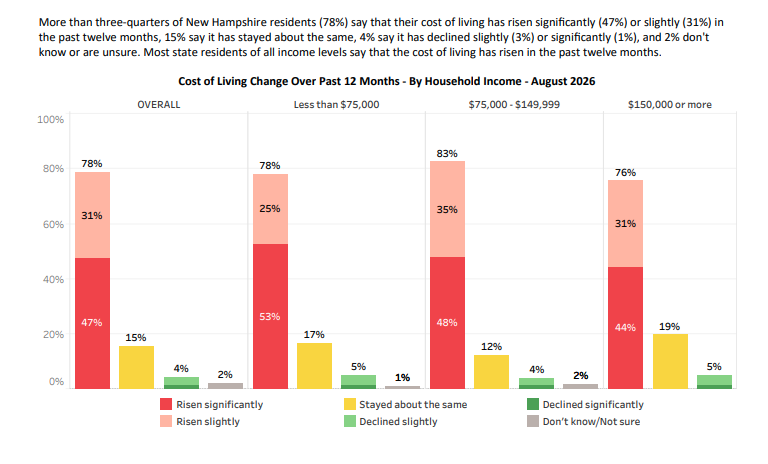
The poll, which was taken by 2,143 New Hampshire residents between Aug. 20 to 24 with a +/- 2.1 percent margin of error, shows more than three-quarters of Granite Staters say their cost of living has increased in the past year, especially gasoline, groceries, and energy.
More than three-quarters expect tariffs to cause prices to increase and a majority disapprove of President Trump’s use of them.
“Overall, Granite Staters are largely pessimistic about the wider national economy, with a majority expecting a recession within the next year, but are more ambivalent about the New Hampshire economy,” according to Andrew Smith of the Survey Center.
The findings are based on the latest Business and Industry Association Report on Consumer Confidence, conducted by the center.
Across all income levels, more than 75 percent of those polled say the cost of living has increased over the last 12 months, with 93 percent citing gasoline, 91 percent groceries, 74 percent electricity or energy, 52 percent healthcare, 31 percent housing, and nine percent childcare.
Seventy-eight percent of those polled believe tariffs will increase prices, 15 percent believe tariffs will have little to no effect, and three percent believe they will lower prices.
Those believing tariffs will raise prices are Democrats, 98 percent, independents, 87 percent and Republicans 57 percent.
However, 43 percent believe tariffs will produce more manufacturing, 33 percent believe they will have little or no effect, 15 percent believe they will cause less manufacturing and 10 percent don’t know.
Fifty-eight percent believe tariffs will have a negative impact on the economy, 29 percent have a positive effect, nine percent little or no effect, and four percent don’t know.
Fifty-six percent of those polled disapprove of Trump’s use of tariffs, while 36 percent approve.
By political party, 96 percent of Democrats and 62 percent of independents disapprove, while 73 percent of Republicans approve.
With the focus on national economic concerns in the news, New Hampshire residents are anxious about their personal finances. According to the survey, only 21 percent of New Hampshire residents believe their household is better off financially than it was a year ago, while 42 percent think their household is worse off —a two-to-one margin— and 38 percent think their household finances are about the same. Despite the negative sentiment, it was worse in May, when 16 percent felt better off and 45 percent — a nearly three-to-one margin —felt worse off financially.
Nearly two-thirds of Democrats, 65 percent, say they are worse off financially than a year ago and nearly half of Independents, 49 percent, say they are doing about the same financially. Among Republicans, 37 percent say they are better off financially, 43 percent are doing about the same, and 20 percent feel worse off.
A majority of those with a household income below $75,000, 54 percent, feel worse off financially than a year ago but only 33 percent of those with a household income of $150,000 and above feel that way.
“Uncertainty is an economic cost. The lack of stability and predictability in trade policy risks continued erosion of consumer and business confidence and that hesitation can have a real impact on the broader economy,” said Michael Skelton, president and CEO of the Business and Industry Association of New Hampshire. “These survey results indicate that the continued changes in tariff and trade policy with key partners are weighing on consumers and likely will change their spending behavior and economic decision-making.”
The negative sentiment continues into the future, as only 24 percent of Granite Staters expect their personal finances will be better a year from now, while 34 percent think they will be worse off a year from now, and 42 percent think their finances will be about the same.
A person’s outlook depends on their partisan leaning, their earnings and their sex.
Forty-four percent of Republicans expect to be better off financially in the next twelve months, but only14 percent of independents and 5 percent of Democrats agree. Those with a household income below $75,000, 43 percent, and women, 42 percent, are more likely than others to expect to be worse off a year from now.
People surveyed don’t believe business conditions will improve in the coming year, with only 24 percent believing they will enjoy good times, while 31 percent expect bad times, and 44 percent expect mixed conditions.
Republicans, older people, men, and those with a household income of $150,000 and above are more likely to expect good times, while young people and women are more likely to expect bad times.
The longer term outlook is not much different as New Hampshire residents are more pessimistic about business conditions than the national average over the next two years.
Forty-three percent expect bad times, 22 percent good times, and 35 percent expect mixed conditions.
Republicans, those over 65, men, and those with a household income of $150,000 and above are more likely to foresee good conditions, while Democrats, those under 50, women, and Seacoast residents are more likely to anticipate bad conditions.
The five-year outlook is even worse, as 34 percent expect bad times, 14 percent good times, and 52 percent mixed conditions.
Granite Staters are more likely to expect widespread unemployment or a depression, 34 percent, than they were three months ago.
Republicans and those with a household income of $150,000 and above are more likely to expect continued good times over the next five years, while Democrats and women are more likely to expect widespread unemployment and or depression.
Fifty-one percent of those polled believe the country’s economy will be in recession in the next 12 months, while 30 percent believe it is not likely, eight percent believe it already is in depression and 10 percent don’t know.
Garry Rayno may be reached at garry.rayno@yahoo.com.