InDepthNH.org is partnering with The Associated Press through the AP Journalism Fund and will publish vote tallies as the votes are counted Tuesday and Nov. 3. Please email your photos and details about what you witness at the polls to me at nancywestnews@gmail.com and we will publish them throughout those days and nights.— Thanks Nancy West
By KATHARINE WEBSTER, InDepthNH.org
CONCORD, NH – New laws and ballot counting machines, ongoing lawsuits and the planned presence of federal election monitors in Nashua and Manchester are making some voters uneasy about next Tuesday’s Republican and Democratic primaries.
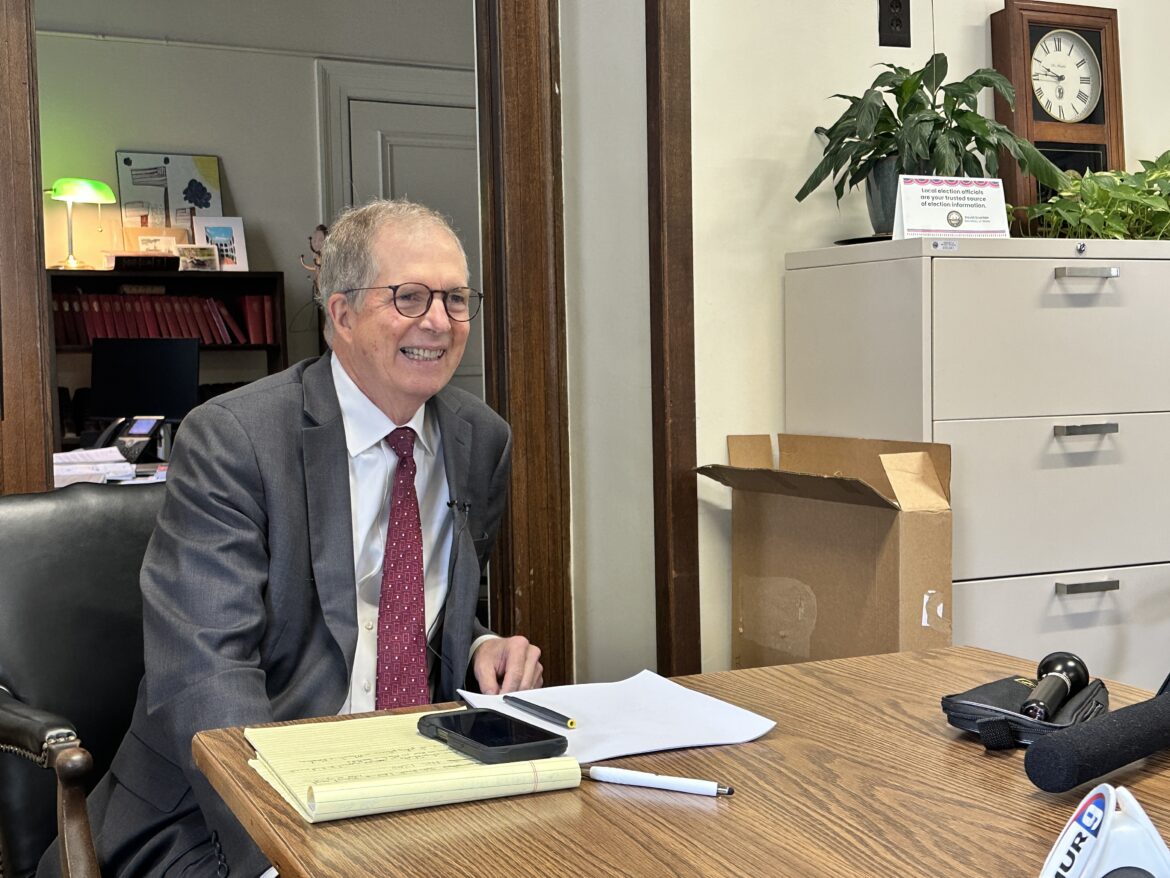
Secretary of State David Scanlan said Thursday that he did not anticipate any problems from the U.S. Department of Justice (DOJ) monitors, who informed the cities of Manchester and Nashua – the state’s two largest cities and the ones with the most citizens of color and immigrants – two months ago that they would be sending monitors.
“I don’t have a concern that it will be disruptive,” Scanlan said. “Massachusetts had their primary election last week: There were monitors there (and) I’m not aware of any difficulty.”
In Wyoming, the governor “expressed concern about monitors being aggressive,” Scanlan said. “I don’t expect that’s going to happen. If it does, I think we’re prepared to deal with it, with the help of the (state) Attorney General’s Office.”
Scanlan said he is predicting 28 percent turnout in Tuesday’s primaries: Out of 297,451 registered Republicans in the state, 243,864 Democrats, and 347,160 “undeclared” voters who can vote in either primary, he expects 145,751 ballots will be cast in Republican races and 103,024 in Democrat contests.
Election Observers and Monitors – and ICE
Upon learning through news reports of the DOJ’s plans to send election monitors to New Hampshire, Gov. Kelly Ayotte, a Republican, and Scanlan said they welcomed the monitors, since they were confident that the state’s elections are fair.
However, the state’s two Democratic U.S. senators, Jeanne Shaheen and Maggie Hassan, signed a letter to the DOJ expressing concern that, under President Donald Trump, the monitors – who normally make sure that local election officials are obeying civil and voting rights laws – could instead intimidate certain voters. The letter warned that any partisan activity could subject the monitors to prosecution.
“It is important that American voters trust that the U.S. Department of Justice’s election monitors will focus only on their statutory ambit and will not target jurisdictions in a partisan manner; discourage voter participation or interfere with the voting process; or pressure, harass, or interfere with state and local election officials as they do their jobs,” the letter said.
The U.S. DOJ will not be the only organization sending observers to the primary and general elections. The political parties often send observers to the polls.
A coalition of New Hampshire voting rights groups, coordinated by America Votes, also will send about 50 volunteers to polling places during the primaries next week and about 130 for the general election on Nov. 3, said Liz Tentarelli, president of the New Hampshire League of Women Voters.
“We will have people in the major cities and larger towns that have had issues in the past,” she said. “We will be doing a lot of the same things the federal election monitors are supposed to do.”
On Thursday, Scanlan reiterated that federal election monitors are subject to the same federal, state and local laws as other election observers. He said his office advises all observers to identify themselves and their roles to the moderator for the town or city ward at that polling place.
“The moderators have broad discretion … to determine where (observers) can be, but the area outside the rail is public space, and people can wander around,” he said.
The federal monitors may want to ask questions of local election officials. They may also question voters in public areas, and they are not required to identify themselves, Scanlan said.
“That’s fine, as long as that process does not in any way impede the process of voting or does not involve voter intimidation,” Scanlan said.
Voters have no obligation to talk to anyone, including federal monitors, he said. If voters or other observers have concerns about anything on Election Day, they should speak with the moderator first, he said. If local election officials cannot resolve the issue, they can contact the state Attorney General’s Office or the Secretary of State, and state officials can be there within minutes, he said.
“The anxiety level of poll workers and voters has increased because of all the talk about what might happen at the polling place,” he said. “There’s concerns that ICE (Immigration and Customs Enforcement) is going to have a presence in the general election, but I have not heard anything that would lead me to believe that’s the case.”
The city clerks for Nashua and Manchester did not return phone messages left Wednesday asking whether they had been in contact with U.S. DOJ officials and how they were preparing for federal election monitors.
However, Scanlan said people in his office met with Manchester officials on Wednesday and planned to meet with Nashua officials Thursday afternoon to advise election staff about how to handle the monitors’ presence.
Pending Lawsuits and Rulings
The six states targeted for federal election monitoring this fall – Arizona, Massachusetts, Michigan, Minnesota, New Hampshire and Virginia – had all denied the Trump administration’s demand for unredacted voter data, including personal information that is private under state law.
That spurred Shaheen’s and Hassan’s concerns that the monitoring was partisan and retaliatory.
“Election monitors are being deployed in the context of President Trump’s ongoing threats to nationalize, militarize, and otherwise interfere with the conduct of free and fair elections,” their letter read.
In May, a federal judge in Concord, NH, dismissed a lawsuit by the Trump administration seeking to force Scanlan and the state to turn over the data. The DOJ appealed to the First U.S. Circuit Court of Appeals in Boston.
The state Attorney General’s Office and Scanlan filed a motion earlier this week asking that the DOJ’s appeal be dismissed without a full briefing, since the federal government had never detailed the legal basis for its records request.
“There is no substantial question as to the facial insufficiency of the federal government’s demand for New Hampshire’s Statewide Voter Registration List,” the motion said.
The federal DOJ also lost similar cases against Maine, Massachusetts and Rhode Island; similar appeals against those states are also pending at the First Circuit, according to Democracy Docket.
A 2024 state law that required voters to present proof of citizenship when registering for the first time in the form of a passport, birth certificate or naturalization document was struck down by a federal judge in Concord in May.
The law eliminated a previous option for people to sign a “qualified voter affidavit,” under penalty of perjury, affirming their U.S. citizenship.
The New Hampshire League of Women Voters, which supported Scanlan and the state in the DOJ lawsuit over the state’s voter database, was among the groups suing the state over the state law tightening proof of citizenship requirements. The law prevented more than 100 eligible voters from registering and casting ballots in municipal elections last year.
“That just shows that the League of Women Voters is taking positions on principle: Qualified voters must be allowed to vote,” Tentarelli said. “We’re on the side of voter rights in both cases.”
Another group that sued over the 2024 law, the New Hampshire Youth Movement, sued Scanlan last month over a 2026 law that bans the use of student IDs as a form of identification when voters seek to obtain an absentee or in-person ballot – or to register for the first time.
Tentarelli, who attended an expedited hearing Tuesday before U.S. District Judge Joseph LaPlante, said she was optimistic that he would make a preliminary ruling in time for the general election on Nov. 3.
Scanlan said Thursday, however, that he does not expect a quick ruling. In order to apply to overseas and military ballots, which must be sent out 45 days before the general election, LaPlante would have to issue an injunction before Sept. 19, he said.
One reason that the Legislature decided not to allow student IDs is because students can get IDs at most New Hampshire colleges under their preferred name, even if that differs from their legal name, he said.
“In elections, that’s problematic,” he said. “You don’t have that confidence” about the identity of the voter that you have with a government-issued ID.
The president’s recent executive order on voting by mail would not work in New Hampshire, Scanlan said, since it requires states to submit a list of voters expected to mail their ballots to the U.S. Postal Service 60 days before an election. In New Hampshire, town clerks can issue absentee ballots – the only ones that can be mailed in – as late as the day before an election.
However, New Hampshire has not joined a lawsuit over the order, which does not affect the primaries. Instead, the state is monitoring developments, he said.
Voting Security
Scanlan said New Hampshire’s elections should be more secure than ever, thanks to new ballot-counting machines that have been adopted by nearly every city and town, along with new electronic systems that can help poll workers check voters in faster and better machines for disabled voters.
The new ballot-counting machines generate a visual image of every ballot – without information about the voter who cast it, he said. Those images make it easier to hold recounts and perform post-election audits.
In terms of citizenship requirements, local election officials have access to other state databases, such as Department of Motor Vehicle records and the statewide voter registration database, that can help them confirm the citizenship of voters registering for the first time, voters who have moved since they last voted, and voters who have been inactive for so long that they have been purged from the checklist.
Scanlan said that while state officials are monitoring warnings from federal law enforcement agencies, they do not anticipate cyberattacks by foreign adversaries such as China, Russia, or Iran, in part because the new ballot counting machines are not connected to the internet.
He said the state is always trying to improve election security, but it has never been an issue in the past.
“The record is pretty clear at this point that in every election, there is some inappropriate activity, but it is very low, (and) it is not organized,” he said.