WRITING ON THE FLY
By GEORGE LISET
There is probably not a more scenic drive than the drive through Franconia Notch State Park in the White Mountains of New Hampshire. We drove through the park on our way to Pittsburg, New Hampshire to fish the Connecticut River Trophy Stretch and the surrounding waters. The drive through the notch is where you start to relax and get excited to fish.
The report from the Lopstick Lodge was that water and river flow was high. When we arrived at the First Connecticut Lake Dam the water was pouring over the top of the top. Rivers change their personalities with the weather and anglers have to be prepared for all situations, especially when you’re away from home for a few days.
I had brought four different fly rods and six different reel set ups for that reason. My son Reed had informed me that he read that the conditions would be difficult and surprisingly told me he brought a rod that was a dedicated nymphing set up. Surprisingly because Reed likes to fish with dry flies and occasionally uses a dropper. He enjoys watching the dry fly float down the river and see the trout come up and sip the fly. Some fly fishing purists say that nymphing is cheating, but they will also tell you that it works.
The concept behind nymphing is simple. Fish and Game biologists tell us that trout eat ninety percent of their food below the surface of the water. Most trout hang the bottom usually behind structures like rocks or drop offs, and wait for the food to come to them to conserve energy. The idea behind nymphing is to fish your flies off the bottom and bring your flies to the fish. Most anglers use a three to four weight fly rod that is eleven to twelve feet long. The fly rod is usually held at arms length with the line hanging directly straight below the tip. This is called tight line nymphing.
When you have mastered the technique of nymphing it is highly successful. But in all honesty, it is real ugly when you are learning. Patience is important when learning nymphs. George Baniel, who wrote the book “Dynamic Nymphing” and has written some great articles for “Fly Fisherman” magazine, mentions that you are going to tie a lot of knots and lose a bunch of flies as you learn. The learning process can be a little humbling but the end result is catching fish.
George Daniel likes to drop two bead head nymphs anywhere between twelve and twenty inches a part from his tippet and then leave room to make a small chain of weights at tippets end. This allows the flies to float off the bottom where the fish are. Making a chain at the end of the tippet gets the flies to the fish and keeps the flies from getting stuck on the bottom saving you some money.
When you are fishing dry flies there is a jolt of excitement. When the trout rises and takes your fly it is a verification that the fly you tied to fool a trout works. There is also the joy of knowing that you were able to get the trout to come to you. Sometimes it is the small things that bring an angler joy. Reed isn’t quite a dry fly purist, but I am not quite convinced he isn’t.
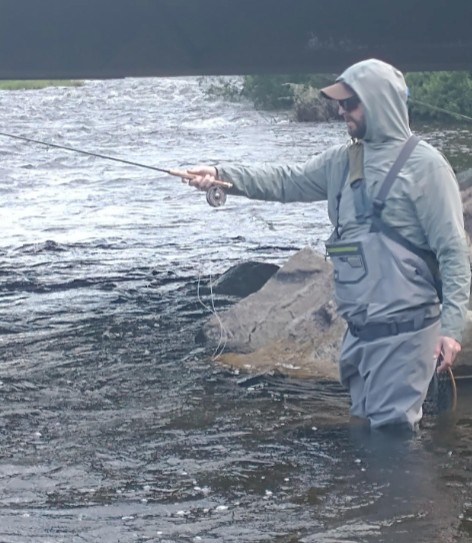
Reed and I began fishing below the dam. I began fishing a green Hornburg. It was a fly that Lou Zambello suggested to use for trophy trout. Lou has written a number of books and they are all in my collection. Reed went with the dry dropper using a small tan Caddis with a size twenty Pheasant Tail midge. We were fishing the riffles where we had a lot of luck on previous trips.
This time was no exception as I caught a nice Brook trout of about fourteen inches. Reed followed suit with a nice Rainbow trout. We had fished for a few hours when the thunderstorms they had predicted started showing up. The weather app showed that a small bank was passing through and that a bigger front would be arriving soon after. We decided to wait out the first wave of storms in the truck so we drove down river to a different spot.
This section was a little deeper and the water a little faster because the river was a little narrower. Reed decided to break out his nymphing rig and I stayed with my Hornburg on a sink tip line. Reed was getting a lot of action and fish. I found my Hornburg wasn’t getting down so I found a slower seam and got into a couple of nice fish. When the thunderstorms finally arrived we headed for the truck and the cabin.
At dinner at the Buck Rub Pub we talked about how Reed had the nymphing pretty well dialed in. I said George Daniel would be proud. Reed smiled and mentioned he might need a new nymphing fly rod. I chuckled and mentioned that he might be going to the dark side and that I would gladly take his dry fly rod. We both roared because we knew that was never going to happen.
George Liset of Dover is an award-winning outdoor writer and avid fly fisherman who shares insights of his time on the water exploring New Hampshire streams and rivers as well of those around New England. George is a graduate of Wheaton College, Illinois, and the University of New Hampshire. His column Writing on the Fly has been honored by the New England Press Association and the New Hampshire Press Association.