By ZACH LAIRD, InDepthNH.org
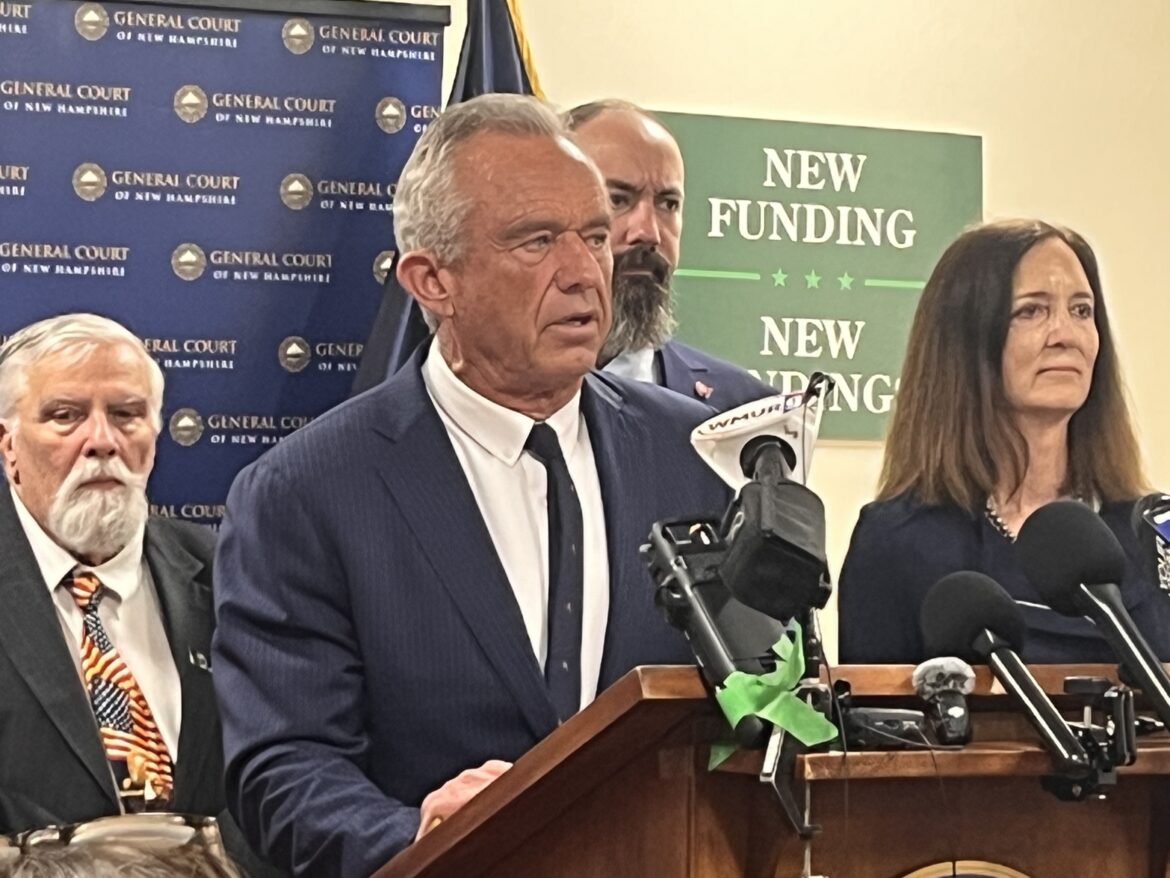
CONCORD — U.S. Department of Health and Human Services (HHS) Secretary Robert F. Kennedy, Jr. stopped at the State House on Friday during his “Take Back Your Health” tour to commemorate Lyme Disease Awareness Month, and revealed new plans to address the spread of the disease.
He was joined by Dr. Stephanie Haridopolos, director of National Health Communications for the Office of the Surgeon General, HHS Chief Data Officer Dr. Kristen Honey, New Hampshire State Senate President Sharon Carson, and Lyme Disease advocates. The disease is the most common tick-borne illness, and approximately 476,000 people in the United States may get the disease each year, according to a report by HHS.
“Millions of Americans living with Lyme Disease and other tick-borne illnesses have been struggling for decades to get diagnoses, treatments, and care. They deserve better prevention, better treatment, and real support. Today, led by the Trump Administration, we’re launching one of the most ambitious federal efforts to undertake and combat Lyme Disease,” Kennedy said.
He recalled how one of his sons suffered facial paralysis for a year after being diagnosed with Lyme Disease. He noted how President Donald Trump made Lyme Disease a national priority during his first term, and signed into law the Kay Hagan Tick Act in 2019. The act aims to ensure the development and implementation of a national strategy to address vector-borne diseases, including tick-borne diseases, per health.gov.
Kennedy explained that the HHS is launching a “major, new multimillion dollar” program which will see the HHS and Centers for Disease Control (CDC) partner with researchers, to develop and deploy practical strategies to eliminate ticks on wildlife before they can breed on deer. He said they’ll begin this effort with researchers of the New England Center of Excellence in Vector-Borne Diseases.
He announced that he’s launching a $10 million program to facilitate more accurate, next-generation Lyme Disease tests. There will also be the Lymex Invisible Voices Prize, which will award up to $250,000 in educational tools and public awareness campaigns. As well, Kennedy announced the creation of the Lymex Innovation Accelerator, a program aimed at identifying promising front-line solutions with a prize of $250,000.
“Americans deserve an answer. They deserve gold-standard science, and a healthcare system that treats suffering seriously,” Kennedy said.
Dr. Haridopolos said while around 31 million people get bit by ticks per year in the United States, not all will develop Lyme Disease. She called for better innovative treatments for those suffering from it.
“We’re going to make the invisible diseases visible now, thanks to Secretary (Robert) Kennedy (Jr.) and President Trump… We know prevention is key. We can prevent not only Lyme Disease, but all the co-infections that go with it,” she said.
According to data from the New Hampshire Division of Public Health Services, there were 1,082 confirmed cases of Lyme Disease in the state in 2021 (the last year for which data was available). One year prior the total number of confirmed cases was 711.
Ticks are active any time the outside temperature is above 40°F and they are not covered by snow, per a report by the HHS. Tick exposure can occur year-round, but ticks are most active during warmer months (from April to November).
“Let me be clear that this movement did not start in government. It started with all of you. It started with the patients, it started with the caregivers. It started with the frontline providers, and those affected families saying, ‘there’s a problem here,’ and rose up, came together, formed unusual allies, and that was the beginning of the Lymex Innovation Accelerator,” Dr. Honey said.
Media personality Sophie Sargent also spoke, explaining that she was diagnosed with Lyme Disease in 2023. In 2017, her mother was diagnosed with it, and said her two siblings were also affected.
“That’s one disease that took years, and some people or family’s decades to properly diagnose. Trying to manage Lyme Disease while launching my career in social media felt like racing in the Daytona 500 in a minivan. Everyone around me was moving fast, and I was just trying not to crash. With 4 a.m. wakeup calls to be on air, and brain fog so thick that I couldn’t speak, but the hardest part of having an invisible illness is actually the fatigue, or the days where you can barely function. It’s actually having to prove to people that you’re sick,” Sargent said.
She continued, saying after years of work to reverse her symptoms that “these are the changes that are not just critical to see in New Hampshire, but across our nation.”
“Let’s make it a gold-standard, and make everybody have the gold-standard in Lyme testing, not the exception. Whether you get an accurate diagnosis depends on a number of factors, like timing, taking in-depth tests, or having doctors who get it and are on your side… Too many patients are only taken seriously after they’ve already been suffering for years. Earlier recognition, better support, and coordinated action from this room can change that timeline,” Sargent said.
-

Federal Judge Strikes Down Voter Registration Restriction Law
The US District Court Thursday found the state’s law requiring a birth certificate, passport or naturalization as the only proof of citizenship instead of an affidavit filed under oath, was unconstitutional.
-

Shaheen Hears Concerns of Tourism Officials; Silver Lining About Summer Labor
Lakes Region business leaders who represent a variety of tourism interests met with U.S. Sen. Jeanne Shaheen, D-NH, Friday to share concerns for the summer season.
-

HHS Secretary RFK Jr. Announces at NH State House Plan to Combat Lyme Disease
U.S. Department of Health and Human Services (HHS) Secretary Robert F. Kennedy, Jr. stopped at the State House on Friday during his “Take Back Your Health” tour to commemorate Lyme Disease Awareness Month, and revealed new plans to address the spread of the disease.