By PAULA TRACY, InDepthNH.org
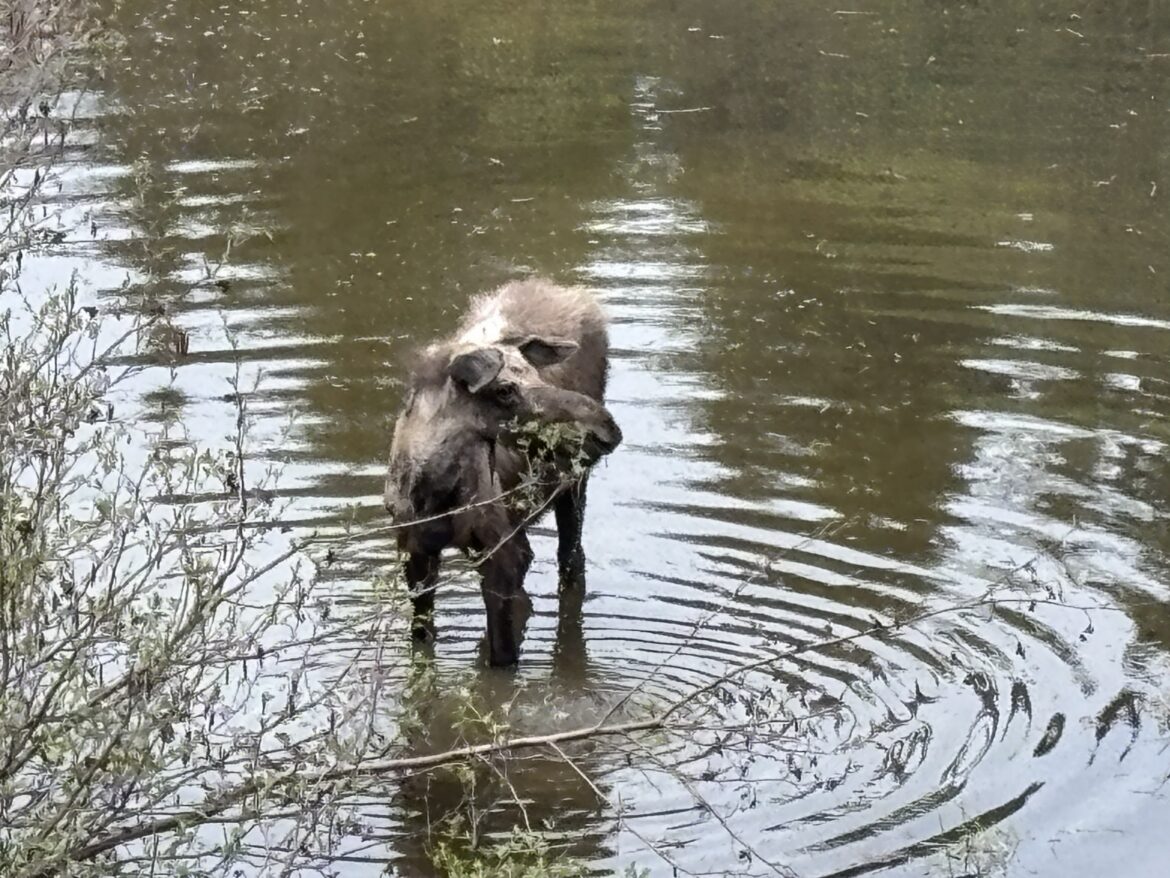
ALBANY – Moose sightings are rare but more common in May along the state’s highways. But they are also a hazard, and in some cases an eyesore that the state is not dealing with on a timely basis, an Executive Councilor said this week.
Charging that the state left a dead cow moose on the side of Kancamagus Highway in Albany for at least four days during the Memorial Day Weekend – a time when thousands travel the mountains hoping to see a live moose – Executive Councilor Joe Kenney, R-Wakefield, said he spoke with DOT Commissioner David Rodrigue about some constituent concerns brought to his attention.
Al Poulin of Lincoln said he picked up the phone and called Kenney after driving by a bloated moose on Tuesday afternoon after learning about the moose being hit on the Saturday of Memorial Day Weekend.
“We need to do a better job,” said Poulin. He has a home in Lincoln on the other side of the Kanc. “That’s not what we want for visitors to see.”
The state has on average about 65 moose collisions a year, with most of them being fatal to the moose who number in the range of more than 3,000 in the Granite State.
They have just come through a long winter and are emerging to eat lots of fresh greenery.
Poulin said there should be a contract the state has for wrecker service to remove the carcasses of these behemoths while Kenney said there is no current law related to the length of time the state is given to remove or bury the remains of a moose.
He said that might be something lawmakers think about next year.
Poulin said the matter “really upset me.”
He said he was on social media last Saturday and noticed someone had posted that a moose was hit and its calf was running around the road on Saturday at that location. He called that visual “heartbreaking.”
On Tuesday at 2:15 p.m. he said he was traveling the Kancamagus Highway in the area near the Bear Notch Road intersection about eight miles in from Conway turn when he spotted the bloated moose still in the breakdown lane.
“It really irked me,” he said and noted there were traffic cones around the dead moose.
“It’s a scenic road. People come from all over the world to see a moose here,” he said.
Poulin said he called NH Fish and Game and was told it was the responsibility of the Department of Transportation to remove it.
He said he then called DOT Shed 105 in Conway and spoke to a gentleman who said he was unaware of the situation though Poulin said there were cones that would suggest someone had come out to look at the situation.
Jennifer Lane, chief communications officer for the Department of Transportation, said in an email:
“When an animal or other obstruction is located in a travel lane and poses an immediate hazard to motorists, the nearest NHDOT maintenance facility is notified, and crews are dispatched as quickly as possible to remove the hazard.
“If the obstruction is not creating an immediate safety risk, it is typically addressed on the next business day. The Department’s top priority is the safety of the traveling public and our employees. When there is no imminent danger, we schedule removal in a manner that minimizes traffic impacts and allows crews to perform the work safely.
“While response times can vary based on the nature of the situation and available resources, NHDOT works to address roadway obstructions as promptly and safely as possible,” Lane said.
Kenney said often moose are buried on the side of the road by DOT where appropriate. He said he conveyed to Rodrigue the importance of the department dealing with the situation.
May to October are considered the best times of the year for the public to see moose along the sides of the roads. They are attracted to the residual salt from the winter road treatments and are primarily found in the White Mountains and the Great North Woods.
Fish and Game issued an advisory this past week to be on the lookout for moose as they are also a road hazard.
The “Brake for Moose” campaign by the NH Fish and Game Department, DOT, and Highway Safety Agency urges drivers to:
Stay alert, especially at dawn and dusk when collisions are most common.
Keep speeds below 55 mph in high-risk areas.
Scan road shoulders and use high beams when possible because they are taller than a deer.
Wear seatbelts and be prepared to stop within the range of headlights.
www.wildlife.nh.gov.