By PAULA TRACY, InDepthNH.org
CONCORD – Since February when gasoline prices began to rise sharply, households with lower incomes have been squeezed disproportionately hard, especially if they have a long drive to work. And if they reduce driving habits, it will also impact road conditions, according to a report released Tuesday.
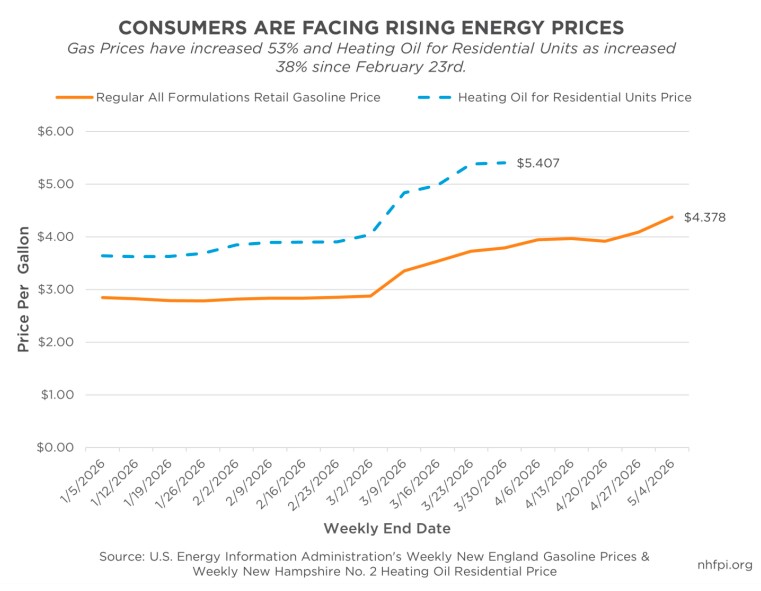
The New Hampshire Fiscal Policy Institute has been looking at the pain at the pump which is now about $4.50 a gallon since the winter and has found how increasing costs are impacting Granite Staters of lesser means particularly hard.
The price for gas has increased about $1.53 since February, the report notes, a 57 percent hike since the war in Iran began.
A person driving a vehicle getting 22 miles per gallon could pay about $768 more per year traveling 11,071 miles, the report notes. And that might mean that they stay home.
“Higher gas prices are creating real financial pressure for many Granite Staters at a time when household budgets are already being stretched by the rising costs of other essentials, including housing, child care, and health care,” said Ben Reynolds, Senior Policy Analyst at the New Hampshire Fiscal Policy Institute and author of the study. “These higher fuel costs could also create longer-term challenges for maintaining and improving New Hampshire’s roads and bridges.”
The report notes that nearly 600,000 New Hampshire workers commuted by motor vehicle in 2024, meaning fuel price increases can quickly add up for many families.
These higher costs may place particular pressure on rural Granite Staters, it notes, households with lower and moderate incomes, and people with longer commutes or fewer transportation alternatives.
The NHFPI report concludes that gas prices – which have gone up roughly 57 percent since the end of February – are creating an immediate short-term financial challenge for those with less fuel efficient vehicles.
“For many families, higher fuel costs can place additional strain on already tight household budgets, especially in rural parts of the state where driving is often a necessity rather than a choice,” it states.
Reynolds also looked at the interconnectedness with reduced driving and the state’s ability to fund bridge repairs and damaged roads.
And while fewer taxes collected and miles rolled lead to fewer bridge repairs, there is some good news in the report: We’ve been making good progress in the past decade improving roads and bridges.
The NHFPI report notes that the state’s bridge conditions have improved over the last decade with the number of state-maintained roads rated in good or fair condition increasing from 68 to 85 percent in the decade which ended in 2024 and the number of red listed bridges dropped by about 24 percent in that decade.
“However, maintaining these improvements will require continued state investment. If high fuel prices lead to less driving overall, the amount of revenue raised by the Motor Fuel tax, https://www.administration.dos.nh.gov/road-toll a key funding source, may be affected,” according to the report.
The Motor Fuel Tax, which is formally called the Road Toll in state law, is a separate and distinct revenue source from the tolling operations on the state’s turnpikes. The turnpike tolls pay for the turnpike system.
The Motor Fuel Tax is not tied directly to the price of a gallon but instead the state charges a flat tax on each gallon of gas sold.
Gov. Kelly Ayotte said for now she is watching but not giving up on collection of the state’s gas tax at 23 cents a gallon. She noted the state has the lowest rate in the region.
The report states that because this tax “is charged per gallon, if gasoline prices rise but drivers continue purchasing the same number of gallons, Motor Fuel Tax revenue remains unchanged. If higher prices lead people to buy less gasoline, drive less often, or move toward more fuel-efficient vehicles, Motor Fuel Tax Revenue could decline.”
There is some talk at the congressional level of trying to suspend the federal 18 cent per gallon gas tax. But there are no solid plans for that, as the summer driving and vacation season nears.
The report notes that at the municipal level local governments receive state block grant aid to help maintain local bridges and roads and there is limited direct federal investment.
“However, the majority of local government services, of which infrastructure construction and maintenance are key components, are funded through local property taxes,” the report states.
Asked if there is evidence that people are driving less since the price hike, Reynolds said, “We have not conducted a price elasticity of demand analysis for fuel consumption habits in New Hampshire in response to price changes. However, the U.S. Bureau of Labor Statistics and the U.S. The Energy Information Administration have conducted research on gasoline prices and vehicle travel. Travel demand appears to be somewhat inelastic, although it varies by income. In the Issue Brief, we noted that households without alternative means of transportation are likely to be more affected by price increases.”
A copy of the full report with regional information is here https://nhfpi.org/resource/higher-gasoline-prices-could-strain-both-households-and-transportation-maintenance-budgets/
The New Hampshire Fiscal Policy Institute is a nonpartisan, independent research nonprofit organization that examines issues related to the state budget, the economy, policy decisions, and the financial security of Granite Staters, centering on issues relevant to people and families with low- and moderate-income. Learn more at www.nhfpi.org.