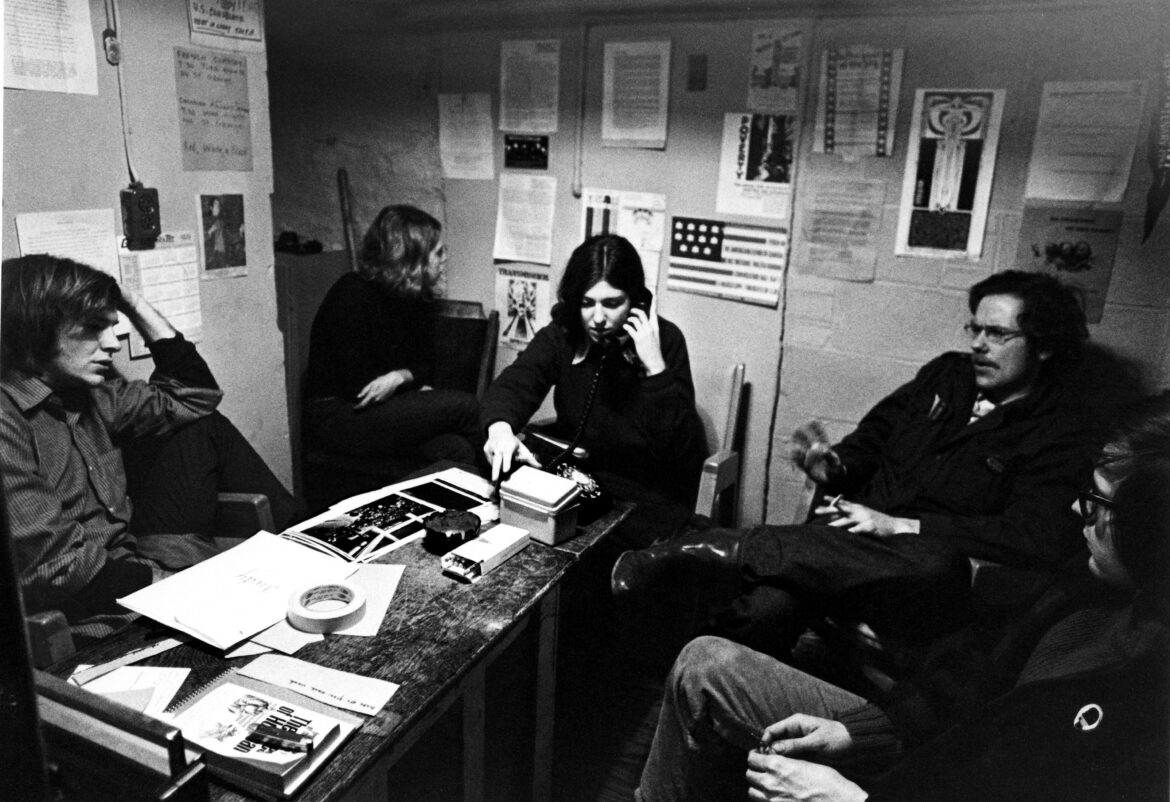
In this two-part series, Arnie Alpert reports on the recent change in the draft law.
Part 1: Today’s report is about the new plan to automatically collect federal data on 18- to 26-year old men for the draft, the history of the draft and becoming a conscientious objector.
Part 2: Read Part 2 here
By Arnie Alpert, InDepthNH.org
Young men and those who care about them would do well to heed a recent change in the law governing the Selective Service System (SSS), the federal agency that would administer a military draft.
The change, which drew little notice when it was approved late last year, is intended to automate the procedure under which young men are registered as potential conscripts.
Titled “Selective Service System: Automatic Registration,” the provision was tucked away in section 535 of the 1260-page National Defense Authorization Act (NDAA), often known on Capitol Hill as the “defense policy bill.”
The new procedure does not mean that a return to the draft is likely, but such a development could go into effect quickly in the event that Congress determines a national emergency exists.
“Except as otherwise provided in this title, every male citizen of the United States, and every other male person residing in the United States, between the ages of eighteen and twenty-six, shall be automatically registered under this Act by the Director of the Selective Service System,” the law states.
In other words, instead of having young men go to the Selective Service web site, pick up a form at the post office, or have their personal information sent to the federal agency when they apply for driver’s licenses, Selective Service plans to scoop up the personal data of millions of young men and sign them up for a potential draft without them even knowing about it.
“This statutory change transfers responsibility for registration from individual men to SSS through integration with federal data sources,” the agency says.
The new procedure doesn’t mean a new draft is being considered, but anti-war and libertarian groups fear it could grease the wheels for conscription to resume.
“Even before a draft is activated, the mere presence of a system to carry it out and enroll men to be involuntarily inducted can encourage politicians and military planners to feel overconfident in planning and carrying out larger and longer wars without having to worry about whether enough people would be willing to fight them,” says a statement issued last month by 43 organizations, including the American Friends Service Committee, Antiwar.com, the Center on Conscience and War, Veterans for Peace, The Libertarian Institute, and the War Resisters League.
“Thus, having a system for a draft in place reduces a critical guard rail for such decisions.”
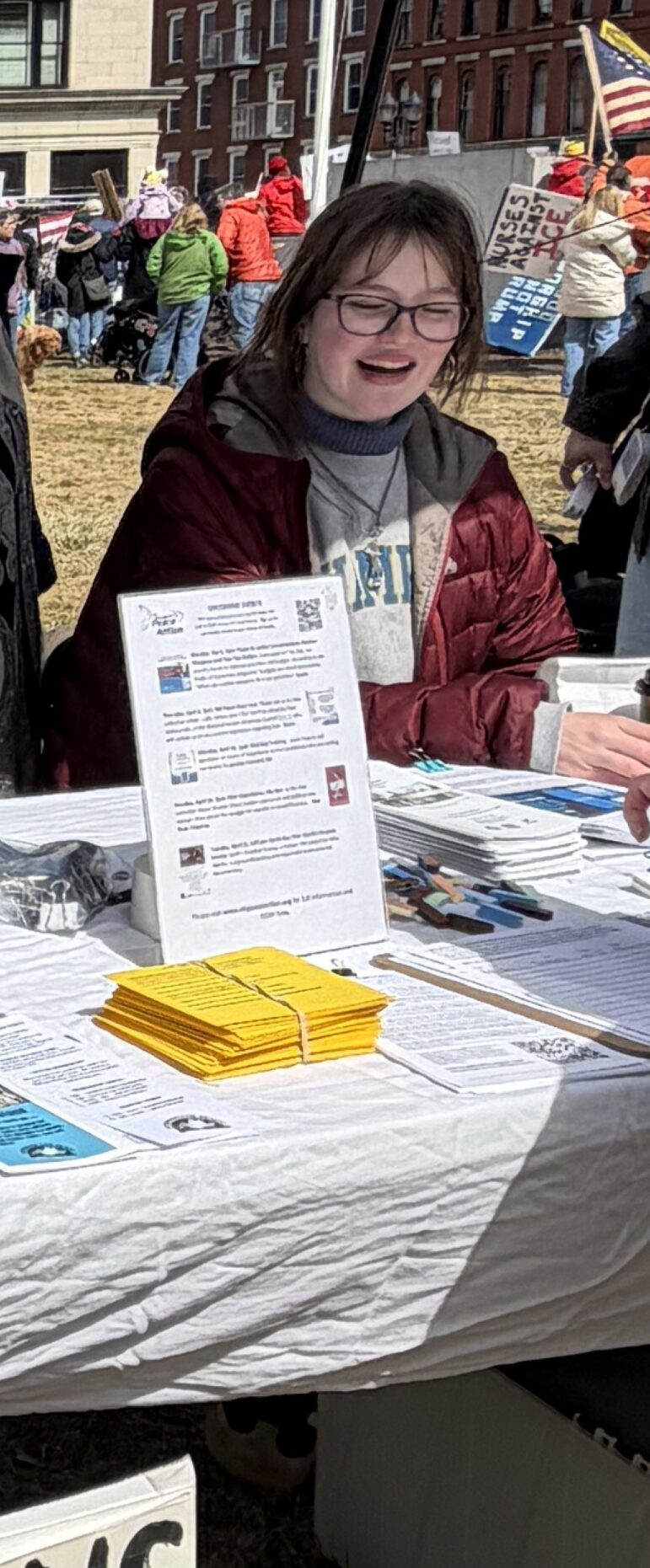
Hazel Armstrong-McEvoy, a 20-year-old junior at UNH Manchester and intern with NH Peace Action, said: “Every step that makes it easier to send people into conflict without their voice feels like a step away from peace and from our rights.”
She is pictured at left staffing tables for NH Peace Action at No Kings rally in Concord.
Implementation
The change will be implemented over the course of the year, Selective Service says, “resulting in a streamlined registration process.”
Conscription, or inducting people into the armed services regardless of their will, was ended after World War Two, brought back during the Cold War, and ended again due to resistance during the U.S. war in Vietnam. Since then, we’ve had an “all-volunteer” military force.
But the SSS itself was not abolished, and five years after registration was suspended, President Jimmy Carter brought it back in reaction to the Soviet invasion of Afghanistan. Since 1980, federal law has required that all men register within 30 days of turning 18. Failure to register is a felony, punishable, according to the law, by five years in prison, a fine of up to $250,000, or both.
It’s likewise a felony to “aid and abet” violation of the draft law. That’s like the crime which sent Eugene Debs to prison in 1918 and the offense for which InDepthNH.org columnist Michael Ferber and about 200,000 others were prosecuted during the U.S. war in Vietnam. (more about Michael Ferber in Part 2)
Millions of men have turned 18 in the last 45 years and no doubt a significant percentage have failed to register, but virtually no one has been charged with violation of the Selective Service Act. According to Ed Hasbrouck, an indefatigable critic of Selective Service, 20 people were charged with draft resistance in the 1980s. He was one of them. No one, he says, has been charged with violation of the act since 1986.
Since even heavy penalties failed to convince enough young men to register, Congress added other sanctions, such as ineligibility for federal jobs for those who refuse or ignore the registration mandate. In addition, some states automatically send data to Selective Service when young men apply for driver’s licenses. SSS data indicates that DMV data provided 62% of registrations in 2023.
Selective Service has made several attempts to tie New Hampshire driver’s licenses to draft registration but thus far the legislature has resisted. The current law enables driver’s license applicants to have their data sent to SSS but specifies that failure to opt into the system “shall not be a basis for denying driving privileges to the applicant.”
New Hampshire law does specify that no one who is out of compliance with the Selective Service Act can enroll in a state-supported college or university, receive funds for higher education, or get hired by the state. A bill sponsored by Rep. Tom Mannion to repeal the aspects of the law applying to higher education passed the NH House of Representatives in 2025 but failed in the Senate.
Another Mannion bill, in 2024, sought to repeal state penalties for non-compliance and would have ended any state enforcement of federal registration requirements except in times of a declared war. That measure was defeated in the House.
The prospect of a draft has occasionally been discussed, but military planners and members of Congress seem to prefer volunteers to conscripts. “America’s Armed Forces are the strongest and most professional in the world because we are an All-Volunteer Force. And we must remain an All-Volunteer Force,” said a statement from Representative Maggie Goodlander, a member of the House Armed Services Committee.
With no plan for a draft and an annual budget above $30 million, the SSS could be seen as a wasteful government program, yet efforts to eliminate it have failed to gain traction in Congress. Instead, debate in recent years has focused on whether women should be required to register. At this point the legal obligation rests solely on those assigned as male at birth.
What Would Happen if a Draft Were Ordered
However unlikely a draft would be, the SSS has detailed plans for how it would be administered if it were ordered. Those plans include a lottery based on dates of birth, a system of exemptions and deferments, and the maintenance of draft boards in every state.
According to Ed Hasbrouck, “In the event of a draft, members of draft boards would function as, in effect, administrative law judges, making both factual and legal determinations with potentially life-or-death consequences in response to draftees’ claims for classification (including classification as conscientious objectors), exemption (including on medical and other grounds), or deferment.”
Hasbrouck says the SSS actively recruits draft board members but doesn’t publicize who they select to be one. However, using FOIA requests, he has been able to sleuth out the names of draft board members for every state, including 28 in New Hampshire. According to the most recent SSS Annual Report, Ronald G. Corsetti, a civilian aide to the Secretary of the Army, is the State Director for New Hampshire.
Conscientious Objection
With no draft, it is not possible to apply for an exemption or a deferment, but it’s never too early to plan for one, especially if you think you, or someone you know, might be a Conscientious Objector (CO), someone who is opposed to military service based on deeply held religious, moral, or ethical beliefs. The inclusion of “moral” and “ethical” was added during the Vietnam era, prior to which the CO option was limited to those with religious objections. Those who qualify are exempt from military service, though they could choose to serve in a non-combatant role. Others would be required to perform alternative service outside the armed forces.
Selective Service says, “Men who would be classified as Conscientious Objectors if they were drafted must register with Selective Service.”
If a potential draftee’s number comes up in the lottery, they would be sent an induction notice. Only at that time could they apply for exemptions or deferments. If they want to apply for CO status, they will need to describe the nature of their beliefs, prove that they are “deeply held,” and show that they apply to all wars, not just the one the government is currently fighting or considering. The Center on Conscience and War says, “Those planning to claim CO status should keep records of their actions and writings which show what they believe about war. Keep a file of everything you send to and receive from the Selective Service System, including notes of conversations, and copies of all forms and information submitted, including the original registration card.” In other words, a potential CO must show their “deeply held” beliefs did not form the day the induction notice appeared in their mailbox.
The local draft board would determine whether a would-be CO has proved their case.
In the Vietnam era, pacifist groups trained thousands of people to be draft counselors, who without “aiding and abetting” noncompliance, provided free advice to hundreds of thousands of young men on how to apply for CO status or other exemptions from military service. “These counselors ensured that men were aware of highly technical aspects of the draft, such as the availability of time-consuming appeals, the obligation of draft boards to reopen cases upon receipt of new information, and the requirement that classification denials be explained in writing,” writes Jerry Elmer, author of Conscription, Conscientious Objection, and Draft Resistance in American History. Lydia Willits, a Durham Quaker, was well-known for the information table she set up every week in the Memorial Union Building at UNH.
A new generation of draft counselors was trained following the renewal of registration in 1980, with support from the Central Committee for Conscientious Objectors. That organization, which was founded in 1948, shut down in 2011. Another longstanding group, the National Inter-religious Service Board for Conscientious Objectors, re-organized as the Center on Conscience and War in 2000.
Potential draftees, potential recruits, active duty and reserve members of the armed forces can also turn to the GI Rights Hotline for information and counseling. Organized in 1994, the Hotline is a non-governmental source of information on military service regulations, including applications for CO discharges from the armed forces. “Some of our counselors are veterans, some are lawyers and some have decades of military counseling experience. We are in constant contact with each other to stay up-to-date on the latest military regulations and practices,” they say.
The Hotline does not provide legal advice but says it can help people find attorneys if they need one. Its services are free and confidential.
(Part 2 of this series will be published Wednesday)
Arnie Alpert spent decades as a community organizer/educator in NH movements for social justice and peace. Officially retired from the American Friends Service Committee since 2020, he keeps his hands (and feet) in the activist world while writing about past and present social movements. You can reach him at arnie.alpert@indepthnh.org.