Speaking of Words
By Michael Ferber
Last January Donald Trump said, “Tariffs is the most beautiful word to me in the dictionary.” I hope someone had the nerve to tell him that this most beautiful word is Arabic, or even worse, a hybrid of Iranian (ta) and Arabic (iff).
There is nothing unusual in this way that a language acquires words, for most of the words in English have been “borrowed” from foreign tongues. On top of the mainly inherited stock of Old English words have come great waves of French, Latin, and Greek, and lesser streams of Spanish (plaza, mosquito), Native American languages (canoe, tomato), Italian (pasta, casino), Dutch (boss, cookie), Malay (ketchup, bamboo), African languages (jazz, banana), and of languages in nearly every place on earth.
In this column, however, I want to discuss the way English makes up new words from its own vocabulary, that is, from words that have become domesticated, whatever their sources. Perhaps the most obvious method is to add prefixes and suffixes, as we see in antidisestablishmentarianism, with two prefixes and arguably four suffixes, all Latin or Greek. There is no end of these words, for they are constantly created. More homely is the -ie or –y ending, as in laddie (perhaps the oldest), lassie, dearie, sweetie, nightie, doggie, roomie (since 1911), homie (since 1929), and hoodie (since the 1970s).
Somewhat similar is the adding of –by or –bie, though it may carry a slight ironic or condescending nuance. In British English the suffix, sometimes with an –s-, was fairly common; we find idleby or idlesby (“idler”), rudesby, lewdsby, and wigby or wigsby (“one who wears a wig”). These were probably inspired by surnames such as Crosby or Slingsby, and they in turn are English place names of Scandinavian origin. Two newer words of this sort are freebie or freeby (since 1925) and newbie (since 1970).
There are two towns in England called Frisby, and one or both of them gave rise to the surname Frisby or Frisbie, one bearer of which founded the Frisbie Pie Company in Bridgeport, Connecticut, in 1871. Sometime in the 1950s students at Middlebury College, or so the story goes, discovered that the pie plates could fly if spun right, and a craze started. The Wham-O Company of California started producing them without the pies, but changed the spelling to Frisbee to avoid lawsuits.
Footnote: I may have introduced the frisbee to Japan. I brought a small one with me when I arrived in September of 1970, and no one I showed it to had ever seen one. By the time I left a year later frisbees were all over the place.
The –by and –sby endings sound English enough, but we sometimes add a suffix from another language. Beatnik and peacenik, among other more transient niks, were inspired by Sputnik (launched in 1957), which means “fellow traveler” in Russian, –nik being the agent ending, like English –er in traveler. But –nik (or –nick) was around in our language since the beginning of the twentieth century, at least among Yiddish speakers, for Yiddish had absorbed it from Russian or Polish. Hence realestatenick, stuckupnick, and nogoodnick.
The opposite procedure, subtracting syllables, is another way to coin new words. In the 1970s, pizza being too long for some young people to say, za began circulating, and it came with varieties such as shrooms and roni. I don’t know if these have had much staying power, but I confess I like shroom, since the full word has nothing to do with mush or room (it comes from French but no one knows where French got it). Then there is hood, from neighborhood, and toon, from cartoon, and now rizz, from charisma. These three, along with za and roni, keep the original suffixes and drop the roots. An older example, from about 1830, is bus, from omnibus, which is pure Latin, meaning “for all,” the dative plural of omnis, “all.” The –bus is just a grammatical ending that can attach to thousands of words, such as pluribus in our national motto.
We also have made-up words not derived from others, such as bling, originally bling-bling, from 1991. It’s a fine word, I think, but it’s a little eerie since it seems to come from nowhere, unless it’s from Mars. But so is skibidi, which might mean “cool” or “bad” among teen-agers (Generation Alpha, born after 2010); the word comes from Skibidi Toilet, the name of a weird web series that began in 2023. This word also seems to have dropped from the skies.
The acronyms from texting have led to a few words, though most of them may not quite be words, but just attempts to pronounce the initials. FOMO and BOGO are frequently seen, though less often heard. GOAT, for “greatest of all time,” is not likely to be spoken very often, since to call a great athlete the goat causes trouble and confusion. But biffles may catch on (from BFFLs, “best friends for life”). An acronym from World War II, SNAFU (for “Situation normal: all fucked up”) is here to stay, for good reason. It is often printed in lower case, and the War had not ended before it became a verb: “The army snafued the soldier’s plan.”
Let me conclude with an interesting concoction that started in English but took a detour to Japanese before returning transmogrified to English: cosplay. It is not, as it seems, co-splay, with the common Latin prefix co– attached to splay, whatever that might mean. It is really cos–play, the cos– being short for costume. That construction took place in Japanese, where abbreviations are based on syllables rather than initial letters (in fact there is no alphabet among the three Japanese writing systems). In 1983 Nobuyuki Takahashi invented ko-su-pu-re for “costume play,” where people dress up as their favorite anime or television or video-game characters. Ko-su-pu-re has four syllables, but the vowel in su and pu is whispered and shortened so the word sounds much like cospray (there is no l in Japanese), and, sent back to English, the l replaced the r and we got a new, and baffling, word. Ko-su-pu-re is a big deal in Japan, second only to frisbees.
I am happy to hear from readers with questions or comments: mferber@unh.edu.
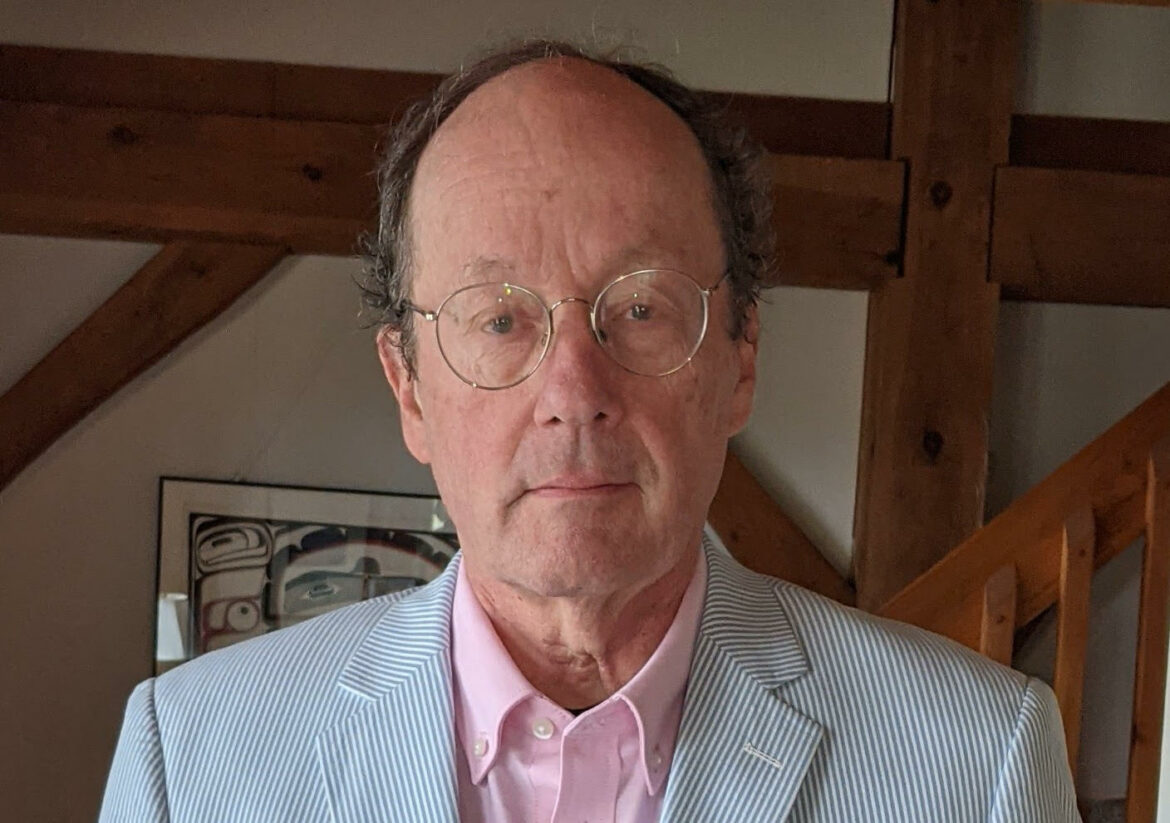
Michael Ferber moved to New Hampshire in 1987 to join the English Department at UNH, from which he is now retired. Before that he earned his BA in Ancient Greek at Swarthmore College and his doctorate in English at Harvard, taught at Yale, and served on the staff of the Coalition for a New Foreign Policy in Washington, DC. In 1968 he stood trial in Federal Court in Boston for conspiracy to violate the draft law, with the pediatrician Benjamin Spock and three other men. He has published many books and articles on literature, and has a deep interest in linguistics. He is married to Susan Arnold; they have a daughter in San Francisco.