Four-year public higher education enrollment in New Hampshire continues to decline, raising concerns about NH’s future workforce
Concord, N.H. – Fewer New Hampshire high school graduates are attending college, with the share enrolling falling from 60.9% in 2014 to 53.9% in 2024, according to a new analysis from the New Hampshire Fiscal Policy Institute (NHFPI). Among those New Hampshire high school graduates who attend four-year colleges, three in five choose institutions outside the state, contributing to concerns about declining enrollment at New Hampshire’s public colleges and universities and the state’s ability to develop the skilled workforce needed to support its economy.
The study, New Hampshire’s Public Colleges and Universities Face Declining Enrollment as Fewer High School Graduates Attend College and More Look Out of State, examines public higher education enrollment, college costs, and the economic importance of higher education in New Hampshire.
Key findings from the study include:
- Three in five New Hampshire high school graduates attending four-year colleges leave the state. About 60% of recent high school graduates who enrolled in four-year colleges in fall 2024 attended institutions outside New Hampshire, including public and private colleges and universities. New Hampshire had the second-highest share of college-bound high school graduates leaving for college among all states, behind only Vermont.
- Fewer New Hampshire high school graduates are attending college as their next step. The share enrolling in college declined from 60.9% in 2014 to 53.9% in 2024. While the number of high school graduates declined 4.8% over that period, the number enrolling in college fell 15.6%, suggesting that declining college enrollment reflects more than demographic changes alone.
- Public four-year college enrollment remains below levels from a decade ago. Enrollment at New Hampshire’s public colleges and universities fell 9.4% between the 2014–2015 and 2024–2025 academic years, from 56,395 to 51,100 students. However, enrollment trends varied across institutions. Total enrollment at the University System of New Hampshire declined 20.3%, while total enrollment within the Community College System of New Hampshire increased 6.1%, based on full-year unduplicated enrollment figures.
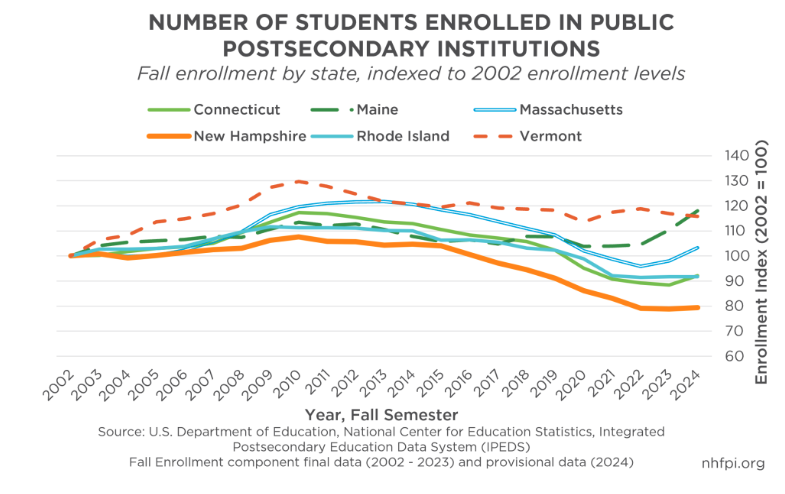
- New Hampshire experienced the largest decline in traditional fall semester and full-time student public higher education enrollment among New England states. Based on fall enrollment figures, enrollment at New Hampshire’s public colleges and universities declined 20.7% between 2002 and 2024, compared with smaller declines in Connecticut and Rhode Island and increases in Maine, Massachusetts, and Vermont. New Hampshire’s enrollment decline was not as steep as in other New England states when accounting for part-time and dual-enrolled high school students at New Hampshire’s public institutions.
- Fewer degrees and certificates are being awarded at public institutions. New Hampshire’s public colleges and universities awarded 8,371 degrees and certificates during the 2024–2025 academic year, 13.4% fewer than a decade earlier. The number of education degrees awarded has fallen by more than half since the 2010–2011 academic year.
- Recent enrollment figures offer some signs of a stop to the downward trend. Enrollment at New Hampshire’s public colleges and universities increased 2.1% between the 2023–2024 and 2024–2025 academic years. The University of New Hampshire also reported a 4.9% increase in first-year and transfer student enrollment across its Durham and Manchester campuses between 2025 and 2026.
- College affordability remains a challenge for New Hampshire students. Graduates of New Hampshire institutions that predominantly award four-year degrees carried an average of $25,364 in student loan debt in 2025, the fourth-highest amount nationally. New Hampshire also ranks last nationally in state funding for public higher education relative to both the state’s population and to personal income.
These trends matter beyond college campuses. New Hampshire’s public colleges and universities help prepare workers for jobs in health care, education, and other industries. According to New Hampshire Employment Security projections, eight of the state’s ten fastest-growing occupations typically require at least an associate or bachelor’s degree. Higher education can also create greater economic opportunities for Granite Staters. In 2025, residents with bachelor’s degrees had median annual earnings of $75,511, compared with $51,714 for high school graduates.
“New Hampshire’s economy depends on having enough skilled workers to meet the needs of our businesses and communities,” said Ben Reynolds, senior policy analyst at the New Hampshire Fiscal Policy Institute and author of the study. “With fewer high school graduates choosing college and many of those who do leaving the state, New Hampshire faces important questions about how to build the workforce it needs for the future.”
Recent efforts to expand tuition assistance may help address some of these challenges. The University System of New Hampshire has announced a program that will cover tuition for eligible students from families earning up to $100,000 beginning in fall 2027. The Governor has also proposed a similar program for eligible community college students, which would require funding in the next State Budget.
“Making college more affordable and accessible is key for the upward mobility of students and families, but also for New Hampshire’s overall economic future,” said Reynolds. “Investments in higher education can help more Granite Staters gain the skills they need and strengthen the state’s workforce.”
You can read the full study, New Hampshire’s Public Colleges and Universities Face Declining Enrollment as Fewer High School Graduates Attend College and More Look Out of State, at https://nhfpi.org/resource/
###
About the New Hampshire Fiscal Policy Institute
The New Hampshire Fiscal Policy Institute is a nonpartisan think tank that promotes opportunity and economic well-being for all New Hampshire residents by producing and disseminating independent research and analysis to inform public policy.