WRITING ON THE FLY
By GEORGE LISET
I am a clock watcher and a planner. Mostly by necessity and convention. I have spent the majority of my life either going to school or teaching school. I’ve lived by the clock and sometimes felt like Pavlov’ s dogs, sometimes to the consternation of my wife and those around me. To be spontaneous is against my DNA, but I’m trying to do better.
On a recent trip to Vermont, I decided to spontaneously bring my fly rod and fish the Battenkill River. My wife and I were meeting my brother-in-law at the Orvis flagship store in Manchester, VT. I enjoy checking out any new fly-fishing equipment and hopefully catch a deal or two. Orvis has a casting pond where they are always willing to let customers try out a fly rod and reel combination. The pond is filled with huge trout that are always on the lookout for a handout.
After lunch we headed down to East Arlington so I could throw in a line. I only had about an hour before we had to head back to New Hampshire. This is where the clock watching comes in. An hour is not enough time to fish, especially if you start catching fish. Heck, some days it takes me an hour just to get my gear on and my fly tied on.
My internal clock was screaming “Not enough time!” But the beautiful fall day was telling me to “Relax and enjoy.”
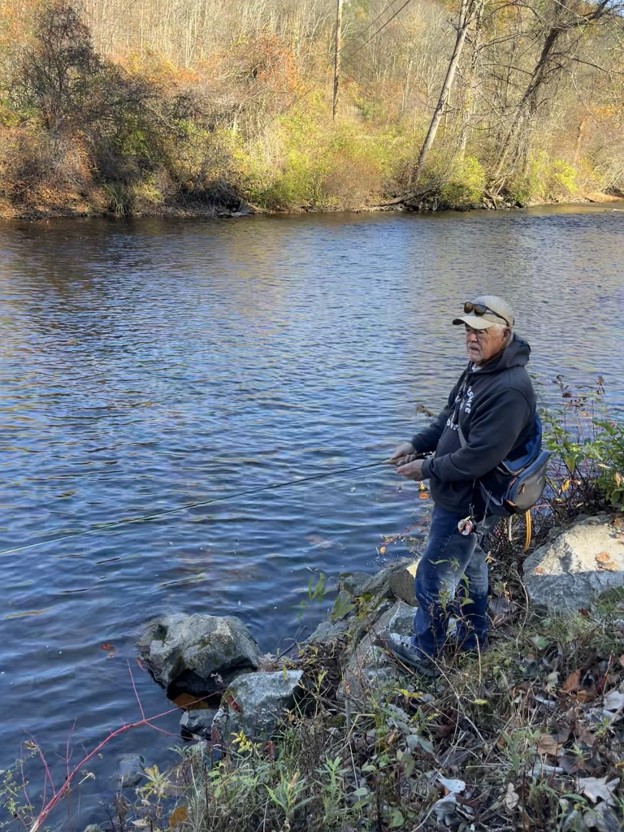
The day was your iconic New England fall day. The sky was azure with not a cloud in the sky. The leaves were a collage of different shades of red and gold with the Green Mountains as a backdrop and it was a comfortable sixty degrees. There is a myriad of information on fishing the Battenkill, but one of my go-to resources for the Battenkill and New England rivers in general is the “Flyfisher’s Guide to New England” by Lou Zambello.
I drove past Orvis on 7A and took a left to catch the river in Manchester by the golf course. The stately mansions with stone walls surrounded by huge lawns was in direct contrast to the older farms on the western side of 7A in Arlington. It was like two different worlds held together by the common thread of the Battenkill.
The section of the Battenkill I was fishing runs from East to West Arlington, VT, Route 313, parallels the north side of the river and River Road parallels the south side. On this day I fished the River Road to West Arlington since there were more pulloffs. River road is a narrow dirt road which is how one pictures the bucolic Vermont, littered with old farms trying to stay relevant. Their properties alone are worth more than they could ever imagine making in many lifetimes, yet they hold on hoping beyond hope that their farms will stay in the family. That all their hard work and toil will be valued by someone and not turned into condos or townhouses.
I drove slowly along the river to find a spot where I could just put on my wading boots and have easy access. The first couple of spots had a steep bank so I kept driving until I found a spot where I could just step into the river. Not being familiar with a river makes it difficult to know where to start fishing and what flies to use. I had about forty minutes to fish so I tied on a #14 Caddis fly to do some prospecting. The flow of the river was perfect for using a dry fly. I had to take a couple of deep breaths to relax. I didn’t see any hatches on the river: nor did I see any fish rising.
After about twenty minutes with no action I tied on a small #12 Wooly Bugger with a small bead since the river wasn’t too deep. I noticed how the shadows on the trees across the river were creeping to their tops. Needless to say that after a number of watch checks I went past my allotted time. The Battenkill has heavy pressure all year and the trout, Browns and Rainbows, see a lot of flies and become wary of a fly that might not look like the real deal. The Battenkill is designated a wild trout stream because it hasn’t been stocked since the 1970’s.
I did a little scouting on the way to West Arlington to catch Route 313 and noted some spots that looked fishy and easy to access. I also noted where a few other fly fishers were working the water. On the ride home I just thought about how great it was to spend even forty-five minutes on an iconic river, fishing for wild trout on a gorgeous New England fall day. Then I wondered why I even wear a watch.
WRITING ON THE FLY
By GEORGE LISET
ing the Battenkill
George Liset
I am a clock watcher and a planner. Mostly by necessity and convention. I have spent the majority of my life either going to school or teaching school. I’ve lived by the clock and sometimes felt like Pavlov’ s dogs, sometimes to the consternation of my wife and those around me. To be spontaneous is against my DNA, but I’m trying to do better.
On a recent trip to Vermont, I decided to spontaneously bring my fly rod and fish the Battenkill River. My wife and I were meeting my brother-in-law at the Orvis flagship store in Manchester, VT. I enjoy checking out any new fly-fishing equipment and hopefully catch a deal or two. Orvis has a casting pond where they are always willing to let customers try out a fly rod and reel combination. The pond is filled with huge trout that are always on the lookout for a handout.
After lunch we headed down to East Arlington so I could throw in a line. I only had about an hour before we had to head back to New Hampshire. This is where the clock watching comes in. An hour is not enough time to fish, especially if you start catching fish. Heck, some days it takes me an hour just to get my gear on and my fly tied on.
My internal clock was screaming “Not enough time!” But the beautiful fall day was telling me to “Relax and enjoy.”
The day was your iconic New England fall day. The sky was azure with not a cloud in the sky. The leaves were a collage of different shades of red and gold with the Green Mountains as a backdrop and it was a comfortable sixty degrees. There is a myriad of information on fishing the Battenkill, but one of my go-to resources for the Battenkill and New England rivers in general is the “Flyfisher’s Guide to New England” by Lou Zambello.
I drove past Orvis on 7A and took a left to catch the river in Manchester by the golf course. The stately mansions with stone walls surrounded by huge lawns was in direct contrast to the older farms on the western side of 7A in Arlington. It was like two different worlds held together by the common thread of the Battenkill.
The section of the Battenkill I was fishing runs from East to West Arlington, VT, Route 313, parallels the north side of the river and River Road parallels the south side. On this day I fished the River Road to West Arlington since there were more pulloffs. River road is a narrow dirt road which is how one pictures the bucolic Vermont, littered with old farms trying to stay relevant. Their properties alone are worth more than they could ever imagine making in many lifetimes, yet they hold on hoping beyond hope that their farms will stay in the family. That all their hard work and toil will be valued by someone and not turned into condos or townhouses.
I drove slowly along the river to find a spot where I could just put on my wading boots and have easy access. The first couple of spots had a steep bank so I kept driving until I found a spot where I could just step into the river. Not being familiar with a river makes it difficult to know where to start fishing and what flies to use. I had about forty minutes to fish so I tied on a #14 Caddis fly to do some prospecting. The flow of the river was perfect for using a dry fly. I had to take a couple of deep breaths to relax. I didn’t see any hatches on the river: nor did I see any fish rising.
After about twenty minutes with no action I tied on a small #12 Wooly Bugger with a small bead since the river wasn’t too deep. I noticed how the shadows on the trees across the river were creeping to their tops. Needless to say that after a number of watch checks I went past my allotted time. The Battenkill has heavy pressure all year and the trout, Browns and Rainbows, see a lot of flies and become wary of a fly that might not look like the real deal. The Battenkill is designated a wild trout stream because it hasn’t been stocked since the 1970’s.
I did a little scouting on the way to West Arlington to catch Route 313 and noted some spots that looked fishy and easy to access. I also noted where a few other fly fishers were working the water. On the ride home I just thought about how great it was to spend even forty-five minutes on an iconic river, fishing for wild trout on a gorgeous New England fall day. Then I wondered why I even wear a watch.