By PAULA TRACY, InDepthNH.org
ASHLAND – A small group of Ashland area residents working on re-starting a community garden are among many of the beneficiaries of a federal grant given to the Lakes Region that aims to reduce waste through composting.
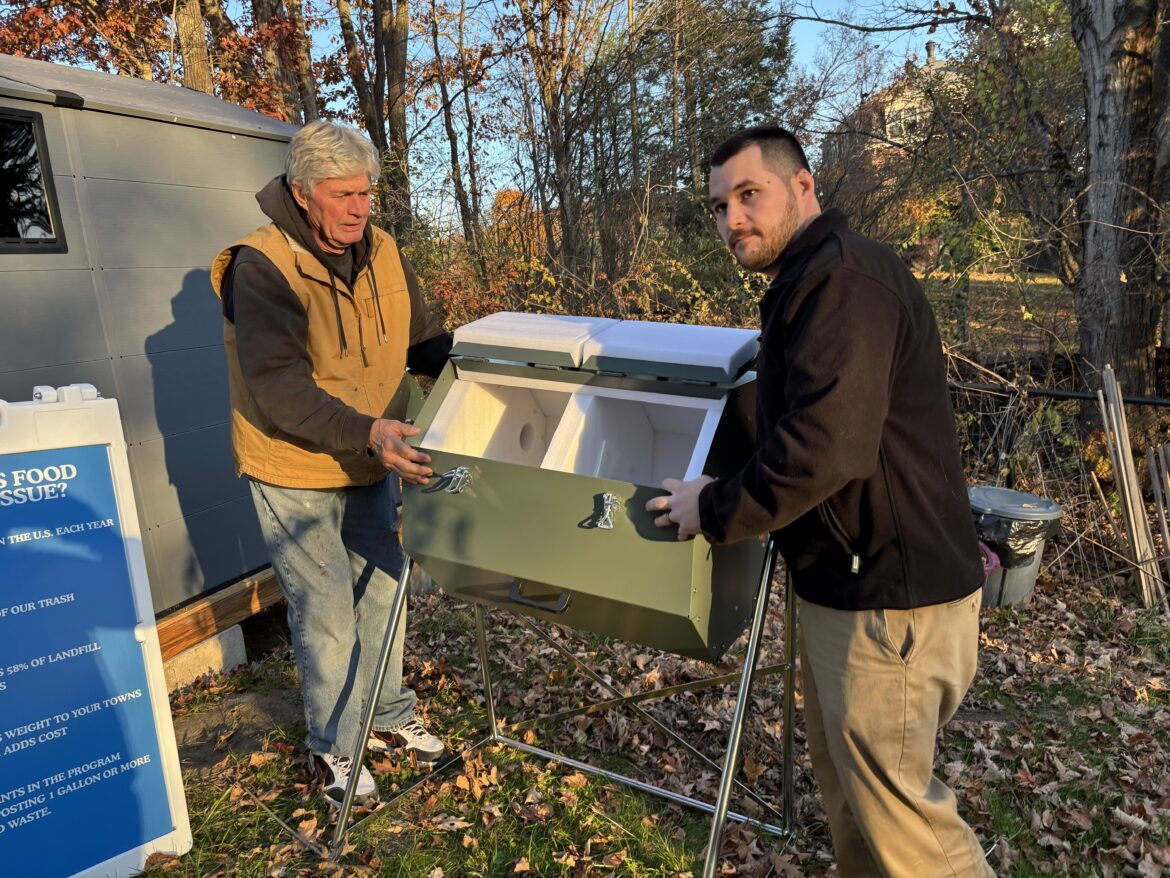
This week, volunteers for the garden received some training on how to use two Jora “tumblers” given to the garden through the grant. The garden is located on the opposite side of the parking lot from Ashland Elementary School.
The USDA Composting and Food Waste Reduction grant totaled $87,300 and was secured last year to launch the region’s first Food Waste Composting Pilot Program by the Lakes Region Planning Commission.
The funding is supporting the development of two large-scale food waste composting sites at town transfer stations in Gilford and Wolfeboro and providing free composting tumblers to 160 Lakes Region residents in five participating communities: Ashland, Bristol, Gilford, Moultonborough, and Wolfeboro.
All of the tumblers, which retail for over $400, have been distributed and the LRPC is now receiving data on how they work and how much food waste was diverted.
The program is designed to equip households with the essential tools and knowledge to compost at home while collecting data to measure the program’s effectiveness.
“It’s all about waste diversion at landfills. New Hampshire on the whole is probably on the lower end of waste diversion tactics,” said Matt Rose, environmental planner at Lakes Region Planning Commission.
He said NH Department of Environmental Services was a project partner who helped with a training platform.
“Compositing is a really good waste diversion tactic in our area because it is a low cost to get started with it,” he said, “and a lot of it is based on education,” he said.
According to the LRPC website, “The program’s data collection will equip our grantor and LRPC with valuable insights on food, waste composting, trainings delivered, landfill diversion, and additional key outcomes,” the LRPC website reads.
The program is offering comprehensive training for both participating residents and solid waste operators to ensure successful implementation of the Lakes Region Food Waste Composting Pilot Program.
At the meeting in Ashland, some of the recipients of the home use tumblers spent time talking about troubleshooting issues, from clumping balls to what is the best “brown” matter to use to mix in with “green” and how often to tumble the “tumbler.”
Paula Finigan of Ashland, a member of the garden program, reached out to the LRPC and got Rose to come talk about the program and the tumblers which will go into use next spring. They were the last two tumblers left after all others were distributed to homes in the five towns.
Earlier this year, individuals who received the tumblers received training on the fundamentals of food waste composting, tips for achieving successful composting at home, instructions for assembling and guidance on required data collection for the pilot program.
Transfer station operators at Wolfeboro and Gilford were trained and certified to accept waste for compost.
According to statistics provided by the LRPC, one third of the food produced in the United States each year is never eaten. Food makes up 24 percent of trash produced and causes 58 percent of landfill methane emissions. and 70 percent of participants in the program reported composting one gallon or more of food waste a week.
Rose said every gallon diverted can lead to cost reduction to towns.
“Anything that does not go in the trash bin is something we don’t have to haul away that costs municipal tax dollars,” he said.
He said the five communities chosen for the grant were the ones who requested being part of it.
Rose distributed for those attending a list of what can go into the composting tumblers and provided a link https://lakesrpc.nh.gov/food-waste-composting-pilot-program/ to go over how to use it with one part green material to three parts brown material. Green is the food waste and brown can be thin wood shavings, unused animal bedding, saw dust, dried leaves and shredded newspaper.
After tumbling food waste including rice, vegetable scraps, egg shells and soft plant waste with the dry brown ingredients the tumbler cooks up the material to create a compost which can improve topsoil and planting and can be used as a top dressing for roots and at the drip line of plants for nourishment.
The participants learned if the “tumbler” is emitting a rotting smell it is too wet and they need to add more dry brown material, if there are big lumps they should be broken up with a hand tool and it may be too wet, and other troubleshooting suggestions.
In addition to receiving two of the tumblers to use next spring, members of the Ashland Community Garden got from the grant a shed to store tools used in the fenced in garden.
Rose said he has found that many are having great success with their composting efforts and that can lead to present and future waste reduction.