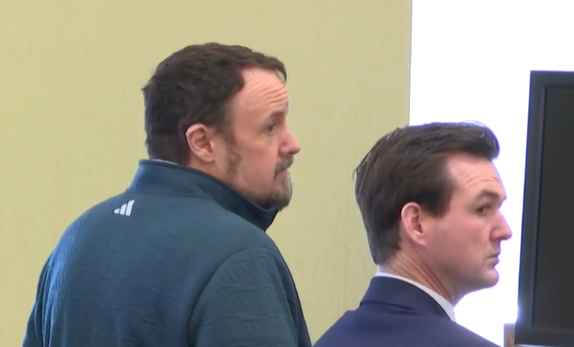
By DAMIEN FISHER, InDepthNH.org
Some constitutional rights are more flexible than others, according to the New Hampshire Attorney General’s Office, like the right to confront witnesses at trial.
Stephen “Spider” Clough spoke from beyond grave to put Timothy Verrill in prison for the double-murders of Christine Sullivan and Jenna Pellegrini. Verrill is challenging his convictions based partly on the fact his attorneys could not cross-examine the dead Clough during the 2024 trial when an audio recording of Clough was played for jurors.
Verrill’s team filed its brief with the New Hampshire Supreme Court this summer, and now the New Hampshire Attorney General’s Office response has come in with the argument that Verrill’s right to confront witnesses is not absolute.
This is the second time Verrill heads to the New Hampshire Supreme Court to challenge the case against him. The first trial in 2019 was shut down because of repeated evidence violations committed by the State. The Supreme Court refused to dismiss the charges, setting up the second trial in Strafford Superior Court at which Verrill was found guilty.
Senior Assistant Attorney General Peter Hinkley writes in the state’s reply brief that Article 15 of the New Hampshire constitution, which guarantees the right of defendants to face-to-face confrontation with accusing witnesses, does not mean that a recording of the deceased Clough is out of bounds.
“Article 15’s reference to an accused’s right to a ‘face to face’ meeting—much like its references to an accused’s rights to ‘all proofs favorable’ and ‘to be fully heard in his defense’—‘is not absolute,’” Hinkley wrote.
Historically, New Hampshire courts have allowed evidence from dead witnesses, according to Hinkley.
“It was well-understood in New Hampshire common law that prior sworn testimony of a deceased declarant subjected to cross-examination was admissible in a trial on the same matter,” Hinkley wrote.
Clough testified during the original 2019 trial, and the defense was able to cross examine him as a witness while he was alive. That means, according to Hinkley, Verrill’s constitutional rights were protected in 2024 by the 2019 cross-examination.
In his appeal brief, filed in June, Verrill challenged Clough’s testimony, the lack of convincing evidence, and inappropriate comments by the prosecutor during closing arguments. Hinkley deals with the supposed lack of evidence tying Verrill to the crimes, disputing Verrill’s assertions.
Among other points Hinkley raised, Verrill is seen on recorded video turning off the surveillance camera system in the house where Sullivan and Pellegrini were murdered. Further, his fingerprints were found on garbage bags containing items stained with the blood of the two women.
“The evidence establishing defendant’s identity and disproving any reasonable alternative not only was sufficient, it was overwhelming,” Hinkley wrote.
Verrill’s appeal also faults the trial court for allowing prosecutors to use the closing argument to dismiss the defense’s case that someone else could have killed the women as “rumors” and “innuendo.”
But Hinkley wrote that nothing in Verrill’s appeal shows those closing remarks by the prosecutor had any effect on the jurors.
“Defendant also has not proven that any actual plain error affected substantial rights—that is, prejudiced him,” Hinkley wrote.
It might be easy for the prosecution to argue the jury got the case right when the whole affair is riddled with so many unanswered questions.
Sullivan and her significant other, Dean Smoronk, ran a drug dealing business that supplied cocaine and methamphetamine to customers throughout New England. Verrill was a factotum for Sullivan and Smoronk’s operation, who occasionally lived at the couple’s Farmington house.
But the drug dealing power couple were in the midst of an ugly breakup that started before the January 2017 murders, with Sullivan and Smoronk fighting about the house and the business. Smoronk was making threats to Sullivan in the midst of the breakup.
“I am going to cut you right to the bone because you’re a greedy, self centered, piece of s***,” Smoronk texted to Sullivan on Jan. 17, 2017, days before the murders.
Sullivan and Pellegrini were murdered on Jan. 28, 2017, according to the state’s autopsy. But as part of the effort to make the evidence fit, prosecutors claimed Verrill killed the women on Jan. 27, 2017.
Smoronk had started a new drug dealing venture with Joshua Cowell, an enforcer and member of the Mountain Men Motorcycle Club. Smoronk was looking to extract himself from the business with Sullivan, and force her to move out of his house. Smoronk didn’t hide his feelings from Cowell, according to texts the two exchanged.
“Bro, I’m so f…ing sick of that bitch … I have got to get her out of my life ASAP,” Smoronk texted Colwell.
Smoronk left the state on Jan. 26, 2017, flying to Florida to stay with another woman. Though he was due to fly back on Jan. 29, Smoronk cut his trip short because he was reportedly worried after not being able to contact Sullivan, the woman he told his friends and associates he hated, and the woman he had threatened to kill.
“I wish you were dead already … I f***ing swear Christine you just turned this lethal, motherf***er. You might as well call the cops right now,” Smoronk texted to Sullivan weeks before the murders.
The supposedly concerned Smoronk had Colwell pick him up from the airport and the pair made their way to the Farmington house where the bodies of the women were discovered. Sullivan and Pellegrini had been stabbed repeatedly, and their bodies wrapped in a tarp and hidden under a porch.
Verrill was soon arrested on the theory he committed the murders in a drug-fueled, paranoid rage and believed that Pellegrini was a police informant. It turns out Pellegrini was merely Sullivan’s friend and house guest, but there were police informants involved in the case.
According to some of the records police and prosecutors failed to hand over to the defense in 2019, Clough was an active Drug Enforcement Agency informant during the 2019 trial.
Cowell himself later avoided prison time after he was arrested in 2018 on federal drug charges, despite facing up to 20 years in prison. At the time, prosecutors cited his work in recovery as reason for the lenient treatment.
The 2019 trial against Verrill featured multiple disclosures by prosecutors that they had failed to hand over exculpatory evidence to the defense. After the third disclosure, a mistrial was called, setting up the 2024 trial.
Among the evidence the state did not originally hand over in 2019 is the fact that Clough was a suspect in the murders, but his DNA was never tested. Police also did not hand over a report on a witness who claimed Smoronk wanted to hire him to kill Sullivan.
The case that the state did present in 2024 did not include any clearcut evidence that Verrill committed the murders. DNA samples taken from Sullivan’s rings, which broke when she fought off her killer, excluded Verrill. Additionally, Verrill’s fingerprints are nowhere on the tarps used to wrap the bodies of Sullivan and Pellegrini after the murders.