By GARRY RAYNO, InDepthNH.org
CONCORD — New Hampshire increased the number of days its rainy day fund could support state government in an emergency, but it remains in the bottom half of the states.
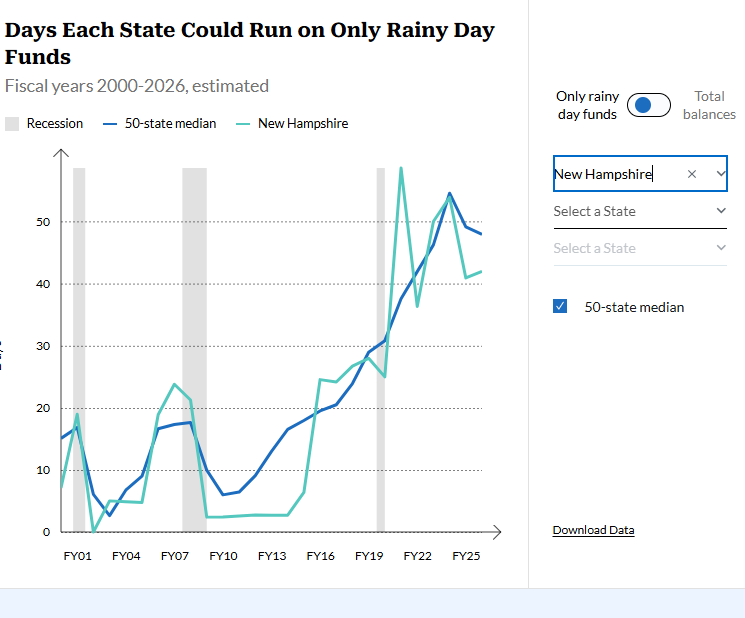
According to a new report by “The Pew Charitable Trusts,” New Hampshire’s rainy day fund would be able to support state government expenses for 42 days. The national median is 48 days, with Wyoming having the largest emergency coverage at 256.5 days and New Jersey the least at 0.
Overall the trend for state rainy day funds coverage is downward. While New Hampshire increased from 40 to 42 days from fiscal year 2025 to fiscal year 2026, those figures are much lower than when it peaked at 58.6 days in fiscal 2021 due to federal COVID relief and rescue money and large revenue surpluses.
“For the second year in a row, states’ rainy day fund capacity—the number of days that reserve balances could cover state operations—fell from it’s all-time high, reached in fiscal year 2024. At the end of fiscal 2026, the median state could run on its rainy day fund balances alone for 47.9 days, down from 49.1 days in fiscal 2025 and 54.5 in fiscal 2024,” according to the report written by Justin Theal, Senior Officer for Fiscal 50, and Page Forrest, Associate Manager for the project. “The back-to-back declines mark a notable shift after years of growth and are the first consecutive years of contraction not tied to a recession since at least fiscal 2000. Although most states still have near-record reserve balances, growing budget pressures could place greater demands on their already shrinking capacity.”
The authors warn that at the same time rainy day fund capacity is going down, so are the leftover budget dollars known as ending balances at a rapid rate.
“As a result, states’ total balances—reserves plus ending balances—and the fiscal cushion they provide are quickly eroding, leaving states with fewer resources to address pervasive budget pressures” the authors write.
Regionally, New Hampshire has the second shortest span to continue government operations, as Rhode Island has only 19 days of reserves.
Connecticut has reserves for 68.6 days totaling $4.58 billion; Vermont has 66.5 days, $464 million; Massachusetts has 57.7 days, $8.14 billion, and Maine has 48 days, $778 million.
Rhode Island reserves are $303 million, and New Hampshire’s $225 million, down from its peak of $258 million in 2021.
The report notes that lawmakers are facing slowing revenue growth, growing spending pressures and reduced aid from the federal government.
“Moving forward, budget reserves will play a critical role in stabilizing state finances as policymakers confront the most widespread fiscal pressures since the onset of the pandemic in 2020,” the authors write. “But state leaders should be cautious about relying on rainy day funds to close deficits, because many states’ reported budget gaps stem from structural imbalances—when recurring revenue is insufficient to support recurring expenditures—rather than from short-term shocks.”
Reserves provide relief at times of fiscal stress, but are not a solution for recurring budget shortfalls, they said.
They note states will be facing increased costs due to federal changes to both the Medicaid health insurance program for the poor and disabled, as well as in the Supplemental Nutrition Assistance Program (SNAP) that provides food to the needy.
The federal government and the states used to share the administrative costs of the SNAP program but in the new federal fiscal year the states have to pay 75 percent of the administrative costs.
Beginning Jan. 1 states must have error rates, which are technical mistakes such as too much or too little aid, below 6 percent or the states are penalized and have to pay a share of the program costs.
New Hampshire’s error rate for fiscal 2026 has not been finalized, but for fiscal 2025 it was 8.85 percent.
The report looks at both states’ rainy day funds and also their total balances which is the surplus money at the end of a fiscal year or ending balance.
Like rainy day funds, states use ending balances to help smooth budget variations or for one-time projects as New Hampshire has done with its large surpluses generated as the state recovered from the COVID pandemic from federal rescue and relief funds and higher business taxes due to the revenues generated from the flow of federal money into the economy.
However, New Hampshire has seen a steep decline in its ending balances, since fiscal year 2022 when its ending balance was $413 million providing 93.8 days of covering government operations; fiscal year 2024, $366, 67.5 days; fiscal year 2025, $225 million, 41 days; and fiscal 2026, $170 million, 31.7 days.
The 31.7 days is one of the lowest in the country. Washington was lowest at 16.1days; Rhode Island, 25.1 days; Illinois, 30.2 days; New Hampshire, 31.7 days, and Maryland, 32.3days.
“States use reserves and balances to manage budget uncertainty, including revenue forecasting errors, budget gaps during economic downturns, and other unforeseen emergencies, such as natural disasters,” the authors write. “This financial cushion can soften the need for spending cuts or tax increases when states need to balance their budgets in response to temporary shocks, though these actions can be necessary to address longer-term structural imbalances.”
Reserves and ending balances are also watched by bond rating agencies and a state’s bond rating also impacts the rates municipalities, counties and school districts receive when they issue bonds.
The authors say there is no one-size-fits-all for states and the amount of reserve funds they should have.
“Pew’s research shows the optimal savings target of state rainy day funds depends on several factors: the defined purpose of funds, the volatility of a state’s tax revenue, the potential increase in spending demands during economic downturns, and the level of coverage that the state seeks to provide for its budget,” the authors said.
The full report is available here: https://www.pew.org/en/
Garry Rayno may be reached at garry.rayno@yahoo.com.