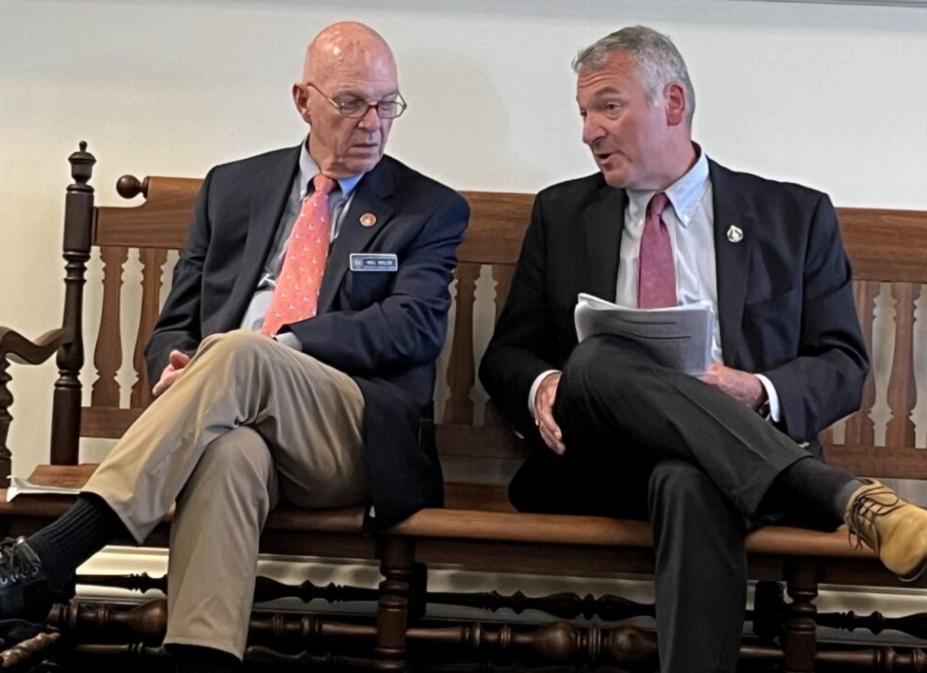
By Rep. Dave Luneau, Rep. Richard Ames, Mary Heath and Mel Myler
For more than 30 years, New Hampshire has struggled to resolve one of its most important public policy challenges: how to provide every child with the opportunity for a good public education.
Despite decades of litigation, legislative debates and changes in funding formulas, a fundamental problem remains. New Hampshire continues to have the lowest state aid in the nation. When that inadequate state support is coupled with poorly-designed distribution methods, children living in communities facing the greatest educational and financial challenges are left with fewer resources to support their education than children living in more affluent communities.
That is why we, as former members of New Hampshire’s Commission to Study School Funding, have filed a friend-of-the-court brief in Rand v. State of New Hampshire, now before the New Hampshire Supreme Court.
Our message is straightforward: Protect our children’s constitutional right to a good public education, and clarify that the Legislature may direct greater state financial assistance to the communities and students who need it most.
In 2020, our Commission completed an extensive examination of New Hampshire’s public school funding system, supported by independent research from the University of New Hampshire and the American Institutes for Research.
The Commission found that New Hampshire’s public schools, on average, achieve among the highest educational outcomes in the nation. But those averages conceal a disturbing reality.
Communities with greater concentrations of poverty generally spend less per student than more affluent communities, even though their property taxpayers often pay substantially higher tax rates. Students in these communities also tend to experience lower educational outcomes.
The Commission concluded that “student equity is the most important principle for good fiscal policy in school funding.”
Under current law, the State distributes education aid uniformly, without regard to true differences in student needs and local financial resources, which perpetuates the very inequities that the Commission found and that smart education funding reform should correct.
In response, we have sponsored legislation establishing a new school funding formula designed to replace New Hampshire’s broken system with a comprehensive approach that addresses differences in student needs, educational challenges and local financial capacity.
Under this approach, total state education aid would increase, all districts would receive some aid, but substantially greater assistance would go to communities where educational needs and local fiscal challenges are greater.
This is not unequal treatment of children or communities. It is a recognition that providing every child with a genuine opportunity for a quality education requires the State to respond differently to communities with very different needs and financial capacities. It’s a smart approach that directs state funding where it’s needed to improve student outcomes and reduce an unfair burden on property taxpayers.
Unfortunately, rather than addressing the problem, Governor Kelly Ayotte is taking the extraordinary step of asking the Supreme Court to take away a child’s right to an education. This is not a solution.
Our brief therefore asks the Supreme Court to take two important steps.
First, reject the State’s misguided request to overturn the Claremont cases, particularly the landmark 1993 decision holding that the New Hampshire Constitution imposes a duty on the State to provide every child with a constitutionally adequate public education and to guarantee adequate funding.
We believe this case was correctly decided and represents one of the most important constitutional decisions in our state’s history.
Second, clarify that the Constitution gives the Legislature authority to establish a comprehensive public education funding system that combines state and local resources to guarantee every district has the financial resources they need to provide a quality education to all children without an unreasonable and disproportionate burden on local property taxes.
The State’s constitutional responsibility as confirmed by the Claremont decisions to guarantee adequate funding must remain firm. And the Legislature must establish clear educational standards, determine the cost for every school district to meet these standards, guarantee every district has access to the financial resources they need without an unfair burden on property taxes, and make sure every child in every school district has the opportunity to succeed.
Rep. Dave Luneau (D-Hopkinton) was chair of the Commission to Study School Funding and is the ranking member on the education funding committee. Rep. Richard Ames (D-Jaffrey) and former representatives Mel Myler (Contoocook) and Mary Heath (Manchester) served on the Commission and on the education committee.