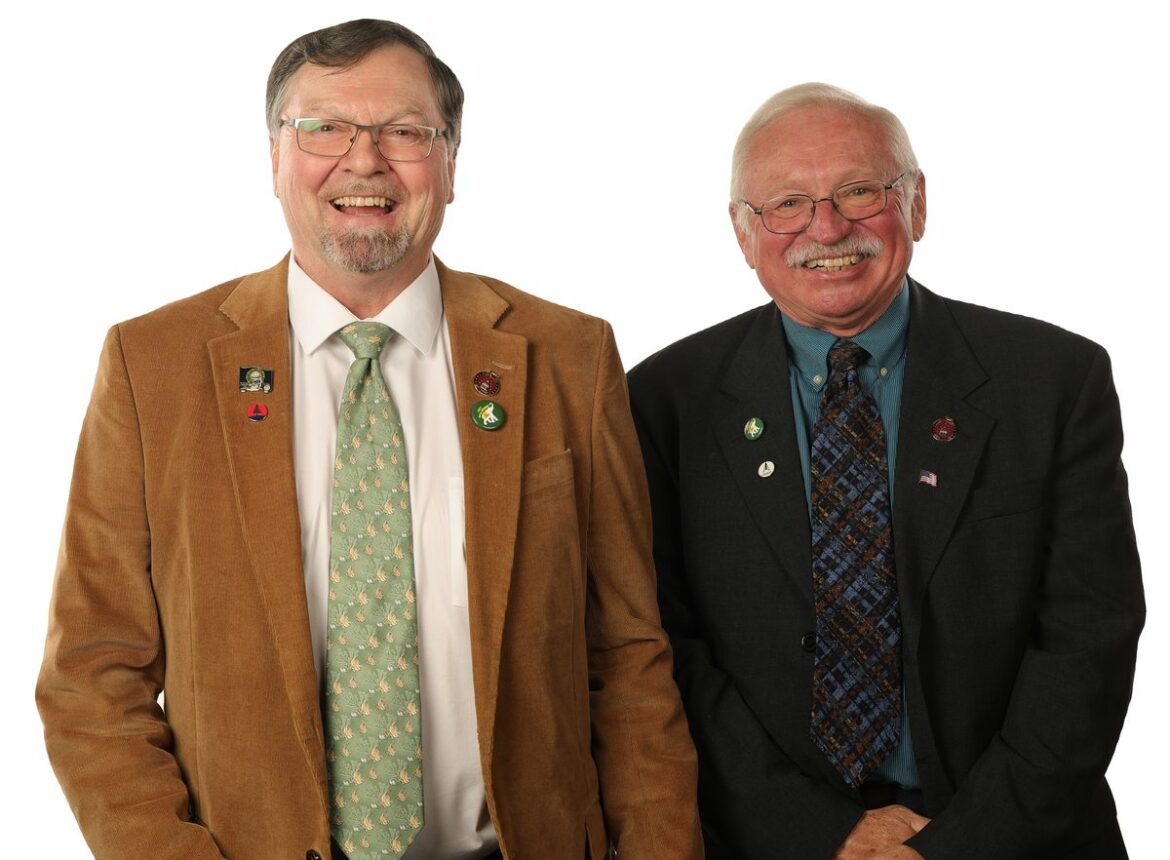

Above, Paul Twomey and Becky Berk are running as Independents Courtesy photo
By ZACH LAIRD, InDepthNH.org
Paul Twomey and Becky Berk tossed their hats into the ring as two Independents challenging the incumbents of Merrimack County District 13 — Rep. Clayton Wood, R-Pittsfield, and Rep. Cyril Aures, R-Chichester — for State Representative in the November election because no one else did.
Berk, of Pittsfield, said she thinks politicians should always have some competition and that voters always deserve a choice. She said if she hadn’t gotten involved then Aures and Wood would have “walked into a third term without any opposition; I don’t think that’s fair to the voters.” Twomey, a well-known Chichester attorney, also shared that sentiment.
“I think the voters should always have a choice; the voters choose, and we go forward from there; that was my main reason for running. My principle reason for running as an Independent is that like so many other people — I think — I’m really tired of the mud-slinging back and forth between the parties, and it feels like the candidates themselves are almost an afterthought,” Berk said, adding that she feels Wood and Aures vote in sync on everything.
Aures said he and Wood are running because they are trying to fix a couple of things, and right now the big thing is taxes.
“We are trying to cap the property taxes to inflation, which would not cut school spending, but it would keep the School Administrative Unit (SAU) overhead costs from continuing to rise rapidly. Over the past decade, school enrollment’s down approximately 25 percent — test scores are down approximately 30 percent — yet administrative (SAU) costs are up 78 percent. Teachers are up one percent, and I can live with that, even though student enrollment is down, because teachers are the ones that do the work, not the overhead. The teachers, I believe, in many cases should be paid more,” Aures said.
He continued that money is being wasted on overhead administrative positions that do not really help the students. He said that in order to reduce the state’s property taxes “we need to begin to control the out-of-control spending at the SAU level.”
Twomey disagreed on the school spending cap that will be on the ballot.
“The bill will destroy public education. It’s dishonest, inconsistent and almost impossible to understand,” Twomey said. “Citizens can make any changes to the budget anytime they want. There is no need for this legislation.”
Twomey said if elected he would like to completely change the way education is funded in New Hampshire. He noted right now that it’s almost completely reliant on property taxes, and he would seek to eliminate that reliance.
Aures noted a past victory of his and Wood’s was reducing the business enterprise tax, which he said has increased revenues (and) that the state’s revenues by this past September were way ahead of last year’s by “millions and millions of dollars.”
Back in May 2024, the House of Representatives went into a 20-minute recess after a heated argument broke out among Republicans over a bill related to background checks, per previous reporting from InDepthNH.org.
When asked what happened, Aures said he was verbally assaulted by Rep. Terry Roy, R-Deerfield, though they later talked and worked everything out. Aures said he considers Roy a friend who probably had a bad day, and feels if he had more time to think that Roy would have stayed seated. Motions to reprimand Roy and Aures were both tabled.
Roy did not respond for comment.
Aures also said he feels that Twomey and Berk are Democrats running as Independents.
Wood stated he is not associated with the Free State Project, a movement created in 2001 with the goal of getting 20,00 like-minded Libertarians to move to the state. Aures also stated he is not associated with the movement.
“I have met people who say they’re from the Free State Project; there’s no way of knowing by talking to them that they’re any different from any other person out there,” Wood said.
He continued that in the past he was accused of being a Free Stater before he even knew what the movement was. Wood said that he was asked what he would do if a Free Stater was a State Representative in the State House, and Wood said “I would work with them like I would work with a Democrat.”
Wood received an ‘A+’ grade from the New Hampshire Liberty Alliance (NHLA) for its 2026 liberty ratings, where it ranks every member of the State House of Representatives and State Senate based upon their votes on pro-liberty and anti-liberty bills. Aures received an ‘A’ grade.
The NHLA says it is a non-partisan coalition working to increase individual freedom in New Hampshire. It ranks every member of the State House of Representatives and State Senate based upon their votes on pro-liberty and anti-liberty bills, according to its website. It also monitors certain bills in each legislative session, which are evaluated based on aspects like effects on civil liberties, personal responsibility, property rights, and accountability.
Twomey said he would like to see Cannabis sold at state-run liquor stores to combat the issue of people traveling out-of-state to Maine, Massachusetts, or Vermont to purchase it, and use that money to offset property taxes. He said he would like to change the interest and dividends tax, adjust it to a high exemption level so that “you’re not taxing people’s retirement accounts, and that you’re really taxing wealthy people.”
Berk said it’s clear to her after talking to voters that “people do not want an income tax or a sales tax,” and said if the state doesn’t want one of those taxes, then “we need to be sure that the other sources of revenue the state does have remain diversified, because otherwise we’re going to box the state into a corner where a tax on earned income or a sales tax will be almost inevitable, because all the other sources have been reduced or totally eliminated.”
“I’m also a huge proponent of public education. I freely acknowledge the challenges and the reasons why people are starting to turn away from public education, but I think that the way the local property taxes are structured in the state is the key driver for three causes of voter dissatisfaction,” Berk explained. She said one is how high the property taxes are; another is the quality of education in their local communities; and also, the issue of housing.