N.H. schools projected to have more than 1,100 teacher openings each year over next decade, with 95 percent of vacancies driven by educators leaving the workforce or changing careers
Concord, N.H. – Teacher recruitment pressures are growing in New Hampshire as fewer Granite Staters complete education degrees, more school employees approach retirement age, and teacher pay and affordability challenges make it harder to attract and retain educators, according to a report from the New Hampshire Fiscal Policy Institute.
The new analysis, New Hampshire’s Educator Workforce Faces Growing Recruitment, Retirement, and Affordability Pressures, draws on data from the New Hampshire Department of Education, New Hampshire Employment Security, the U.S. Census Bureau, federal higher education data, and national wage and salary research to understand changes in the state’s educator workforce. The analysis examines how an aging workforce, a shrinking pipeline of potential new teachers, recruitment activity, teacher compensation, and New Hampshire’s high housing and child care costs may affect schools’ ability to recruit and retain educators.
The analysis finds that New Hampshire schools may face a growing gap between the number of teachers they need to hire and the pool of new educators available to fill those positions. New Hampshire Employment Security projects 1,114 annual openings for kindergarten, elementary, middle, and secondary school teachers through 2034, while education bachelor’s degree completions at New Hampshire colleges and universities fell from 567 in 2015 to 283 in 2025. At the same time, a growing share of the state’s school workforce is approaching traditional retirement age, which could further increase the need to replace departing educators.
Key findings from the analysis include:
- New Hampshire Employment Security projects 1,114 teacher openings annually from 2024 through 2034, with 95 percent resulting from workers leaving the labor force or transferring to other occupations, rather than from employment growth.
- Education bachelor’s degree completions at New Hampshire colleges and universities fell by half between 2015 and 2025, declining from 567 to 283. A smaller pool of graduates could make hiring more difficult, particularly for rural or lower-paying school districts competing with higher-paying districts.
- New Hampshire’s school workforce is aging, with 33.7 percent of workers in elementary and secondary schools age 55 or older in 2025, up from 22.1 percent in 2004.
- New Hampshire ranked 42nd nationally for average starting teacher salary in the 2024-2025 school year, according to a 2026 analysis that included all 50 states and the District of Columbia, with starting pay below comparable salaries in Maine, Vermont, and Massachusetts.
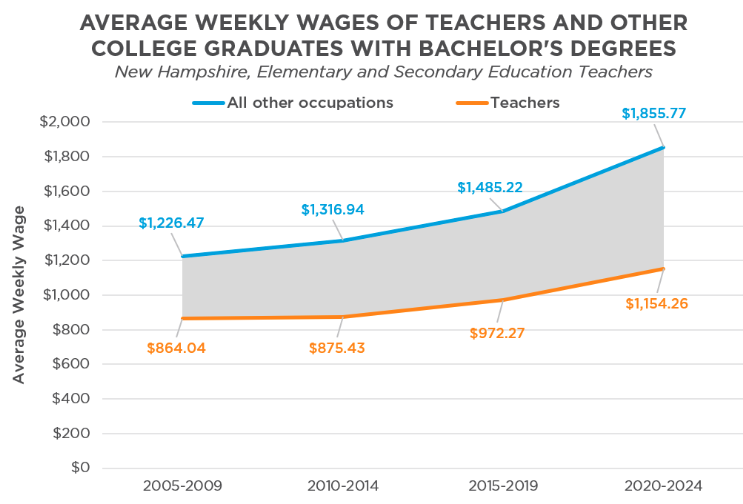
- New Hampshire teachers earn about one-third less for each week spent working than comparable college graduates in other professions. The estimated 33.8 percent teacher pay gap was substantially larger than in neighboring states, including Maine (21 percent), Massachusetts (23 percent), and Vermont (12.3 percent), according to a 2026 analysis.
- There are substantial differences in teacher pay across New Hampshire school districts. For the 2025-2026 school year, minimum starting salaries ranged from $36,148 in Bath to $59,396 in New Castle. Even districts very close to each other can also have very different starting salaries, such as Franklin ($39,990) and the neighboring Winnisquam Regional School District ($51,830).
- High housing and child care costs may add to recruitment and retention challenges, particularly for early-career educators. A 2023 legislative committee studying teacher shortages heard examples of entry-level teachers who turned down positions because they could not find affordable housing. New Hampshire’s median single-family housesale price increased more than 71 percent between 2019 and 2025 to $519,000, statewide median rent for a two-bedroom apartment was $2,024 per month, and center-based care for an infant and a four-year-old cost nearly $30,000 annually.
- Public school teacher staffing declined 5.7 percent over the last decade, even as recruitment activity increased. Shortages also remain in several specialized teaching areas, including mathematics, chemistry, physics, computer science, early childhood education, world languages, and career and technical education.
“New Hampshire schools may be serving fewer students, but projections suggest they will still need to recruit more than a thousand teachers each year as educators retire, leave the workforce, or transition to other careers,” said Ben Reynolds, Senior Policy Analyst at the New Hampshire Fiscal Policy Institute and author of the report. “At the same time, fewer Granite Staters are completing education degrees, teacher pay is falling further behind other professions competing for the same talent, and high housing and child care costs can make it harder for educators to build a life in New Hampshire.”
“New Hampshire’s ability to recruit the next generation of teachers will depend both on whether enough people are entering the profession and whether they can afford to stay in it,” said Reynolds. “With teachers facing lower pay than other college graduates alongside rising housing and child care costs, the state’s ability to recruit and retain educators may become increasingly challenging.”
The full report, New Hampshire’s Educator Workforce Faces Growing Recruitment, Retirement, and Affordability Pressures, is available at https://nhfpi.org/resource/