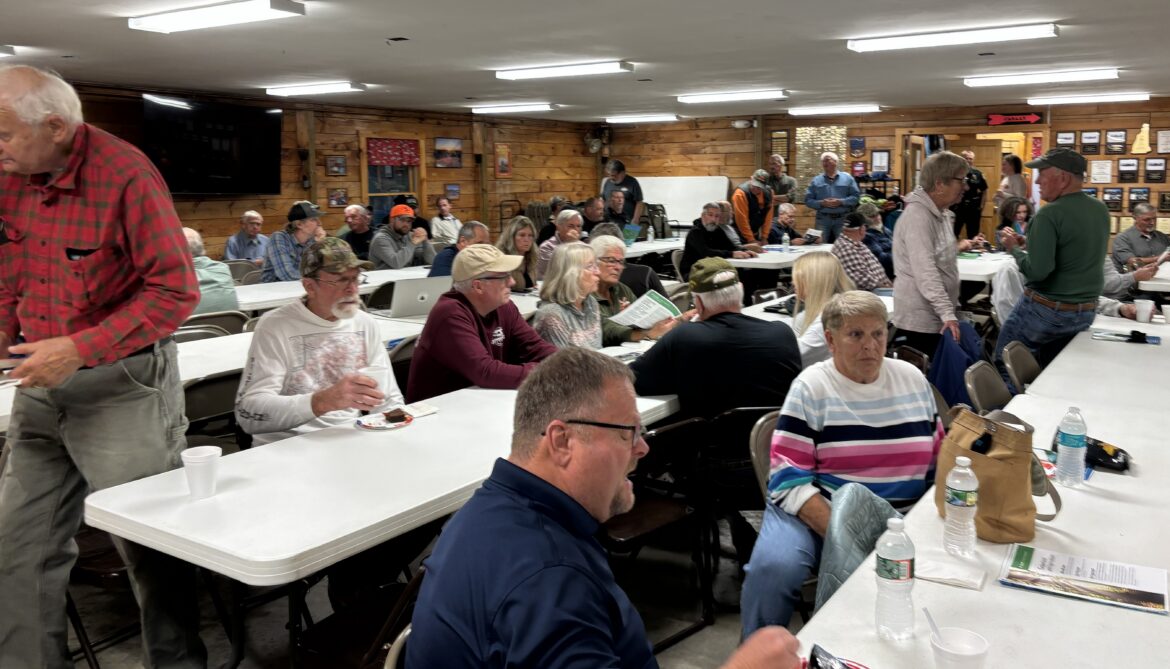

Annie Hussa ands Matt Bonham of Manulife Forest Management laughed as they fielded questions from people gathered in Pittsburg Thursday night about the company’s plans to log the Connecticut Lakes Headwaters tract here and in Stewartstown and Clarksville. Manulife closed on the nearly $70 million deal Wednesday. PAULA TRACY photo
By PAULA TRACY, InDepthNH.org
PITTSBURG – It was a friendly crowd of more than 100 who came out to the Pittsburg Ridge Runners clubhouse Thursday night to hear from the new owners of the Connecticut Lakes Headwaters tract on what their plans are for the 146,400 acre tract.
From logging plans, to carbon capture, road maintenance to taxes and the potential for expanded ATV use, representatives of the company which just closed on the state’s largest land tract came with answers and they were thanked for their approach and information.
The land is critical to logging, hunting, fishing, camp owners who lease the land and mills in the region. The land is located in Pittsburg, Stewartstown and Clarksville.
The meeting came only hours after the ink dried on the almost $70 million land transaction between the new owner, Manulife Forest Management from Aurora Sustainable LLC.
Aurora had acquired the tract as part of a large merger and is in the carbon capture business which did not log as much as had been done in the past.
Officials for Manulife hosted the town hall style meeting Thursday.
They said they plan to log the property and if the market for carbon credits is good, they will sell credits as well, but assured that they would be cutting at least 30,000 cords a year for the next eight years, an increase from recent years.
Since 2003, the land has had an easement to protect public recreation and logging on the tract and the state just completed an agreement with Aurora, which Manulife has assumed to increase the cut.
Matt Bonham, president of the company’s forest management arm, said, “I feel right at home here” in the Granite State.
The company has 5.6 million acres managed for logging globally and 3.4 million acres in North America.
“We love loggers and we need them,” he said. “Everyday logging is our deal.”
Annie Hussa, general manager for Manulife’s Great Lakes and Northeast states, introduced herself. She said she will be taking on primary responsibilities for the tract and will be visiting numerous times a year. She said she was born and raised in Wisconsin and a forester for over 20 years. “I get how logging is the heartbeat of the community.”
She said the company is excited to be here. They both said they came to listen and answered questions for an hour, until the crowd was out of questions to ask.
“We are aware of what happened in the past. It’s not us,” Bonham said.
Aurora was criticized for not cutting as much as had been done in the past, impacting jobs and the local economy.
Bonham said “We are not going to please every one in this room.” He explained the company’s history, noting it previously had land in the state.
Manulife bought John Hancock Life Insurance in 2006 and it was formerly called Hancock Forest Management.
The 30,000 cord annual harvest is something that the company is committed to, Hussa said. They have retained contracts of the former owner and said she “feels good we are on track.” They do plan to hire two full time foresters and hope to hire locally.
Taxes were also discussed upfront.
Bonham said regardless of where the cuts occur each of the three towns on the tract will receive the last 10 years average revenue.
Hussa said the plan is to cut to keep the forest healthy. She said she hoped the public would alert them to any damage due to infestations and other stressors.
The annual rate of growth on the forest is about 60,000 cords a year, Bonham said, and the plan is to cut about half that.
Harry Brown of West Stewarstown, a founder of Ride the Wilds, asked if there are any changes in the land management plan from Aurora and Bonham said ‘no’ and said he would consider expansion of ATVs particularly for safety and connectivity reasons.
Bonham said every acre is open to hunting and that won’t change. There are almost 120 leased camps on the headwaters property.
There were camp owners in the room who were concerned about increases in lease fees. Hussa said they have camp lease arrangements on land that Manulife owns in Maine, Pennsylvania and Michigan.
There will be modest camp fee increases, Bonham said noting that the hope is not to price people out.
Charlie Levesque, a member of the citizens’ advisory committee, asked specifically if Landvest, which has done land management, will be hired to stay on.
Bonham said the company will hire two people and who they put on the property will be decided by them. Manulife is not purchasing the Landvest property in West Stewartstown, he was told.
Road repairs were also discussed.
The main haul roads – totaling 269 miles – are owned by the state since 2003, Levesque noted. Manulife will own all the other, gated side roads and maintain them.
Hussa said if there are damage issues, the company will look at safety first and deal with it and Bonham said he did not know the inventory of bridges on this property yet but the roads would be maintained to allow for the conveyance of logs out.
Levesque asked about the plan for selling carbon on the land.
Bonham said there are almost 10 carbon banks on Manulife Property and there is no requirement issue carbon credits.
“It’s really not necessary for us to sell carbon credits,” Bonham said.
He noted the market for carbon credits is not strong right now.
“We don’t have to have credits issued,” he said, and the plan could be to focus on logging for their investors. But the minimum cut will be 30,000 cords, he assured.
In addition to providing the crowd with chili and pulled pork sandwiches from Green Acres, a local bakery and market in Pittsburg, Manulife officials offered brochures about their harvest operations and trail stewardship among others and even offered phone numbers to reach them.
Mill relationships and selling the wood was also discussed and Hussa said she felt that there was strong interest for the wood in the region from regional mills.
Manulife has assumed the current local logging contracts and the plan is to continue to use local contractors and not bring in out of state workers.
The two were thanked for coming and explaining their plans.
“I love that you love this property,” Bonham said. “It fires me up.”