By ZACH LAIRD, InDepthNH.org
PLYMOUTH — Executive Director of 350NH Rebecca Beaulieu took some time Saturday during the 5th Annual Environmentalist Summit to talk about the group’s advocacy work to stop the climate crisis, and encouraged attendees to get involved through voting and outreach efforts.
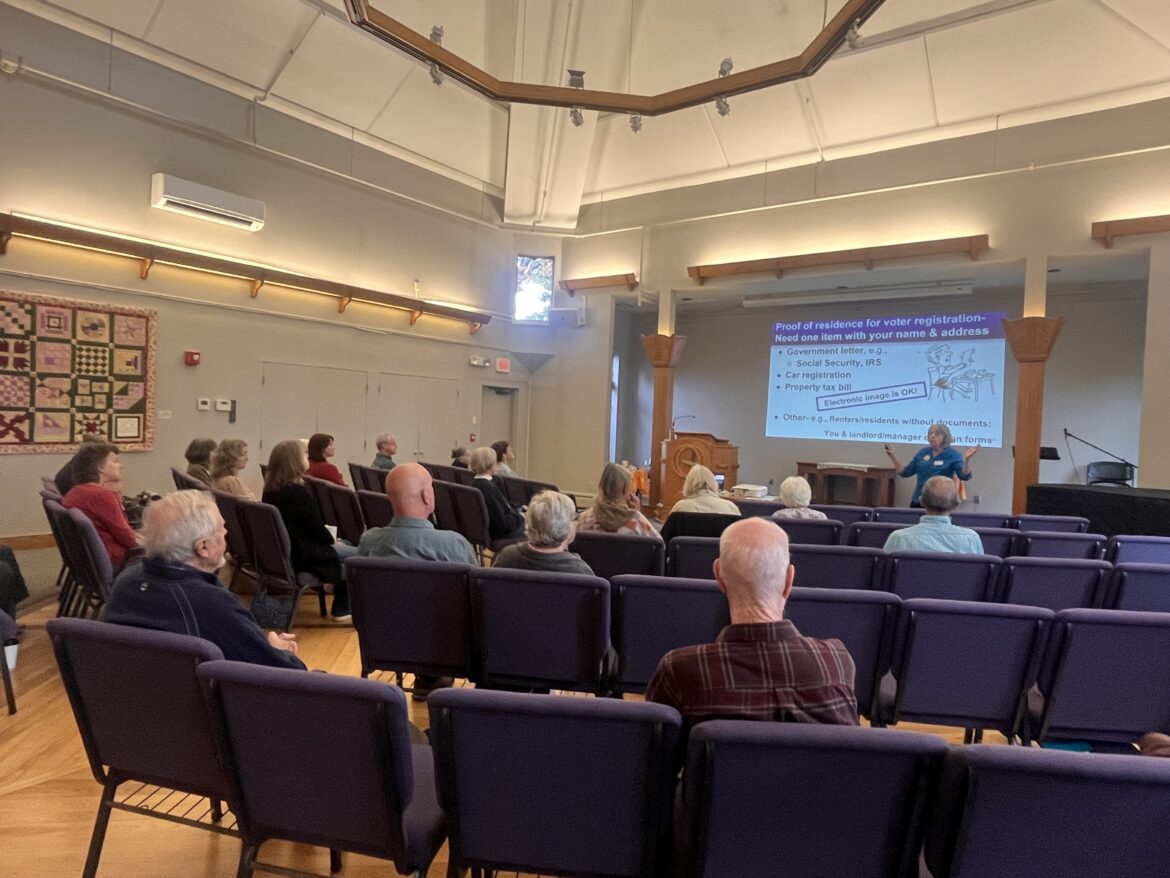
The day began at 9 a.m. as the attendees gathered at Starr King Universalist Fellowship for coffee and snacks before the event kicked off. Other groups who presented their work and brainstormed with attendees on ideas for a greener future were: League of Women Voters NH; Third Act NH; Monadnock Sustainability Hub; NH Healthy Climate; Sierra Club NH; Laudato Si’; and Citizens Climate Lobby (CCL). The event was hosted by New Hampshire Network, a non-partisan environmental organization.
Rebecca Beaulieu, executive director of 350NH, started her presentation by saying the organization had an exciting win last year: helping shut down the last coal-fired power plant in New England through advocacy and pressure on elected officials. The Merrimack Station was located in Bow and owned by Granite Shore Power.
“After that closed, we set our sights on fossil fuel peaker plants across the region. Peaker plants are only turned on during the hottest days of the year, thus they are sort of the easiest places to progress our transition to clean energy,” she said.
350 New Hampshire is a multigenerational movement advocating for a just transition to clean energy and an end to fossil fuel use and extraction, per its website. The group’s mission is to “stop the climate crisis by building grassroots support for a just transition to renewable energy and an end to fossil fuel use and expansion.”
The move to get the plant closed was part of the organization’s “No Coal No Gas” campaign launched in partnership with Climate Disobedience Center, which provides “logistical, legal and spiritual resources, on the ground assistance, and advice to climate activists engaged in civil disobedience across the country,” per its website.
According to 350NH’s press release on the matter, other advocacy groups like the Sierra Club and Conservation Law Foundation aided in these efforts and “waged many of the legal and regulatory battles associated with this facility.”
She continued that the sites where peaker plants are located would be great for things like solar panels and battery storage, which she said could help replace them. She noted that all of the fossil fuel peaker plants in New Hampshire are owned by Granite Shore Power, which she said is also looking to build a “hyper-scale Artificial Intelligence (A.I.) data center at the site of the Merrimack Station.
Eversource and Granite Shore Power applied to the Federal Energy Regulatory Committee for a viability study for an up to 350-megawatt interconnection at the Merrimack Station, per previous reporting by InDepthNH.org. Beaulieu said she doesn’t think the site can handle a project that size.
Beaulieu said the organization has “pivoted to address that A.I. data center.”
“For the next five weeks, we are in full, ‘Get-out-and-vote’ mode at 350NH Action – our political wing. We’re out canvassing most days of the week… We’re also treating election day this year like a federal holiday, because it should be. What that means for us is that we’ve been involved in a coalition with other groups around election protection,” Beaulieu said.
She said people have been scared about Immigrations and Customs Enforcement (ICE) being out on the streets of communities around New Hampshire (and) the Department of Justice sending federal monitors to oversee local elections.
As a result of what Beaulieu described as “uncertainty about what could happen on election day,” 350NH is encouraging people to sign up as poll observers at their local voting areas.
Aside from the organization’s “No Coal No Gas” campaign, it also has two others: the Utility Justice Working Group, which plans actions and events “to educate the public about our corrupt utility system. They are fighting for more affordable energy, clean energy, and getting utilities’ money out of our politics.”
The Community Power Working Group gets community power passed in towns across the state, and collaborates to bring new towns into the community power coalition, and also works to get this issue on their town and city ballots. According to Clean Energy NH — another advocacy and outreach group — community power is a system where a local government such as a city, town, or county, may procure electricity on behalf of its residents and businesses on a competitive basis.
Looking ahead to 2027, 350NH has various goals to work toward a greener climate, such as:
- Stop fossil fuel use and expansion
- Stop A.I. data centers from opening up in the region
- Organize people to pressure state legislators
- Hold elected officials accountable
“I think it’s great getting all these folks together in one room, to have a conversation in-person… I think we’re also seeing a lot of variety in approaches to these common problems, and I think that’s critical,” Event organizer Reinmar Seidler said.