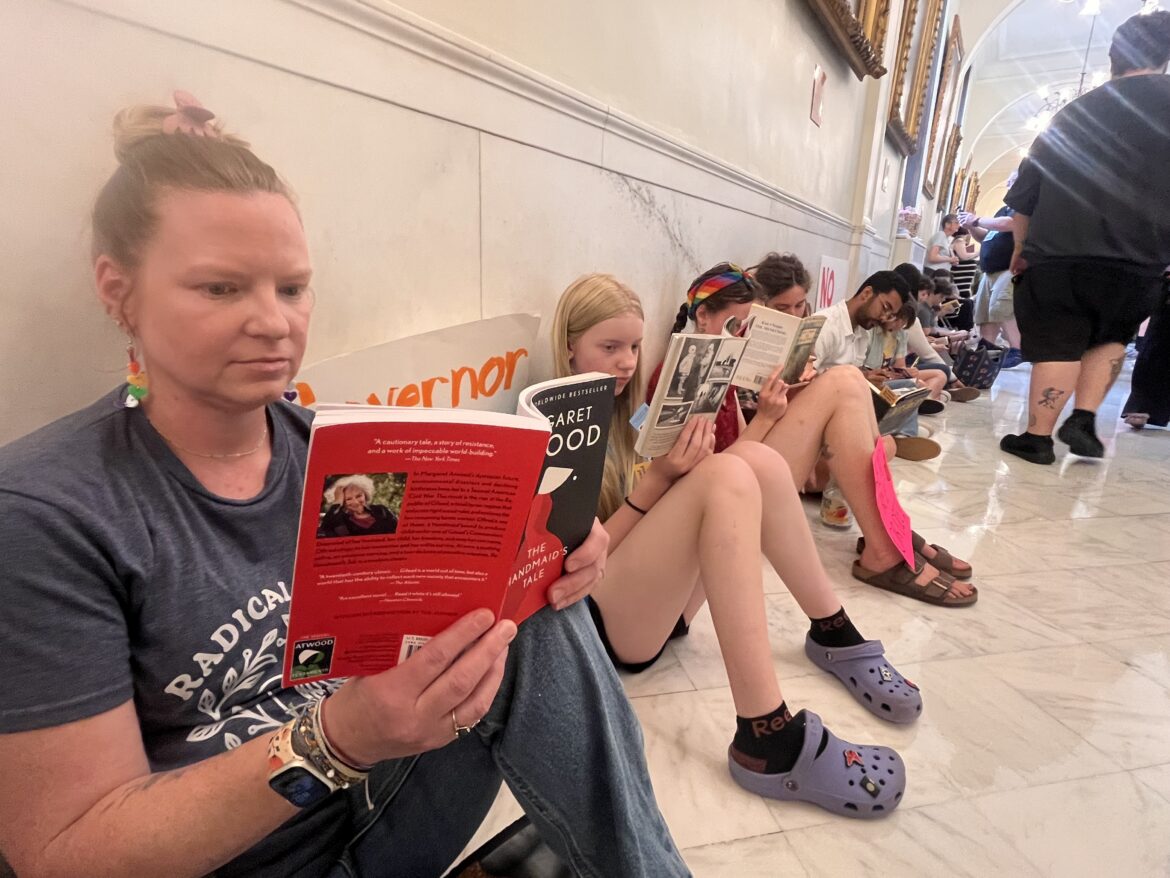

Above, A basket of banned books was delivered to Gov. Kelly Ayotte’s office on Thursday morning during the ‘Read-in to Keep Book Bans Out,’ hosted by the ACLU-NH. ZACH LAIRD photo
By ZACH LAIRD, InDepthNH.org
CONCORD — Dozens of Granite Staters filled the second-floor hallway of the State House on Thursday and cozied up with their favorite banned books, taking part in a quiet demonstration against censorship of literature and media in New Hampshire schools.
They rallied to oppose Senate Bill (SB) 434, which looks to prohibit materials harmful to minors in schools. While it passed both the House and Senate and awaits Gov. Kelly Ayotte’s signature, she previously vetoed a similar piece of legislation — House Bill (HB) 324 — last year.
The American Civil Liberties Union (ACLU) of New Hampshire hosted the “Read-In to Keep Book Bans Out” event in partnership with other local advocacy groups such as MomsRising, 603 Equality, Engage NH, National Education Association (NEA) New Hampshire, and American Federation of Teachers (AFT) NH.
“We are here today encouraging the Governor (Kelly Ayotte) to veto SB 434, which is a book ban, but it’s broader than your traditional book ban because it would create avenues to ban not only books, but guest speakers, art performances… and we’re definitely concerned from the ACLU’s perspective of students’ free speech rights being infringed,” ACLU NH Policy Associate Rachel Potter said.
Potter continued that while the ACLU is heartened that Gov. Ayotte vetoed HB 324, the organization is not giving up the fight to encourage her to also veto SB 434. They delivered to Ayotte’s office a basket of banned books, which includes work such as “Harry Potter and the Sorcerer’s Stone” and “Little Women,” which Potter noted are some of Gov. Ayotte’s favorite books.
Deb Howes, president of AFT NH said SB 434 takes away from the robust public education that students deserve (and) their First Amendment rights to have a wide variety of materials available in public schools. “It’s not a policy we need,” she said.
Heidi Carrington Heath, executive director of New Hampshire Outright (a non-profit dedicated to supporting, protecting, and advocating for LGBTQ+ youth across the state) said SB 434 creates a space where “some of our young people who most need to see themselves reflected in the classrooms may no longer be able to do that.”
“It’s so important that we trust our educators and librarians. They’re the ones that went to school for years to learn how to properly educate our children, and we need to allow them to do so,” attendee Jennifer Foley said.
According to the legal language of the bill, material considered harmful to minors means that it predominantly appeals to the prurient interest of minors in sex, that is, an interest in lewdness or lascivious thoughts; depicts or describes sexual conduct in a manner so explicit as to be patently offensive to contemporary adult standards, in the county within which the school district resides, with respect to what is suitable material for minors; and lacks serious literary, artistic, political or scientific value.
The bill states that by Nov. 1, 2026 each local school board shall adopt a policy to be used to address complaints submitted by parents or guardians which alleges that material presented or made available to students is obscene and harmful to minors. By the following year, the local school boards must adopt a procedure to address the complaints.
During a Senate session on February 20 where SB 434 was passed, Sen. Daryl Abbas, R-Salem, explained the bill sets up a uniformed, statewide process to ask superintendents to determine if material is appropriate for children (and allows parents to appeal any decision to the school board), per a previous article from InDepthNH.org.
“Parents concerned about inappropriate material in school libraries deserve a transparent process for their complaints to be heard. This leaves all decisions with local school boards and would not remove a single book anywhere in New Hampshire. Too many districts have simply ignored parents who believe their young children are being exposed to material not suitable for their age. The scare tactics being used to block parents from having their voices heard are ridiculous,” Prime sponsor of SB 434, Sen. Timothy Lang, R-Sanbornton said.