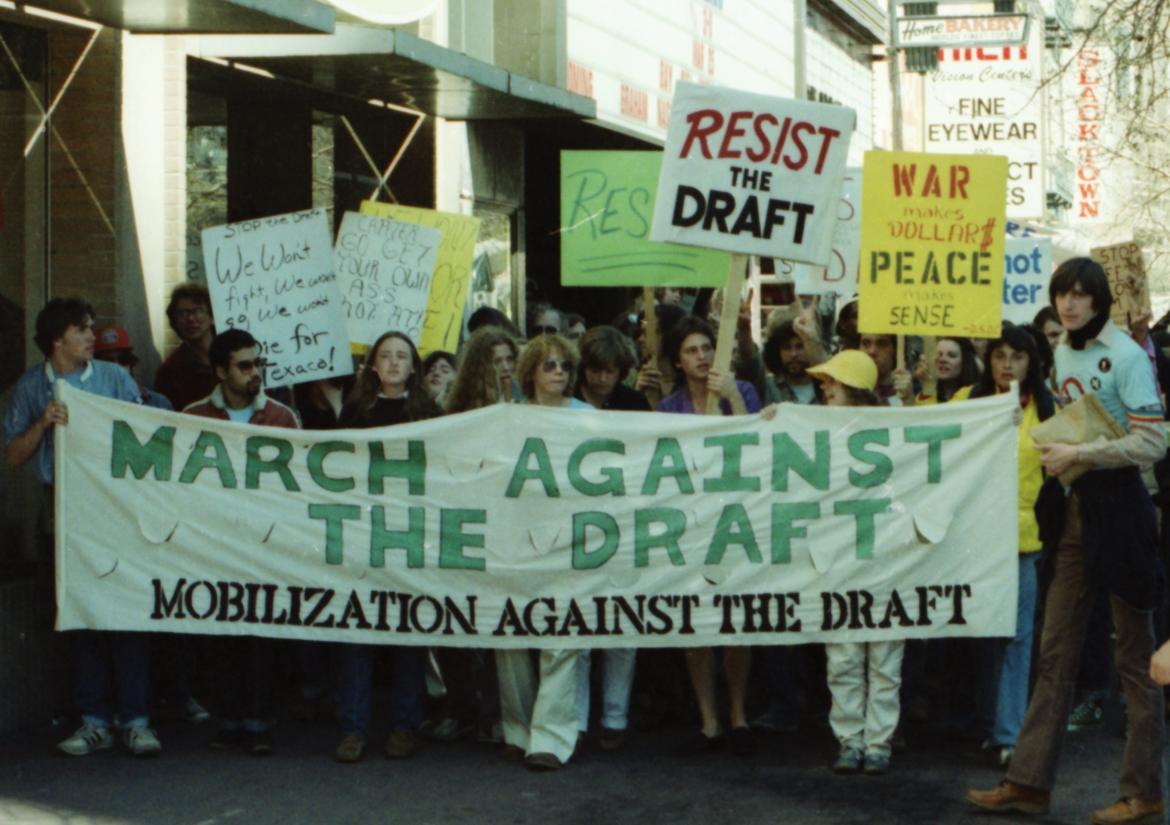
By ZACH LAIRD, InDepthNH.org
DURHAM — While eligible men ages 18-26 will now automatically be signed up for the draft starting in December using federal data, some students at the University of New Hampshire pushed back against the change, calling it unnecessary and an overreach of the government.
The change in law governing the Selective Service System, titled “Selective Service System: Automatic Registration,” was included in section 535 of the 1,260-page National Defense Authorization Act (NDAA) and signed into law by President Donald Trump in December 2025. A draft has not been in effect since 1973.
The law states that “every male citizen of the United States, and every other male person residing in the United States, between the ages of eighteen and twenty-six, shall be automatically registered under this Act by the Director of the Selective Service System.”
“The way the law that was enacted (last) December works is that it will, starting next December, give the Selective Service authority to commandeer any data from any other federal agency that the Selective Service thinks will be useful in identifying or locating potential draftees. Which data from which agencies that will be used is left to be spelled out in regulations, which have not yet been published,” said Edward Hasbrouck, editor and publisher of Resisters.info, the most comprehensive and non-governmental source of information about the draft per its website.
In the 1980s, Hasbrouck was one of 20 vocal non-registrants prosecuted prior to the government abandoning enforcement of draft registration. He was convicted of willful refusal to present himself for and submit to registration with the Selective Service System, and served four and a half months in a Federal Prison Camp in 1983-1984, according to hasbrouck.org.
He continued that as it stands now, the regulations were drafted by the Selective Service and are currently being reviewed by the White House. After the regulations are reviewed, they will be published publicly in the Federal Register. Until then, Hasbrouck said it will not be known which data will be used in what manner.
He said it seems overwhelmingly likely that this will include Social Security numbers, IRS and census data, as well as immigration data. Hasbrouck noted mandatory registration applies to citizens and residents, adding that it applies to immigrants considered residents regardless of citizenship. He also noted that student visas are for the most part considered temporary non-resident visas, saying that most foreign students are not required to register.
“I think it’s bad. I don’t think the U.S. has fought a just war in years. I think the war in Iran is an atrocity, and (President) Donald Trump is a pedophile… After Vietnam, I don’t know if they’d ever be able to get it through, and I think if they tried, people in this generation would mobilize pretty significantly against it,” UNH student Leo Fields of Arlington, Mass. said when InDepthNH.org visited UNH seeking student opinions.
Fields continued that he supports the draft dodgers who fled to escape conscription into the Vietnam war, adding that he would do the same.
UNH student Caleb Eckert of New Hampton said the change seems very problematic and that it “doesn’t seem like they’re giving the people a whole lot of choice,” adding that it feels like federal overreach.
“I understand the point of the draft, but I don’t think that it’s OK to be doing it, especially to a lot of young men that don’t want to go to college, because college is super expensive… I’ve known a couple acquaintances in the military, but I always thought the biggest point is that it was a choice. It’s a very brave and respectable choice, but you have got to give people the choice to go and do that,” Eckert said.
He continued, “I’ve got little brothers that I don’t want just automatically signed up for that and sent out (and) they don’t get a choice… That’s kind of a scary thought.”
When asked if he felt this change would impact his generation in a big way, he said it depends whether or not the country goes to war. According to the Selective Service System, automated registration will not reinstate a draft. Reinstating a draft would require a separate law to be passed to authorize conscription.
“I don’t really see the need to make it mandatory, because I feel like in today’s day and age, if you’re interested in pursuing that path of life, then you should take it. If you’re not, I don’t see a need for it to be required of you to go down that path… I think if our political climate continues in the direction it’s going, it could impact our generation in a major way,” UNH student Chase Jackson of Plymouth, NH said.
Another student, Michael Walsh of Salem, NH said he’s not a fan of the draft in the slightest, and that it’s predatory toward students who have to sign up for it to receive financial aid for college.
Hasbrouck said another issue with the change is that only individuals who were assigned a male gender at birth are supposed to register.
“In order to figure out who’s supposed to register, they have to try and find information about the sex as assigned at birth for every 18–26-year-old, regardless of what’s in current records… The Selective Service now has a mandate and authority to go on not only a witch hunt to aggregate data that might locate undocumented immigrants, but they have a license, mandate, and authority for a gender-judging witch hunt against transgender and non-binary youth,” Hasbrouck said.
He noted this data gathering incentive is entirely unprecedented both in its scope and lack of any restraints, which he said is particularly concerning because “the Selective Service has a track record of disregard for privacy laws and laws on disclosure of data-sharing practices.”
“We don’t yet know what this is going to look like… Regardless of what data they try and suck in, we do know that it won’t work for a draft, but it is likely to result in a collection of data in ways that, at the very least, will be highly vulnerable to mis-use and weaponization, particularly against vulnerable immigrants and transgender youth,” Hasbrouck said.
A spokesperson for U.S. Sen. Jeanne Shaheen, D-NH, a member of the New Hampshire Congressional Delegation, said Congress alone has the authority to restart conscription, noting that option is not currently under consideration. She said Shaheen believes that America’s all-volunteer force remains integral to the health of the country’s democracy.
You can read Arnie Alpert’s two-part series about the new draft law here: https://indepthnh.org/2026/04/22/automated-military-draft-not-imminent-or-is-it/