By Jess Williams, Senior Policy Analyst NHFPI
This Mother’s Day, the New Hampshire Fiscal Policy Institute team is recognizing the hard work of New Hampshire mothers by doing what we do best: highlighting key data that underscores both the challenges mothers face and the vital contributions they make across the Granite State.
Below are five key facts surrounding New Hampshire’s mothers and families.
Mothers With Children Under Age 18 Make Up 13% of the State’s Labor Force
Based on 2020-2024 aggregated data, there were approximately 125,418 Granite State mothers between the ages of 20 to 64 with children under 18 years old who lived with them. Among this group, about 80% were in the labor force.
Mothers ages 20 to 64 with at least one child under 18 years old made up about 13% of the total 2024 Granite State labor force. However, labor force participation varied depending on the age and number of children in the household. Here’s how that total 13% breaks down:
- 3%: Mothers with at least one child under age 6
- 2%: Mothers with at least one child under 6 and at least one child between 6-17
- 8%: Mothers with at least one child between ages 6-17
While many parents may choose to remain out of the labor force to care for children, the high cost and low availability of child care may push many mothers to reduce their work hours or leave the workforce entirely. The average cost for an infant and four-year-old in center-based care in New Hampshire was nearly $30,000 per year during the 2022-2024 period; this equates to about 19.0% of household income for median-income married couples with children under 18 ($157,670 in median household income in 2020-2024), and 59.1% for median-income single mothers ($50,766).
More than Half of NH Mothers Took Unpaid Maternity Leave in 2023
While maternity leave can allow women to remain in the labor force after giving birth and bond with their newborn, access to paid leave may be limited for some Granite State mothers. According to 2023 data collected by the New Hampshire Department of Health and Human Services, 52.2% of mothers took paid leave and 54.5% took unpaid leave, with some mothers taking a combination of both; 7.1% did not take any leave from work after their child was born.
While the survey data does not specify how long mothers were out of work, both paid and unpaid leave time varies depending on workplace and governmental policy. The New Hampshire Paid Family and Medical Leave (NH PFML) Program is a voluntary insurance program that provides workers with 60% wage replacement for up to six weeks per year when they take time off for qualifying life events, including caring for a new child. However, unawareness of the program, a lack of access among smaller employers, concerns around job loss, and affordability constraints can deter enrollment, with only around 3% of Granite State workers participating in the program in 2025.
The federal Family and Medical Leave Act (FMLA) allows for up to 12 weeks of unpaid leave with job protection for eligible employees, although many families may not be able to forgo that income and still cover household costs. Nationally, new mothers returning to the workforce take an average of ten weeks of maternity leave, including both paid and unpaid time.
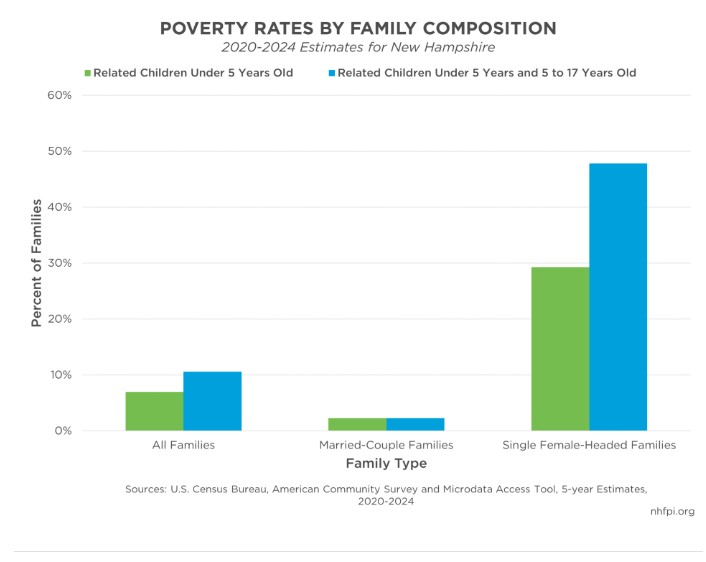
About 23% of All Single Female-Headed Families with Children Live in Poverty
According to 2020-2024 aggregated data, around 2.3% of married-couple Granite State families with at least one related child under five years old lived in poverty. In contrast, single female-headed families with a child or children all under five years old were more than thirteen times more likely to live in poverty, with over one out of four families (29.3%) having household incomes below the federal poverty threshold.

According to the same five-year data, having at least two related children, one under age five and one between the ages of five and 17 years, increased a family’s likelihood of living in poverty. Around 47.8% of single female-headed households with this family composition were in poverty, compared to only about 2.3% of married-couple families.
Health Care Barriers Remain for Postpartum Mental Health Services
Adequate health care access before, during, and following pregnancy is crucial for maintaining and improving the health status of a mother and her baby. According to the most recent data from 2023, around 85.9% of Granite State mothers started prenatal care during the first trimester, with 88.5% attending at least nine prenatal care visits throughout their pregnancy. Around 94.7% reported having at least one postpartum checkup.
Despite relatively high prenatal and postpartum care, engagement with the health care system before pregnancy was more limited. Among those who had a health care visit in the 12 months before their pregnancy, 69.2% had a regular family or primary care visit, 67.3% had a regular OB/GYN visit, and 20.4% had a visit for family planning services.
New mothers are also more likely to experience symptoms of anxiety and depression. In 2023, about 69.7% of Granite State mothers reported being able to receive needed mental health services following birth. Among those who were not able to receive that needed care, the most common reasons identified by mothers included not having the time due to work, child care, or other commitments (44.9%); not knowing where to go for services (40.2%); not being able to afford care (24.1%); and not being able to get an appointment as soon as they needed (20.0%).
Medicaid Finances More than a Fifth of Health Care Services for New Granite State Mothers
Medicaid is a state-federal fiscal partnership that provides health coverage for New Hampshire adults and children with low incomes, people with disabilities, certain older adults, and other eligible populations. In 2023, New Hampshire expanded Medicaid coverage for new mothers, permitting up to 12 months of postpartum coverage regardless of income changes.
Medicaid remains crucial for providing health care access for new mothers and their children across the state. In 2023, around 21% of births in New Hampshire were financed through Medicaid, and nearly 24% of mothers had their prenatal and postpartum care covered by Medicaid. Future data, if made available, can provide more insight into the results of recently expanded coverage.
—