By PAULA TRACY, InDepthNH.org
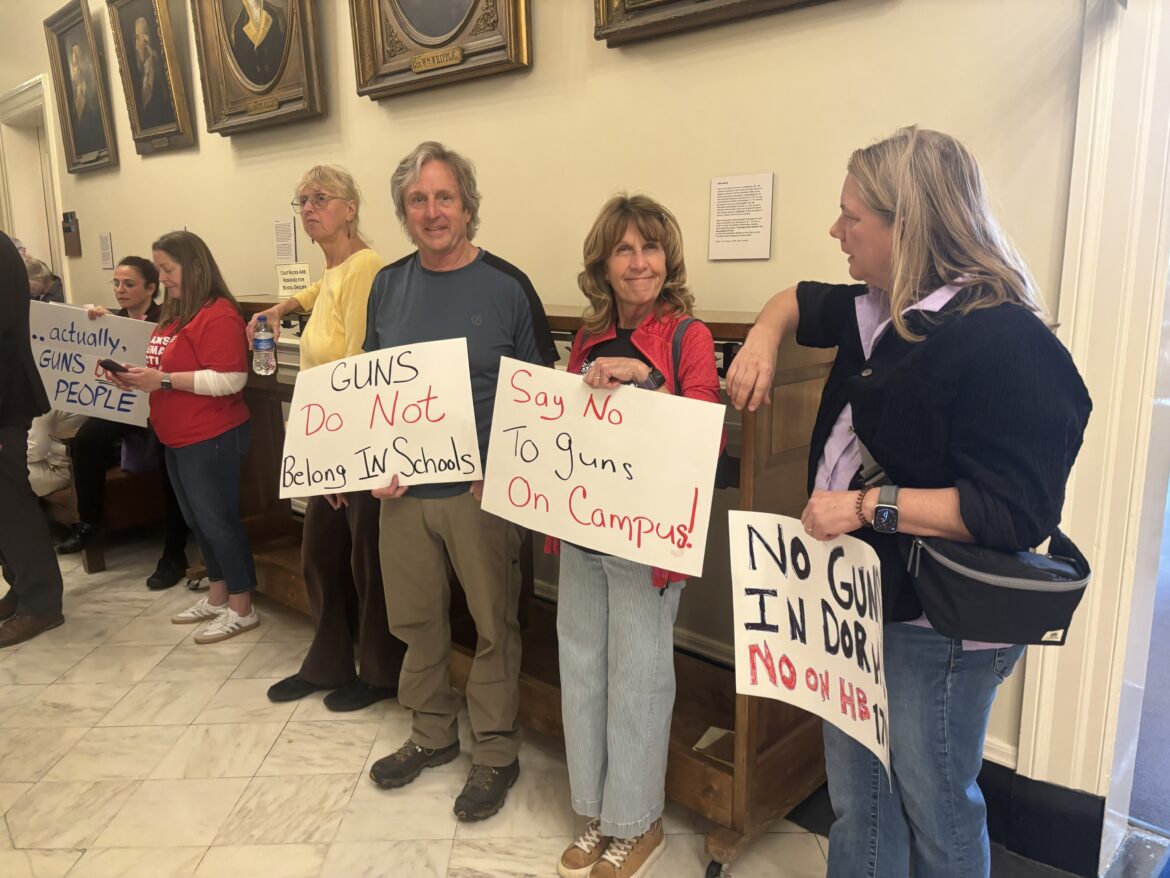
CONCORD – A bill that would prohibit public universities and colleges in the state from regulating the possession of firearms on campus brought a huge crowd to the Senate Judiciary Committee public hearing Tuesday.
House Bill 1793-FN has already passed the House on a vote of 188-165.
It is sponsored by state Rep. Samuel Farrington, R-Rochester, who is a senior at the University of New Hampshire and a first-term legislator who has filed a series of bills related to firearms.
He mentioned mass shootings where the students, shoppers and theater goers were unarmed and murdered and said that perpetrators target gun-free zones.
“They know victims will be left defenseless and vulnerable,” Farrington said.
He said 92 percent of mass shootings occurred in gun-free zones.
Sen. William Gannon, R-Sandown, who is chair of the committee, noted he is a big gun rights supporter but he does have concerns about safety in dorm rooms, drunken parties and shared use of a space.
He notes West Point does not allow guns in dorm rooms. This bill would allow that.
Gannon said he also has concerns about big events, games and areas where there are younger school children in attendance on the campus.
Farrington said Gannon’s concern about dorms is the most reasonable concern for the bill. He said that is a unique circumstance because students can be randomly matched to live together.
He said he would be open to a carefully worded amendment to require a locked box in a room when the person leaves the dorm room.
Gannon asked about insurance issues, and Farrington said he has an amendment to indemnify the institution.
State Sen. Daryl Abbas, R-Salem, asked if Farrington would have a problem about those carrying firearms while drunk on campus.
Farrington said the school could still be allowed to control that through reckless endangerment statutes, but he would be willing to consider a carefully drafted amendment.
New Hampshire is a constitutional carry state which allows the public to carry a weapon in a public place with exceptions.
People lined up to speak to the bill and the hearing, which was expected to begin at 1:45 p.m. but did not begin until almost 3 p.m. It was expected to last into the evening with many students camped out on the floor of the State House waiting to testify late into the afternoon.
If passed and signed by the governor, the bill as it now reads would prohibit public colleges and universities in Durham, Keene and Plymouth from regulating the possession or carrying of firearms and non-lethal weapons on campus.
It would also extend to all seven community college campuses. If any of the other 19 institutions of higher learning in the state do take public funds, they would be included in this bill as well.
Currently, each state institution has the right to regulate firearms on their campuses.
Eleven states allow campus carry while other states, like New Hampshire allow the institutions to decide. The states that allow campus carry are not in New England but include Colorado, Utah, Texas, Oregon and Wisconsin.
“This would be the best campus carry statute in the entire nation,” Farrington said.
Four Republican state senators have signed on to the bill and the Senate has a 16-8 majority of Republicans.
The University System of New Hampshire stated in the bill that the measure would impact insurance premiums, increase the likelihood of accidental incidents, intentional shootings and other weapon-related injuries and would make the institutions it oversees less desirable for prospective students to attend.
“To help mitigate the increased risk, USNH may need to invest in enhanced security measures, such as additional campus security/police personnel, surveillance systems, and training programs. Provision of storage capacity to accommodate students wishing to secure their weapons at any time, including while participating in athletics and other extracurricular activities,” though USNH did not give a specific dollar amount for the impact of the bill.
With daycare centers located on campus in Plymouth, Keene, and Durham, conflict with DHHS rules governing daycare and firearms would need to be adjudicated and summer youth camp protocol and precautions would need to be addressed, since adopted rules do not preclude the presence of unrestricted firearms.
“Legal liability relative to students under the age of 18 (102 enrolled in fall 2025) and ubiquitous access to guns on campus would need to be ascertained,” the bill reads.
A rally to oppose the bill was held on the State House grounds before the hearing and close to 100 people attended. They were members of the NH Gun Violence Prevention Coalition.
“Colleges and universities are places of learning, and students should be able to focus on academic growth and personal development instead of worrying about a classmate with a loaded firearm sitting next to them in class or sharing a dorm room,” said Zandra Rice Hawkins, director of GunSense NH and executive Director of Engage NH in a statement advancing the rally.
“Guns on campus are opposed by students, parents, faculty and staff, and the wider New Hampshire community,” said Kathleen Slover, GunSense NH Advocacy Director and a member of Moms Demand Action. “Putting guns on campus will only lead to unintentional tragedies, or worse. The National Institute of Health reports that the second cause of death among college students is suicide, and putting readily accessible firearms on college campuses, with no requirements for safe storage and no restrictions on where guns can be located, puts more students at risk.”
In a recent UNH survey, 85 percent of students strongly opposed HB 1793.
Speaking at the rally were Jack Dalton, Durham deputy chief of police; John Bunker, former associate dean of UNH College of Health; and students and others. Plymouth Police Chief Nate Buffington opposed the bill.
He said college campuses are unique, crowded and situations can escalate rapidly particularly if there is substance abuse.
“We have to make a split second decision, not knowing good from bad,” Buffington said.
Elizabeth Chilton, president of USNH along with Don Birks, president at Plymouth and Keene, testified in strong opposition and Chilton asked the committee to propose the Senate kill the bill.
Safety is a primary concern, Chilton said, and the state has some of the safest campus in the country. There is no evidence that this would make this safer, Chilton said.
Such campus carry policies reduce confidence for campus safety and those perceptions really matter, she said.
This would remove all authority from the university, she said. It would impact child care centers on campuses as well.
This would make New Hampshire unique among all states and would not give the campus authority to keep the campus safe.
Sophie Gold, a University of New Hampshire student, said as a campus guide for prospective students she is often asked if the campus is safe. This bill would be particularly problematic.
Sen. Debra Altschiller, D-Stratham, asked Farrington about his written comments including what he called an “April fools” post about calling on young men to help him take over the Portsmouth Naval Shipyard. He said her question was “foolish.”
“We are not putting guns into anybody else’s hands,” he said. “I am sorry you don’t have a sense of humor,” Farrington said.
Altschiller said: “I am passing on to the next person, you have said enough.”
State Rep. Bob Lynn, R-Windham, spoke in support of the bill. A former Chief Justice of the Supreme Court, he said he is not suggesting that there should be no restrictions for times when it is not on a person’s body. But the basic question is about the Second Amendment and the right to defend themselves.