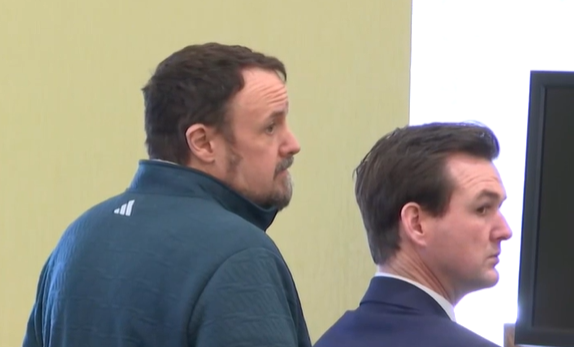
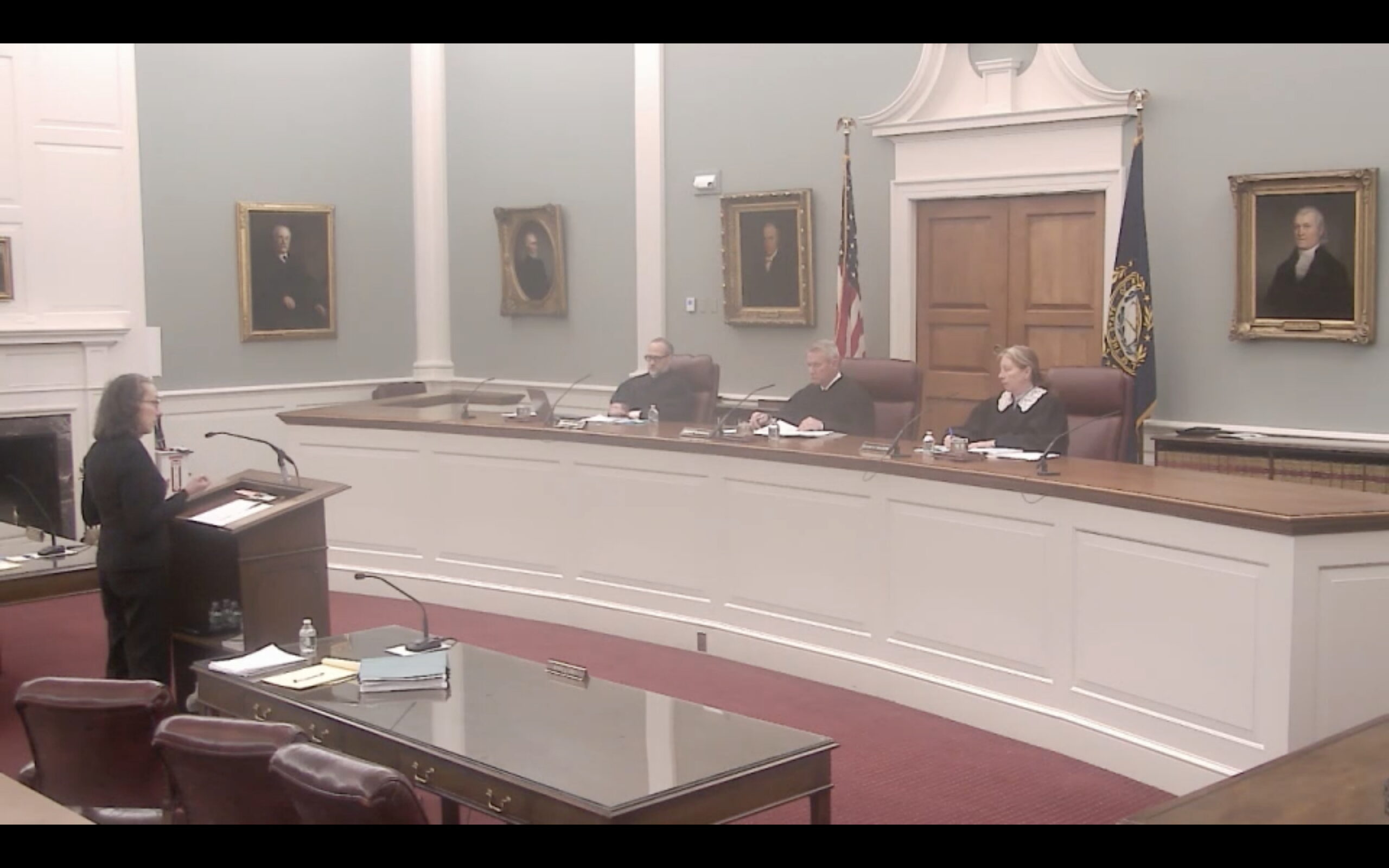
There’s no conclusive proof Timothy Verrill murdered Christine Sullivan and Jenna Pellegrini, Chief Appellate Defender Stephanie Hausman argued Tuesday before the New Hampshire Supreme Court.
“The state’s piecemeal, circumstantial evidence failed to exclude the reasonable conclusion that Mr. Verrill was not the murderer,” Hausman said.
Verrill is appealing his convictions in the 2017 double murders tied to a drug ring that was under federal investigation. He’s now serving two back-to-back prison sentences of 45 years to life for the brutal killings.
Parts of the case against Verrill are still shrouded in questions over who was or was not working with law enforcement when Sullivan and Pellegrini were killed in the Farmington house owned by Sullivan’s romantic and business partner Dean Smoronk.
But Senior Assistant Attorney General Peter Hinckley told the justices the evidence presented to jurors during Verrill’s trial, while circumstantial, is more than enough to support the conviction. Jurors took in all of the individual pieces of evidence and came to the correct conclusion, he said.
“When you look at all of these circumstances, circumstance upon circumstance, upon circumstance, upon circumstance, altogether, the only reasonable alternative is that it was [Verrill,]” Hinckley said.
But the prosecution against Verrill was never cut and dry. His first trial, in 2019, was shut down and declared a mistrial after repeated discovery violations were uncovered. Prosecutors did not hand over all the evidence gathered before the trial began, according to court records.
The 2024 retrial also featured the recorded testimony of Stephen “Spider” Clough, which Hausman argues is grounds for at least a new trial.
Clough testified during the 2019 trial, but died in a traffic accident before the 2024 trial. His 2019 testimony, which was played for jurors in 2024, was incomplete based on the withheld 2019 evidence, according to Hausman. In fact, before a mistrial was declared in the 2019 trial, prosecutors were sanctioned after the first batch of withheld evidence was discovered and ordered to bring Clough back so that he could be cross-examined again. After that, prosecutors found more withheld evidence that forced a mistrial.
“The trial court ordered the state, as a sanction for its discovery violations, to produce Clough for further cross-examination. That further cross examination never came to pass because the state’s additional discovery violations made a mistrial manifestly necessary,” Hausman said.
Among the evidence the state did not originally hand over is the fact that Clough was a suspect in the murders, but his DNA was never tested. Also withheld was the fact Clough was a DEA informant at the time of the murder investigation.
Hinckley told the justices that Clough’s recorded testimony does not mean the 2024 trial was defective, even though the Supreme Court has held that defendants have a right to see their accusers face-to-face in court. Clough’s recorded testimony played for jurors in 2024 is essentially allowable hearsay evidence, Hinckley said.
Hausman began her argument with a breakdown of the evidence that she says does not point to Verrill. None of his DNA was found on the victims, the state’s medical examiner put the actual time of death almost 24 hours before prosecutors say Verrill committed the murders, and there is a crucial two-hour gap in the home surveillance videos provided to police by Smoronk.
“The state’s evidence also showed that [Smoronk] had remote access to the surveillance system, and that of the videos that the homeowner turned over to the police, there were two hours missing,” Hausman said.
One of the odd evidentiary inconsistencies in the murder case is the fact Verrill’s fingerprints were found on the outside of garbage bags containing bloody items taken from the women, but not on any of the items inside the bags.
Sullivan and Smoronk ran a drug dealing empire, and the Farmington house was used by many people involved in the business at all hours of the day or night, according to evidence in the case. Verrill was part friend, part drug ring employee, and often at the house.
Hinckley maintains that Verrill is the only person who had access to the women when they were murdered.
“This was in an isolated location, and he was the only person with the victims, not only in the hours before their murders, but also in about the day and a half up to that point,” Hinckley said.
In the weeks before the murders, Smoronk and Sullivan were going through a bitter break up, romantically and professionally. Smoronk was in Florida at the time prosecutors say Verrill killed the women on Jan. 28, 2017, despite the medical examiner putting the likely time of death on Jan. 27, 2017.
Smoronk had started a new drug dealing venture with Joshua Colwell, an enforcer and member of the Mountain Men Motorcycle Club. Smoronk was looking to extract himself from the business with Sullivan, and force her to move out of his house. Smoronk didn’t hide his feelings from Colwell, according to texts the two exchanged.
“Bro, I’m so f…ing sick of that bitch … I have got to get her out of my life ASAP,” Smoronk texted Colwell.
Smoronk left the state on Jan. 26, 2017, flying to Florida to stay with another woman. Though he was due to fly back on Jan. 29, Smoronk cut his trip short because he was reportedly worried after not being able to contact Sullivan.
The supposedly concerned Smoronk had Colwell pick him up from the airport and the pair made their way to the Farmington house where the bodies of the women were discovered. Sullivan and Pellegrini had been stabbed repeatedly, and their bodies wrapped in a tarp and hidden under a porch.
Text messages presented during the 2024 trial show Smoronk made frequent threats against Sullivan in the weeks before the murders.
“I wish you were dead already … I f***ing swear Christine you just turned this lethal, motherf***er. You might as well call the cops right now,” Smoronk texted Sullivan.
Among the withheld evidence is a police report on a witness who claimed Smoronk wanted to hire him to kill Sullivan.
It’s not clear if Colwell was working with the DEA or any other law enforcement agency at the time of the murders. Colwell later avoided prison time after he was arrested in 2018 on federal drug charges, despite facing up to 20 years behind bars. At the time, prosecutors cited his work in recovery as reason for the lenient treatment.
Tuesday’s Supreme Court bench included associate justices Patrick Donovan and Melissa Countway and Superior Court Judge Michael Klass. Associate Justice Daniel Will, former solicitor general, is disqualified from the case. Associate Justice Bryan Gould announced his surprise retirement on Monday, and the court lost Chief Justice Gordon MacDonald in October due to ethics violations.