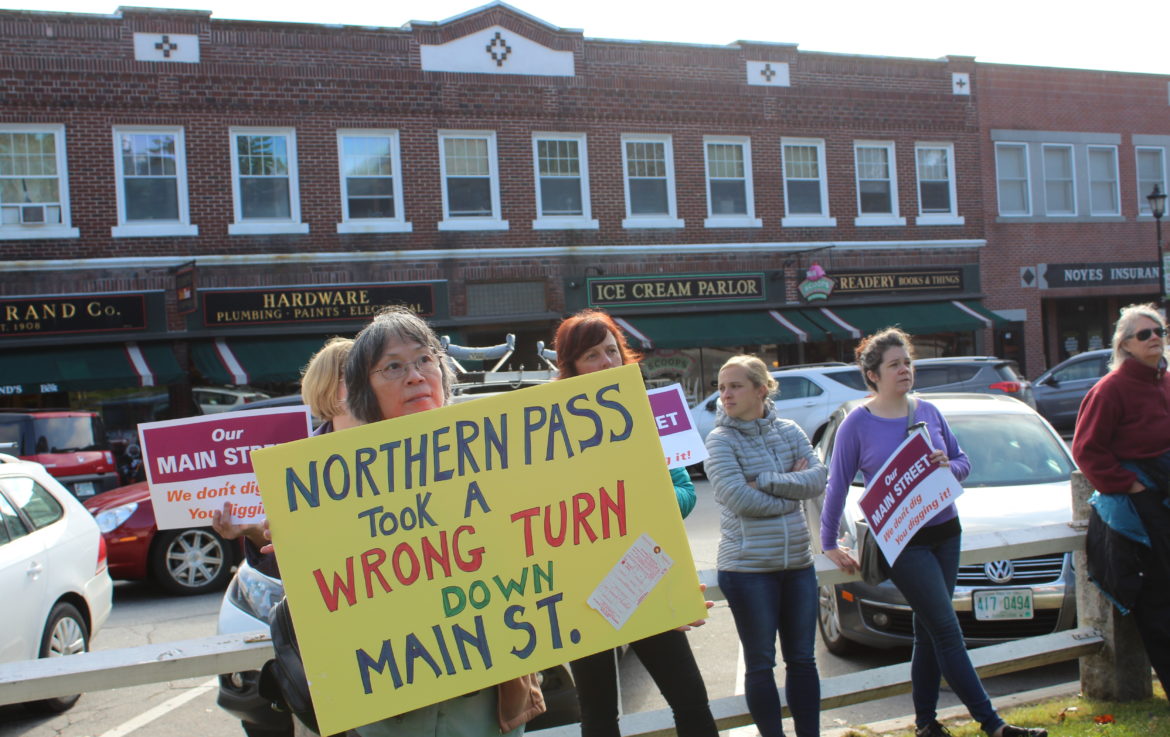
Editor’s note: We are celebrating the writers and columnists and readers who have made us InDepthNH.org for Thanksgiving Week. This one’s by Garry Rayno, InDepthNH.org’s State House bureau chief Feb. 1, 2018 when regulators denied the Northern Pass project.
By GARRY RAYNO, InDepthNH.org
CONCORD — The third day of the Site Evaluation Committee’s deliberations on the Northern Pass Transmission Project through the heart of New Hampshire from Pittsburg to Deerfield dawned with the usual sea of orange in the old Healthsource building off I-93 on the Concord/Bow line.
Few knew what lay ahead that day.
The $1.6 billion project running 192 miles through the state was intended to bring Hydro-Quebec electricity to Massachusetts while the state’s largest electric utility would build the massive project and collect the costs from Massachusetts residents for “clean energy.”
After the project was first proposed quietly eight years earlier, opposition built from a wide range of interests including environmentalists and conservationists, small business owners, residents along the route, local municipal and planning officials and all but two of the host communities.
The project had the support of large businesses and business organizations, unions and economic development officials.
The project offered jobs to union workers, property tax relief for the host communities, needed alternative energy for the New England grid and an upgrade of an undersized transmission line in Coos County that had stymied more wind power development in the northern reaches of the state.
Those opposing the project often wore orange vests or coats or ties to the hearings and the first three days of the scheduled 12 days of deliberations they flooded the room with orange.
The first two days of deliberation had all seven members speak about their concerns and agreement with the testimony presented during the more than 40 days of public hearings.
When it came time for the chair, Martin Honigberg, to speak he related testimony from one of Eversource’s hired guns and said it did not pass the “straight face test.”
Vice chair Kathryn Bailey took on the finances and wondered how the project could qualify to participate in forward bidding for future generation with the costs the project would carry.
Before the third day of deliberations, the late Judy Reardon, who worked for an organization opposing the project, asked me what I thought might happen and I told her I could count at least three or four no votes on the seven-member board, but was unsure of the state agency representatives who might have orders “from on high.” She agreed saying she was optimistic.
No one was expecting what happened that afternoon after a lunch break.
The committee earlier had found Eversource had the financial, technical and managerial capability and experience to construct the project.
But on the third day the committee took up the criteria to determine if the development would negatively impact the orderly development of the region and a soft straw vote was taken and the committee broke for lunch.
After lunch, Bailey moved they deny the project saying the committee could not approve it because all seven members agreed the project would negatively impact the orderly development of the region.
The room — bigger than a high school gymnasium — was deathly quiet and the tension in the room was visible on the jittery and uneasy backs of the people in the room both for and against the project.
Despite the widespread media coverage from time to time, there were two reporters in the room when the vote was taken, one from the Union Leader and me.
The vote was called and the unanimous 7-0 vote sent opponents into celebration and Eversource and its supporters into shock as no one had said “No” to the company for any of its major undertakings before.
The vote would hold up to a reconsideration motion and the scrutiny of a unanimous state Supreme Court. Soon after Eversource abandoned the project and Maine became the favored route to transport electricity from Hydro-Quebec to Massachusetts.
There would be no scar through the mountains, meadows and communities of New Hampshire.
Garry Rayno may be reached at garry.rayno@yahoo.com.
Original story posted Feb. 1, 2018 below
Regulators Vote 7-0 to Deny Northern Pass Application In Deliberation Day 3 Shocker
By GARRY RAYNO, InDepthNH.org
CONCORD — Opponents of the Northern Pass transmission project celebrated Thursday afternoon as the Site Evaluation Committee unexpectedly voted 7-0 to deny the application.
The seven-member committee said earlier in the day that project developer Eversource failed to meet its burden of proof that the project would not negatively impact the orderly development of the region, one of four criteria that must be met for approval.
After the straw vote, the committee continued to review the evidence, but after lunch Vice Chair Kathryn Bailey moved to deny the application because, she said, the committee could not approve the application.
“There are pros and cons to continue the proceedings, but at this point we cannot grant a certificate and there are some risks in continuing deliberations,” Bailey said. “We’ve reached the point where we cannot grant a certificate if everyone votes the way we articulated this morning on orderly development.”
The SEC’s decision ends eight years of controversy and opposition once the 192-mile transmission line from Pittsburg to Deerfield was announced in 2010.
Martin Murray, spokesman for Northern Pass said: “We are shocked and outraged by today’s SEC outcome. The process failed to comply with New Hampshire law and did not reflect the substantial evidence on the record. As a result, the most viable near-term solution to the region’s energy challenges, as well as $3 billion of NH job, tax, and other benefits, are now in jeopardy.
“Clearly, the SEC process is broken and this decision sends a chilling message to any energy project contemplating development in the Granite State. We will be seeking reconsideration of the SEC’s decision, as well as reviewing all options for moving this critical clean energy project forward.”
Long-time opponent Susan Schibanoff of Easton said: “The SEC did the right thing today by law and by the people of New Hampshire.”
Jack Savage of the Society for the Protection of New Hampshire Forests said the committee rejected a proposal that has had fundamental flaws since the beginning.
“That is why they could not make their case,” he said.
The company has 30 days after the committee issues a written decision to ask for a rehearing or to reconsider its vote.
If that is granted, a rehearing would be held before the SEC, said attorney Michael Iacopino, but if it is denied, Eversource would have 30 days to appeal the decision to the Supreme Court which would determine whether it was unreasonable or unlawful.
Depending on the court’s decision, Iacopino said, the SEC could rehear the case and may have to go back to the beginning and start over again. “We’ll do what the court says,” he said.
Northern Pass was recently selected as the sole of 46 proposals to provide 1,200 megawatts of renewable electricity for Massachusetts Clean Energy Project and has two months to negotiate contracts with that state’s utilities before going before regulators.
In announcing the selection, Massachusetts energy officials said one of the key reasons was the project’s ability to begin operations in 2020, at least two years earlier that other proposals.
The SEC had earlier this week concluded Eversource has the financial, technical and managerial capability and experience to construct the 192-mile, $1.6 billion project stretching from Pittsburg to Deerfield.
But members were concerned about the ability to manage any project the size of Northern Pass, saying it would be difficult to ensure requirements and conditions are met during construction.
On Thursday, the SEC said the project does not meet the criteria that it not negatively impact orderly development of the region, sending opponents home to celebrate and project officials back to Manchester to determine what to do next.
Thursday was the third of 12 deliberative sessions ending Feb. 23 when an oral decision is expected.
By GARRY RAYNO, InDepthNH.org
CONCORD — The seven Site Evaluation Committee members said Thursday they do not believe Northern Pass developers have met their burden of proof that the project would not negatively impact the orderly development of the region, one of four criteria that must be met for approval.
On the third day of public deliberations, members said Eversource experts were not credible in finding the project would not negatively impact property values, tourism, businesses and land use.
Committee members also noted the experts failed to reach out to affected communities in developing their reports and failed to understand the state and its character.
However, the committee members did agree the project would create jobs, lower electric rates and increase tax revenues for the 31 host communities.
The SEC has yet to take a formal vote on any of the four criteria the project needs to meet to receive a construction certificate, but did conclude earlier that Eversource has the financial, technical and managerial capability and experience to construct the 192-mile, $1.6 million project stretching from Pittsburg to Deerfield.
The board’s consensus encouraged the project’s opponents who said the committee is focusing on the same deficiencies others have stressed during adjudicative hearings last year.
“The things they talked about are exactly the same things we brought up,” said Jack Savage, of the Society for the Protection of New Hampshire Forests. “Based on the deficiencies and proof they require, it appears those things are not easily remedied in a short time frame.”
Northern Pass was recently selected as the sole of 46 proposals to provide 1,200 megawatts of renewable electricity for Massachusetts Clean Energy Project and has two months to negotiate contracts with that state’s utilities before going before regulators.
In announcing the selection, Massachusetts energy officials said one of the key reasons was the project’s ability to begin operations in 2020, at least two years earlier than other proposals.
But SEC members were concerned about the ability to manage any project the size of Northern Pass, saying it would be difficult to ensure requirements and conditions are met during construction.
On Thursday the SEC reviewed environmental requirements the project has to meet. Thursday was the third of 12 deliberative sessions ending Feb. 23 when an oral decision is expected.
The SEC has to issue a written decision by the end of March.
Garry Rayno can be reached at garry.rayno@yahoo.com