InDepthNH.org is republishing this Associated Press story in partnership with the AP Fund for Journalism
By The Associated Press
U.S. envoy Jared Kushner said Thursday he believes Russia is “comfortable” with NATO-like security guarantees for postwar Ukraine, while Kyiv’s European allies expressed concerns about President Donald Trump’s meeting in China with the Kremlin leader.
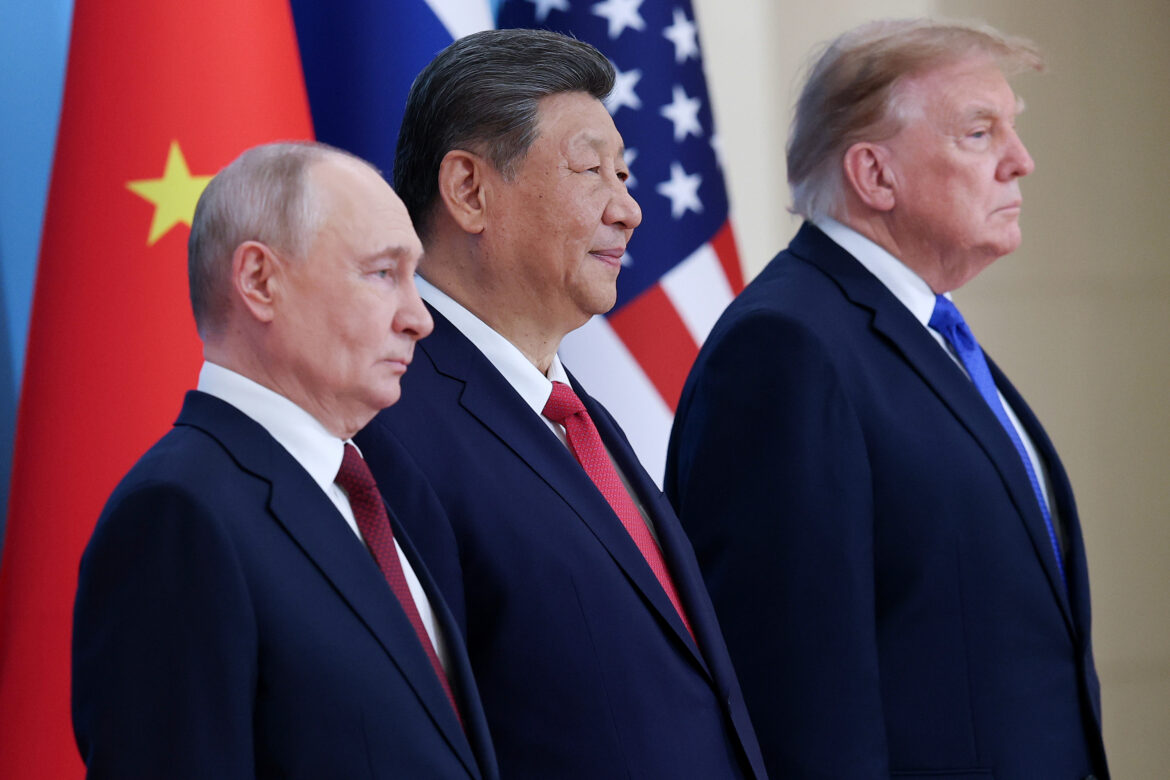
Kushner’s remarks came after Trump wrapped rare three-way talks with Russian President Vladimir Putin and Chinese President Xi. According to fellow U.S. envoy Steve Witkoff, Trump discussed a peaceful end to the Russia-Ukraine war during the trilateral meeting — which was billed as a historic but seemed to lack breakthroughs.
The trio, convening in China, was also meant to discuss the war with Iran and how to reduce the dangers posed by nuclear arsenals. But after roughly 70 minutes behind closed doors, they agreed to a far narrower agenda: To reform the United Nations, refine more fossil fuels and curb the reach of the International Criminal Court.
Here’s the latest:
Michigan Sen. Slotkin endorses Chris Van Hollen for majority leader
Elissa Slotkin, a moderate Democrat first elected in 2024, is backing Van Hollen in his challenge to Chuck Schumer to lead Senate Democrats when they take the majority next year.
“I don’t think that Sen. Schumer is best positioned to be our next leader,” Slotkin said Thursday in a video. “Because I’ve been clear that I wasn’t supporting Schumer, I will be supporting Chris Van Hollen.”
Slotkin’s endorsement is notable because Van Hollen has drawn much of his support from the party’s progressive wing, which she has criticized in the past.
But she has also repeatedly called for a new generation of Democratic leadership. In her video Slotkin pointed to former House Speaker Nancy Pelosi’s decision to step aside and make way for younger lawmakers, alluding to criticism from some that Schumer should announce that he will retire after 2028.
Everyone is a friend: Trump’s meetings in Asia show his varied approaches to shifting world order
The president huddled with leaders from longtime partners Japan, Australia and India in a resort conference room in Manila, Philippines, this week to strengthen a partnership called the Quad that is meant to counter China.
Two days later he warmly greeted Chinese leader Xi Jinping and Russian President Vladimir Putin in an unprecedented trilateral summit of countries that have been long considered rivals to take on “new opportunities and approaches on a range of very important issues.”
Trump effusively described all these leaders as friends, but the meetings highlighted some key differences. The two geopolitical gatherings on the same whirlwind Asia trip reflect his varied foreign policy approaches at a time when the world order is shifting.
“The Quad, comprising four democracies that uphold the rule of law, represents the post-World War II international order,” said Ken Moriyasu, a senior fellow focused on Asia at the Hudson Institute.
“The trilateral, meanwhile, raises the prospect of a very different order — one in which three great powers stand above the rest, recognize each other’s spheres of influence and refrain from interfering in each other’s core interests.”
? Read more
Pete Rose posthumously pardoned by Trump after baseball’s career hits leader was reinstated by MLB
The presidential pardon comes more than two years after the baseball star’s death and a year after he was reinstated by Major League Baseball Commissioner Rob Manfred.
“I have just given a Complete and Total Pardon to the Late, Great Pete Rose, a true Baseball SUPERSTAR & LEGEND,” Trump said Thursday on social media.
Rose, baseball’s career hits leader at 4,256, entered guilty pleas on April 20, 1990, to two counts of filing false tax returns, admitting he failed to report $354,968 during a four-year period. That was about eight months after he agreed to a permanent ban from baseball.
? Read more
Democratic senators preview probe of Trump’s ballroom
Richard Blumenthal of Connecticut and Adam Schiff of California said Thursday that they sent letters to lobbyists who “played an instrumental role” by donating to the ballroom project at the White House.
Blumenthal, who will be the chairman of the Senate Homeland Security Committee’s investigative subcommittee next year, and Schiff sent letters to Brian Ballard of Ballard Partners and Reince Priebus, who was a Trump chief of staff during his first term and is now chairman of the board of Michael Best Strategies.
The senators demanded that they produce documents and communications related to the ballroom and any efforts to solicit donations from companies with interests before the Trump administration. They asked for the documents by Jan. 4, the day after Democrats assume the majority in the Senate.
“This pipeline of corporation donations raises concerns of widespread corruption at the White House, with quid pro quo transactions potentially tainting official government action,” the senators wrote.
Hawley on 2028: ‘I have a lot of thinking to do’
Before the midterms, Republican Sen. Josh Hawley seemed to rule out a presidential bid, with the Missouri senator telling the Washington Examiner that “I have no intention of doing so, period.”
Now, after the catastrophic midterms for the GOP, Hawley is dropping hints that he’s changing his mind.
“After this most recent election, I think everybody that cares about the future of the party, the future of the country, has a lot of thinking to do,” Hawley told The Associated Press on Thursday when asked about his presidential ambitions. “So I’ll just say I have a lot of thinking to do.”
Hawley said the main takeaway for him from the midterms was that voters want the party to focus on affordability issues and that Republicans needed to cater more to a blue collar electorate.
“We’re a blue collar state,” Hawley said, referring to Missouri. “And I think the Republican Party will either be a blue collar party or we will be a permanent minority party.”
US withholds judgment on ICJ genocide verdict in Myanmar case over treatment of Rohingya Muslims
The State Department said Thursday that it was “studying the decision to fully assess its implications” before offering an opinion on the International Court of Justice verdict.
The Trump administration has taken a dim view of international law, in particular vowing to dismantle the International Criminal Court, which it regards as a renegade globalist institution.
The ICJ and ICC are separate entities and the administration has yet to question the legitimacy of the ICJ.
The State Department said “the proper interpretation of the Genocide Convention is of paramount importance, as is preventing politicization of the ICJ.”
The department reiterated U.S. support for the people of Myanmar and said it shared “grave concerns over the continued abuses of human rights against Rohingya Muslims and members of other minority groups.” It noted the U.S. is the largest single humanitarian donor to the Rohingya humanitarian crisis response.
FEMA head commits to ‘breaking the cycle of federal dependency’ in disaster management
FEMA administrator Cameron Hamilton told House lawmakers Thursday that the agency was “restoring federalism to emergency management” and “breaking the cycle of federal dependency,” the latest indication that the Trump administration still aims to rebalance the federal role in disasters.
Hamilton told members of a House Homeland Security subcommittee that he was committed to delivering assistance quickly, but that FEMA would refocus to support states, tribes and territories “only when disasters truly exceed their capacity,” instead shoring up local capability and resilience.
Lawmakers on both sides maintained the need for FEMA readiness and funding support. Democrats offered a glimpse of how they might push back on the Trump administration’s management of FEMA in the next Congress.
” Politicizing FEMA ” would be part of future oversight investigations, Democratic Rep. Delia Ramirez of Illinois told Hamilton. “I look forward to seeing you very soon again,” she said.
Iran war costs surpass $48B as lawmakers demand unreleased estimates on base damage
The Iran war’s costs have risen to an estimated $48.3 billion as of Nov. 13, but that doesn’t include damage to U.S. bases attacked in the Middle East.
Arthur Miller, a Pentagon budget official, provided the latest figure Thursday to the Senate Armed Services Committee. It’s considering Miller’s nomination to be Navy comptroller, among those of other officials for roles in the military.
Democratic Sen. Richard Blumenthal of Connecticut pressed Miller for an estimate on damage to U.S. installations, which Miller said he didn’t have. An Associated Press analysis found Iran attacked aircraft hangars, systems that detect incoming strikes, troop housing and more, causing billions of dollars in damage.
Republican Sen. Roger Wicker of Mississippi, the committee’s chair, directed Miller to try to provide an answer as soon as possible.
Ecuador is Hegseth’s latest stop in South America trip
Defense Secretary Pete Hegseth has stopped in Ecuador following a surprise visit a day earlier to Venezuela, where he signed a new military cooperation agreement.
The Pentagon said early Thursday that Hegseth would meet with President Daniel Noboa about working together on defense and countering drug trafficking.
After departing Caracas, Hegseth flew to Bogota, Colombia, where he presided over the delivery of a military transport plane. The plane’s delivery comes as Colombia’s new president embraces Trump’s policies on countering drug trafficking.