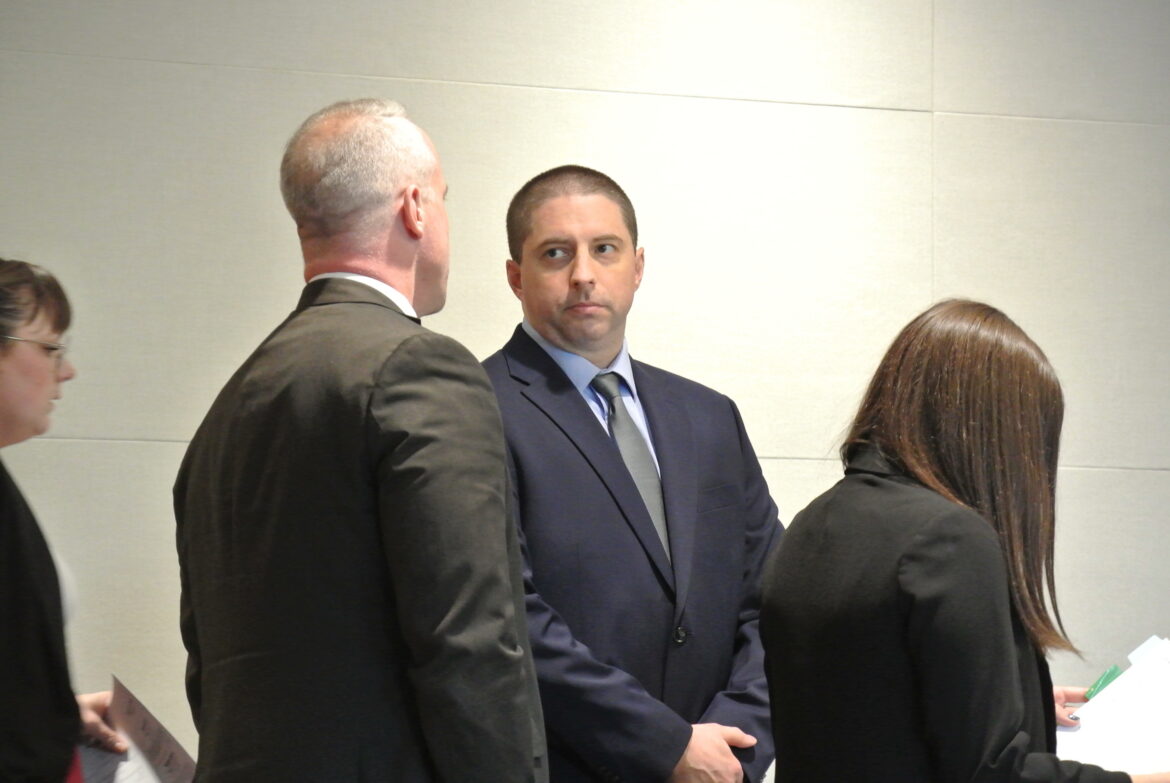
By DAMIEN FISHER, InDepthNH.org
CONCORD – The former corrections officer acquitted in the 2023 death of Secure Psychiatric Unit patient Jason Rothe, Matthew Millar, settled his part of a wrongful death lawsuit brought by Rothe’s sister, Aimee Khatib.
Khatib filed her lawsuit earlier this year in the United States District Court in Concord, naming Millar a defendant along with the Department of Corrections, former Commissioner Helen Hanks, and several other corrections staff involved in Rothe’s final moments, Lesley-Ann Cosgro, Paul Sanchez, Timothy Wright, Josephine McDonough, Maria Bissonnette, and nurse Jennifer Fitzgerald.
Millar spent a year in jail awaiting trial after he was charged with second-degree murder in Rothe’s death. He was acquitted last year after the jury deliberated less than two hours before finding him not guilty.
The terms of Millar’s settlement have not been disclosed, and now the focus for the lawsuit will be on the others named as defendants. Court records indicate the possibility of mediation resolving the lawsuit. DOC officials did not respond to InDepthNH.org’s request for comment.
Khatib’s lawsuit accuses the DOC and Hanks of failing to train the officers in room extractions, and in safe use of force practices, as well as accusing Hanks of destroying evidence in the wake of Rothe’s death. Many of the facts used in Khatib’s lawsuit came out during Millar’s trial.
“Commissioner Hanks held inappropriate investigative meetings on two separate occasions with the involved officers despite being noticed by the Attorney General that these COs were considered witnesses in investigations into Mr. Rothe’s death,” the lawsuit states. “Commissioner Hanks failed to properly investigate the Use of Force deployed in Mr. Rothe’s case, relying on incomplete reports, and completing performance reviews of the implicated COs. More outrageous, Commissioner Hanks then coached the implicated COs, instructing them to revise their statements, and destroyed their original statements. Commissioner Hanks also destroyed her own notes taken during these improper meetings.”
Rothe was 50 when he died on April 29, 2023 after fighting with several officers who were attempting to remove him from a day room inside the Secure Psychiatric Unit. Rothe suffered from severe schizo-affective disorders, was obese and had heart disease. He was also known to be violent when agitated, according to court records.
Evidence and testimony at trial show Cosgro, the officer in charge, decided to lead an extraction team to get Rothe out of the SPU dayroom without enough officers to do it safely, without protective gear, without a plan of action, and without a civilian nurse present, among other violations of DOC policy. She also tased Rothe eight times, once in the head, during the ensuing melee despite the DOC policy limit of three taser strikes.
The nearly 10-minute fracas with Rothe included officers punching him in the head, pressing him down on his stomach, and putting him in a prime stress position before he was put onto a restrain stretcher, according to the lawsuit, as well as other court records. Millar was accused of putting a knee on Rothe’s back for up to several minutes, causing the death. However, there is no evidence Millar did that, and none of the other officers testified to that during his criminal trial.
After Rothe’s death, Hanks conducted interviews with all of the officers despite knowing that the New Hampshire State Police and the New Hampshire Attorney General’s Office considered them witnesses, according to the lawsuit. During those meetings Hanks decided Millar was to blame and instructed all of the officers to change their statements on Rothe’s death, according to the lawsuit.
After Millar was charged in early 2024, Hanks had another round of interviews with the officers, bringing Personnel Director Fallon Reed with her. Again, at this point Hanks had been instructed by the DOJ not to speak to potential witnesses in a criminal case, according to the lawsuit.
Hanks shredded her notes of the meetings and issued disciplinary letters to three of the officers. Hanks did not disclose the meetings or the letters to the DOJ for more than a year, with the information only coming to light weeks before Millar’s trial. When it came to light, the evidence showed Reed also kept notes, and those notes differed from the information in the disciplinary letters, according to the lawsuit.
Hanks resigned from her job suddenly in May of last year. Reed was terminated this year, according to information obtained by InDepthNH.org.