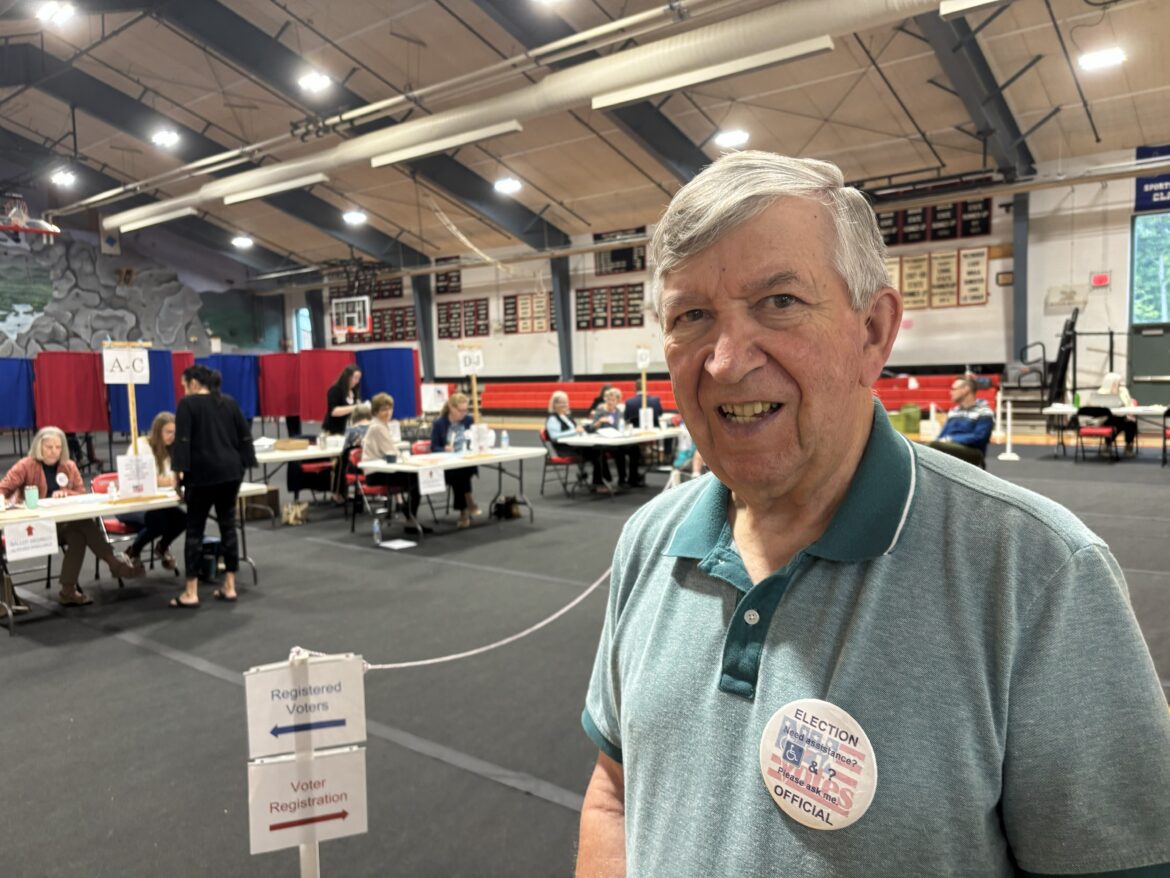
Send your pics from the polls to nancywestnews@gmail.com with name of photographer, polling place and your comments. InDepthNH.org journalists Garry Rayno, Paula Tracy, Nancy West, Katharine Webster and Zach Laird will be reporting and The Associated Press will provide the tallies as the votes are counted! Happy Voting! We will post your pics and comments here so check back and tonight come to InDepthNH.org is ready to post your Associated Press vote tallies as the votes are counted.
Primary Day notes and quotes
A lawyer for the New Hampshire Attorney General’s Office who did not give his name said that he had received no reports of U.S. Department of Justice election monitors in Nashua by mid-morning.
But shortly after noon, Lisa Kovack, director of the New Hampshire Voting Rights Program for America Votes, said in text messages that volunteer election observers with the New Hampshire Coalition for Voting Rights had reported seeing federal observers in Nashua Wards 4, 6, 7 and 8.
“In Manchester, there are two teams of two rotating around, spending about an hour in a location,” she said, noting that observers with the coalition had seen them in Manchester Ward 5.
The coalition has 62 volunteer observers at 71 polling locations in 21 cities and towns, Kovack said.
“Overall, friendly, efficient operations so far,” she wrote. “The challenge is ensuring official guidance about offering the affidavit to prove citizenship is flowing down accurately to all poll workers and being applied consistently. It mostly is.”
Kovack was referring to a change from the previous election, when voters had to present documentary proof of citizenship when registering for the first time in New Hampshire under a 2024 state law. A federal judge ruled in May that the law was unconstitutional. That means new voters can sign an affidavit, under penalty of voter fraud, that they are U.S. citizens.
Judith Blachek, moderator in Nashua’s Ward 7, said she had gone to five trainings before the primary election: three offered by the Secretary of State’s Office, including one last Thursday afternoon specifically focused on federal election monitors, and two trainings by the city.
“The feds notified the state they would be sending three teams of two people,” Blachek said, noting that Ward 7 has many low-income voters because it has public housing projects and low-income senior housing.
By 10:30 a.m., only 320 of 4,291 registered voters in Ward 7 had voted, said ward clerk Lynn Laughton.
Blachek said that was normal for a primary.
“I’ll be happy if 1,000 voters come out,” she said.
Blachek, who was elected as moderator for her ward, said she was not paid for most of the election worker training sessions she attended.
“I’m retired. I’m doing this out of love of country, so I’m willing to sacrifice my time in hopes of having a good democracy,” she said.
******
Meanwhile, in Atkinson, local Democrats were crying foul over text messages that went out to voters Tuesday saying that the two incumbent Republican state representatives, Debra DeSimone and Jay Markell, both of Atkinson, were for Democrats as well as Republicans.
“We do not, and have never, supported Deb DeSimone and Jay Markell as Democrats,” the Atkinson Democratic Town Committee said in a Facebook post. “We would never endorse Republicans as they do not support the values we believe are necessary for a stronger community.”
DeSimone and Markell are not on the Democratic primary ballot. The town Democrats have endorsed Christine Duerr, who is on the Democratic primary ballot, and have asked that their supporters also write in Beth Cacciotti’s name.
“Please do not fall for text messages sent by Joe from Granite Solutions,” the Democrats’ Facebook post said.
Granite Solutions is a political action committee (PAC) run by state Rep. Joe Sweeney, R-Salem, the House deputy majority leader.
From Terry Farish:

Garden at New Franklin School

Eleanor Bronson Dickerson
TERRY FARISH: Voting in Ward 1, Portsmouth, New Franklin School
My mother (Eleanor Bronson Dickerson) cried when she voted. To me as a child, I saw voting as steeped in emotion. Today in NH, even seeing the garden at New Franklin School where I vote, the commitment of the poll workers, the good will of neighbors who baked muffins for us, there I am crying. It’s not the 1950s like it was for my mother, glad her brother didn’t died in that war of her childhood. I still cry at the polls. Maybe it’s about our power to keep discovering that we can create what we need.

Voters and poll workers are pictured Tuesday at Plymouth Elementary School. PAULA TRACY photo

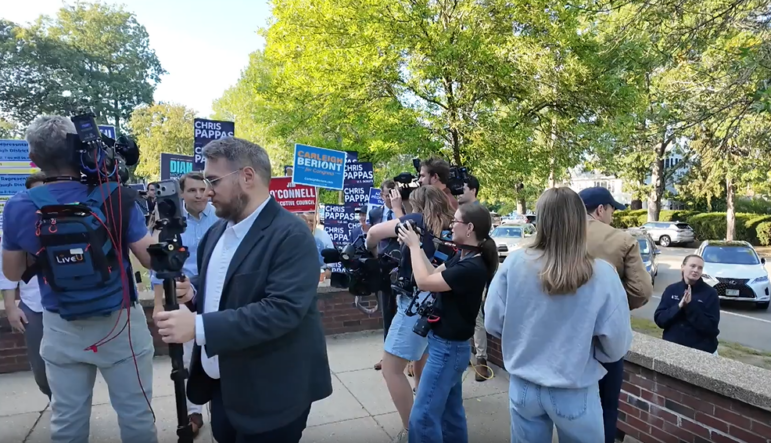
Paige Beauchemin, third from right who is running against U.S. Rep. Maggie Goodlander in the Democratic primary for the 2nd Congressional District, and her supporters hold signs outside the Ledge Street School polling place in Nashua Tuesday. KATHARINE WEBSTER photo
WHAT TO KNOW!
Keeping New Hampshire’s registration and voting requirements in mind, here’s what you need to know before you go to your polling place on Tuesday to vote in either the Republican or Democratic primaries.
Secretary of State: 1-800-540-5954 or (603) 271-8241 (Email: NHVOTES@sos.nh.gov)
Department of Justice: 1-866-868-3703 (Email: electionlaw@doj.nh.gov)
InDepthNH.org: 603-738-5635 (Email: nancywestnews@gmail.com)
First-time Registration and Voting in New Hampshire
If you have never voted in New Hampshire before, you can register on election day at your polling place. You will need:
- Proof of U.S. citizenship. Acceptable documents include a birth certificate, a passport or passport card, military ID, and a naturalization certificate for people born abroad. If you do not have any of these documents, or cannot obtain them by election day, poll workers may check other databases, such as Division of Motor Vehicles (DMV) records, to try to confirm your citizenship. You can also sign an affidavit swearing that you are a U.S. citizen, under penalty of voter fraud. You may be investigated if you use an affidavit and even charged if you are not a qualified citizen. (This measure was in place in previous years, but outlawed in 2024. Several voting rights groups sued and won a federal court ruling in May reinstating the affidavits. The state has appealed, but for now the affidavits are legal.)
- Proof of identity. A federal or state photo ID, such as a passport, passport card, military ID, state driver’s license or state non-driver photo ID card – available for free at the Division of Motor Vehicles for voting purposes only – are all acceptable. The name on your ID must “substantially” match your name on the voter rolls. New this year: Student IDs are not an acceptable form of identification for registration or voting. (The Coalition for Open Democracy has sued over this law in federal court, but it is currently in effect.)
- Proof of age. Any of the previously mentioned documents can be used to prove age.
- Proof of domicile. In addition to the above documents, acceptable proofs that New Hampshire is your primary residence include a state resident motor vehicle registration or a government-issued check, benefit statement or tax document with your current address. If you do not have any of those documents, you can sign a form saying you are a state resident under penalty of voter fraud AND provide one of the following with your current address: a lease or rental agreement; a utility bill; a “confirmation of domicile” form signed by the landlord or owner of the place where you live; or a “homeless confirmation of domicile” form.
Repeat and Lapsed Voters
- All voters must show an acceptable form of government photo ID – see above – before being issued a ballot. Student photo IDs are no longer accepted, even if they are issued by a public high school, college or university.
- People who have voted previously in New Hampshire but who have moved must bring both ID and proof of domicile or residence at their new address.
- People who remain at the same address but have not voted in several years and may have been stricken from the checklist should bring both ID and proof of domicile or residence.
- People who have changed their names since they last voted may also need to provide proof of the legal name change, such as a marriage certificate or court document, and re-register to vote under their new name.
What to Know About the Primaries
- Primaries are candidate nomination contests for each qualified political party. In New Hampshire, if you are registered as a Republican, you will receive a primary ballot listing competing Republican candidates only. If you are registered as a Democrat, you will receive a Democratic primary ballot.
- If you are an “unaffiliated voter,” you may request either a Republican or Democratic primary ballot. Once you do that, your voter registration is automatically updated to show you as a member of that party. You can switch your party membership back to “unaffiliated” at your polling place immediately after you vote.
Your Voting Rights
- You have the right to vote if you meet the above requirements for registration and voting.
- If you are disabled, you have the right to vote in person – with or without assistance from an election official or person of your choice – using a handicapped-accessible voting booth or machine. You also have the right to apply for an absentee ballot either in person or by mail, and to return it by mail, if you provide copies of the necessary documents.
- You also have the right to apply for an absentee ballot if you certify that you will be absent from your town or city on the date of an election; if you serve in the U.S. military or live overseas; if you are jailed on a misdemeanor charge.
- If you are serving a prison sentence for a felony, you do not have the right to vote. But you do have the right to vote, including during pretrial detention, before you are convicted. You also have your voting rights restored after you are released, including when you are on probation or parole.
- If you are a newly naturalized citizen, you have the right to vote even if your name is not yet listed in a state or federal database. You must supply your naturalization certificate as proof of citizenship.
- You have the right to photograph your ballot and post the photo on social media. You also have the right to keep your vote secret.
- You have the right to refuse to answer questions from federal election monitors, people promoting issues and candidates outside the polling place, political party observers, observers from voting rights organizations, reporters, or anyone else, including law enforcement agents. You also have the right to ask them to identify themselves, although they are not obligated to answer. They are not allowed to misrepresent themselves or their roles or pressure you into talking.
- If you think your or someone else’s voting rights are being violated, for example by people approaching you and questioning your citizenship or criminal record, you have the right to speak to election officials and the moderator at your polling place, to contact the Secretary of State’s Office, or to call the state Attorney General’s Office’s voting rights hotline: 1-866-868-3703.
- You also have the right to contact voting rights organizations, such as the ACLU of New Hampshire, which maintains a voting rights hotline at 603-333-2201, and to speak with voting rights observers, law enforcement, or lawyers present at the polling place.
Voting Wrongs
- You do NOT have the right to harass or intimidate voters, observers or election officials, or to interfere with the election officials’ work.
- You do NOT have the right to wear or bring partisan clothing, buttons, hats, stickers, literature and other items inside the polling place. Election officials may turn you away or remove you. Alternatively, they may ask you to remove or cover up any partisan messages before entering.
- You do NOT have the right to spread false or misleading information about voting requirements and fraud, either verbally or by displaying information on a sign, T-shirt, or handouts.