New Hampshire employment is growing and unemployment is below 3%, but average wages are not keeping pace with rising prices
Concord, N.H. – Ahead of Labor Day, a new analysis from the New Hampshire Fiscal Policy Institute finds that New Hampshire’s labor market has strengthened in 2026 after a difficult 2025, but the headline numbers do not tell the full story of how Granite State workers and families are faring.
New Hampshire has added jobs, its labor force has grown, and unemployment has fallen below 3% this year. At the same time, average wage growth is once again falling behind inflation, reducing workers’ purchasing power. Job growth has also varied significantly across industries, and some Granite Staters looking for work have faced longer periods of unemployment.
The new analysis from NHFPI’s Ben Reynolds, New Hampshire’s Labor Market Improving in 2026, but Risks Remain, provides a comprehensive look at the state of work in New Hampshire, including employment, wages, labor force participation, industry trends, affordability pressures, and emerging risks to workers and the state economy. The report draws on and compares the latest available data from New Hampshire Employment Security, the U.S. Bureau of Labor Statistics, the U.S. Census Bureau, the U.S. Bureau of Economic Analysis, and other sources, using household and employer surveys, unemployment claims, wage and inflation data, and longer-term measures of productivity and compensation to provide a fuller picture of how New Hampshire’s labor market and its workers are faring.
“On Labor Day, we recognize the contributions workers make to New Hampshire’s economy, and the data show there is a lot to be encouraged by,” said Gene Martin, Executive Director of the New Hampshire Fiscal Policy Institute. “But having a strong economy means more than simply having more people employed. It also means workers can see their earnings keep pace with the cost of living and that Granite Staters across ages, industries, and income levels have opportunities to thrive. This report shows that we still have work to do to make sure economic growth is reaching everyone.”
Key findings from the report include:
- New Hampshire employment has rebounded in 2026. Seasonally adjusted nonfarm employment increased 1.1% between January and July, compared with 0.2% nationally. However, that increase represents a partial recovery from 2025, when employment in the state declined 1.1%.
- Wages are not keeping up with rising prices. Average private-sector wages in New Hampshire grew more slowly than consumer prices in the Northeast in both 2024 and 2025. During the first seven months of 2026, wage growth again lagged inflation, reducing estimated purchasing power by 1.6% relative to 2025.
- Workers are producing more, but compensation has not kept pace. Between 2007 and 2024, labor productivity in New Hampshire increased 32.8%, while inflation-adjusted hourly compensation increased 20.3%, creating a 12.5 percentage-point gap.
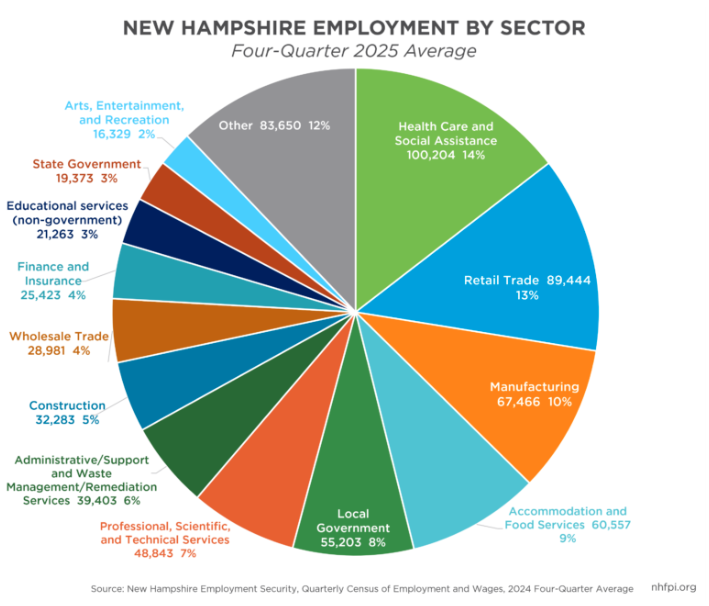
- Job gains have not been evenly distributed. Health Care and Social Assistance continued to grow as New Hampshire’s largest employment sector, while employment declined in manufacturing, retail trade, and wholesale trade. Small businesses were an important source of growth: companies with fewer than 20 employees accounted for 79% of net job growth in 2025.
- Many Granite Staters are still having difficulty finding work. During the first seven months of 2026, the number of ongoing unemployment claims was 23 percent higherthan during the same period two years earlier, while the number of new claims remained relatively steady. The increase suggests some unemployed workers are spending longer looking for work, even as the state’s headline employment numbers improve.
- The labor force is growing, but its composition is changing. New Hampshire was the only New England state to experience labor force growth during the 12 months ending June 2026. However, the number of labor force participants ages 20 to 34 declined, while workers ages 35 and older increased their share of the workforce.
- Affordability remains closely tied to New Hampshire’s future workforce. With an aging population, younger workers and people moving into New Hampshire will become increasingly important to maintaining the state’s labor supply. Yet the median single-family house sale price reached $535,000 in 2025, while average annual center-based child care for an infant and four-year-old approached $30,000. These costs can affect whether younger workers and families can remain in, or are able to move to, the state.
The report also identifies several risks that could affect workers and employers in the months and years ahead, including persistent inflation, national economic weakness, changes to federal trade policy, and the potential effects of artificial intelligence on entry-level employment. Overall, NHFPI finds that while much of the labor market strengthened in early 2026, other indicators of workers’ economic well-being have lagged behind.
“New Hampshire’s labor market has stronger job growth than it did a year ago, but a job alone doesn’t tell us whether a family is getting ahead,” said Ben Reynolds, NHFPI Senior Policy Analyst and the lead author of the report. “When wages grow more slowly than the cost of everyday goods and services, workers can be employed and still lose purchasing power. Looking beyond unemployment and job growth gives us a much clearer picture of the economic realities facing Granite Staters.”
You can read the full report, New Hampshire’s Labor Market Improving in 2026, but Risks Remain, at https://nhfpi.org/resource/new-hampshires-labor-market-improving-in-2026-but-risks-remain/.
###
About the New Hampshire Fiscal Policy Institute
The New Hampshire Fiscal Policy Institute is a nonpartisan think tank that promotes opportunity and economic well-being for all New Hampshire residents by producing and disseminating independent research and analysis to inform public policy.