By AARON DAVIS, InDepthNH.org
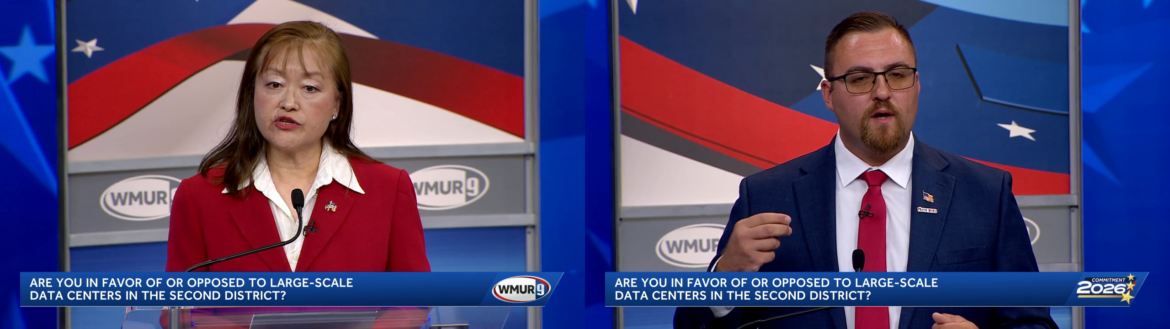
Candidates for the Republican primary for the U.S. House of Representatives Second Congressional District took to the stage on Monday night. Newcomer Victor Orlando, owner of a roofing company, positioned himself as the independent working-class alternative to frontrunner Lily Tang Williams, as well as the candidate more likely to break with President Trump on civil liberties and institutional power.
The debate, hosted by WMUR and the first of five primary debates scheduled for this week, ran an hour and touched on over 20 topics, from the trade war with Canada to ICE enforcement and data centers.
Tang Williams, an anti-communism crusader and third-time candidate for the position, has a roughly 50-point lead over Orlando, according to recent polling from UNH, and played the debate more cautiously than she has in the past.
That said, Tang Williams did stumble on an early question on whether she supported efforts by the Trump administration to suspend the writ of habeas corpus (the right to challenge your detention) for undocumented immigrants, telling the moderator that she would “look into that principle” but supported self-deportation.
Orlando jumped on the question and took the chance to draw a line between his campaign’s approach to the Trump administration and Tang Williams’.
“I would never support suspending habeas corpus as a fundamental right. Whether it makes it easier or harder, these are our rights as citizens,” Orlando said in response.
Both candidates were supportive of ICE enforcement and wanted local police to collaborate more closely with ICE officers.
Tang Williams recovered on the next question on data centers in the second district, staking out a stance of local control over communities.
“I would say no government perks, credits and taxpayer dollars should be involved,” she said. “If a private company wants to come here, build data centers, then they need to respect our local control and address our concerns of environmental impact and electricity costs.”
Orlando’s position was that he was neither for nor against them, but that he didn’t think any data centers would be coming to New Hampshire because of the cost of electricity in the state.
Moderators’ questions on artificial intelligence, education and worker protections drew distinctions and similarities between the two candidates. Tang Williams shared her story about her son who was laid off from his banking position due to AI and that guard rails were needed, but focused on restoring American global competitiveness through education reform.
Orlando noted guardrails more specifically for self-driving trucks and airplanes and said that more money should be invested in trade skills and technical education because he believed they were more “AI-proof” careers.
Orlando took another moment in the debate to differ from both the president and Tang Williams in a response to Elon Musk’s Department of Government Efficiency, also known as DOGE. Candidates were asked if there were any programs that shouldn’t have been cut by the organization.
“DOGE did lots of good things for this country and for the taxpayers,” Tang Williams responded and claimed that the agency whose authority has been challenged in court exposed fraud and corruption. She said she continued to support DOGE.
Orlando drew another distinction between his campaign and the GOP by saying this power already rested with Congress and that lawmakers, not DOGE, should audit the federal government.
As it came to the end of the hour, the topic turned to their electability against incumbent Democratic Rep. Maggie Goodlander and the fight for a seat that hasn’t seen a Republican win in 16 years.
Tang Williams pointed to how close she came last time and her clear polling lead.
“I got 47% (of the vote) last time without a single TV ad,” Tang Williams said. “I think this time is the right time for me to go against Maggie Goodlander again. I challenge her to debate me and I challenge her to town halls.”
Tang Williams isn’t just leading in the primary polls, but is also leading in her campaign war chest. She’s raised over $1.2 million so far and has a little over $630,000 cash on hand left, according to Federal Election Commission reports as of Aug. 19. Orlando meanwhile has had a bit more trouble bringing in donations and has raised $170,000 and spent nearly all of it, with $9,600 cash on hand remaining.
How is Orlando expecting to overcome Tang Williams’ advantage as well as his Democratic opponent in November?
“It’s because 55% to 65% of Republicans aren’t showing up to polls. Why? The others are working class people, waking up at 5 or 6 a.m. in the morning, going to a job and working all day long… We need a candidate who is relatable to them. It’s all about voter turnout and right now, there’s no one representing them.”
The primary election for New Hampshire will be held on Tuesday, September 8 and WMUR is hosting a series of five debates between candidates for the Republican and Democratic primaries.
On Wednesday, candidates for the Republican primary for the First Congressional District will face off. On Thursday, both the First and Second Congressional District races for the Democrats will air. On Friday, WMUR will air the U.S. Senate Democratic debate.
For the first time in recent history, there will be no U.S. Senate Republican debate between the two primary opponents on WMUR. Former U.S. Sen. John Sununu declined to debate with opponent former Massachusetts Sen. Scott Brown of Rye.