By GARRY RAYNO, InDepthNH.org
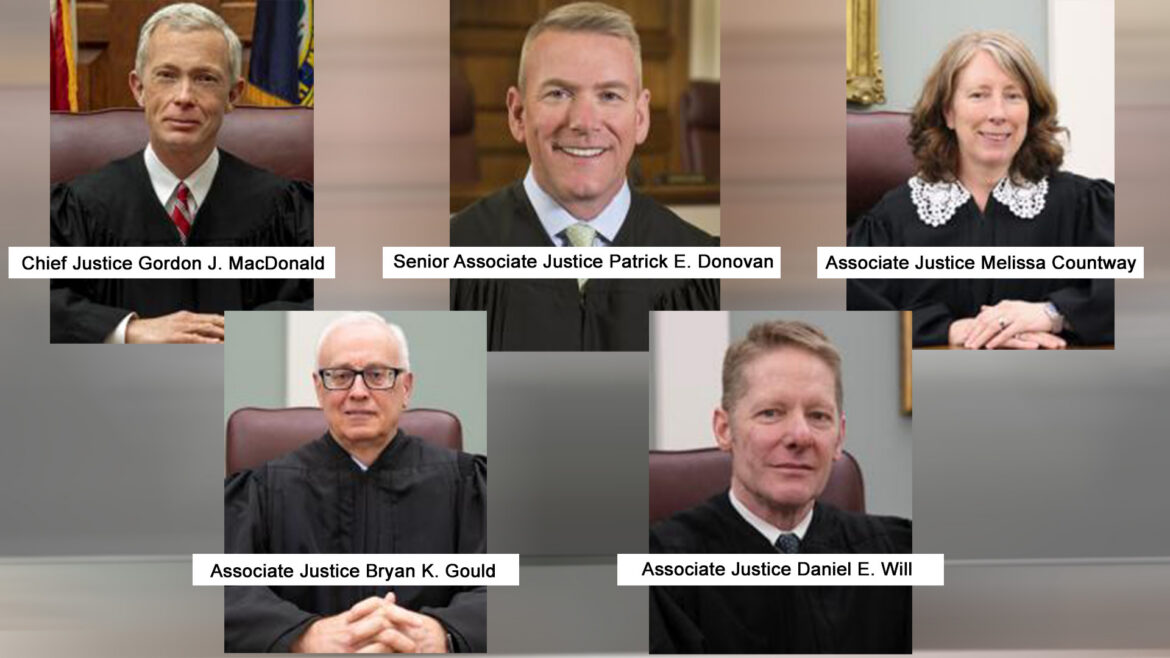
CONCORD — The attorneys for the Rand education funding case are asking again for the recusal of Chief Justice Gordon MacDonald and associate justice Daniel Will from deciding the state’s appeal at the Supreme Court.
With the state asking the court to both overturn the prior ConVal decision in favor of the plaintiffs, and its requirement to increase state aid by $500 million in its brief in the Rand case, the attorneys argue there is new information to be considered. They note that MacDonald recused himself from the ConVal case because he was attorney general when the state fought the case and Will was the state’s lead attorney.
The plaintiffs had asked that four of the five justices be recused from the appeal, but all four motions were denied by the individual justices. The plaintiffs asked for reconsideration, which requires a decision from all five justices, but the court has yet to act on that request.
The plaintiffs also accused the court of subverting the recusal process in order to have a more favorable court sitting to decide whether to overturn both Claremont decisions as well as the ConVal decision.
The attorneys note the state also argues in its Rand brief that the ConVal decision should have “diminished weight” because two of the justices were temporary, one filling a vacancy and other to sit for MacDonald.
The plaintiffs’ attorneys note the state’s contention opposes state statute which clearly states a temporary justice sitting on a case is indistinguishable from a permanently appointed justice.
The state is both arguing the ConVal decision should be overturned along with its state aid requirements, and the current justices who worked on the case on the state’s behalf should continue to sit on the Rand appeal, the attorneys note.
“Followed to its conclusion, that argument means that Chief Justice MacDonald, who recused himself from deciding ConVal in the first instance, should nonetheless be the one to reverse it a year later, and that Justice Will, who was lead counsel for the State in ConVal I, should decide de novo whether the decision reached in favor of the ConVal plaintiffs – the very decision he opposed as an advocate on the State’s behalf – should now be overturned for a ruling in the State’s favor,” the attorneys write.
The Attorney General’s Office representing the state, asked the Supreme Court in its brief in the Rand case, to overturn the two original Claremont Education Funding decisions that found the state has a constitutional obligation to define an adequate education, provide it to the state’s children and pay for it. The Claremont II decision found that the education funding system is unconstitutional as it depends on local property taxes with widely varying rates to pay for public education when the state requires taxes on its behalf to be proportional and reasonable.
The state claims in its Rand brief the original decisions were based on the wrong section of the state’s constitution meaning all further education funding decisions that followed were based on the same false assumptions.
The plaintiffs notes when they first asked for four of the justices to recuse themselves, the state had not filed its Rand brief.
Now that the brief has been filed with the request to overturn the Claremont decisions and the ConVal decision and the requirement to increase state education aid, the plaintiffs argue that renders moot the argument both MacDonald and Will used in deciding not to recuse themselves from the Rand case.
“The Brief, which was filed after the recusal motions were denied, removes all doubt that the State is now expressly asking this Court to overturn ConVal II (and, with it, this Court’s order establishing a minimum threshold of $7,356.01 per pupil, that base adequacy aid funding must exceed),” the attorney’s write.
The Rand decision found the state was not meeting its constitutional obligation to fund both an adequate education and special education services. It also found the state education funding system was unconstitutional because it uses property taxes with widely varying rates and not one that is proportional and reasonable.
The attorneys claim the brief provides a materially new fact that undermines the reasoning in both orders under consideration.
“In sum, even though ConVal II was decided a little over a year ago, the State’s brief lays bare the motivation for its last minute expansion of issues in Rand: the State seeks to use this appeal as a vehicle to reverse ConVal II and eliminate the court-ordered funding floor that increased state education aid by approximately half a billion dollars,” the attorneys write. “The State wants a panel it considers more legitimate – and, in substance, more favorable – to reconsider that outcome. Because the sitting, appointed justices of this Court include Justice Will and Chief Justice MacDonald, the State’s argument necessarily asks this Court to have those two justices, and not any justice assigned to sit temporarily in their place, be the ones to overrule ConVal II.”
Both MacDonald and Will had to disqualify themselves from hearing the ConVal appeal to the Supreme Court, the attorneys note, and nothing has changed since MacDonald’s decision to recuse himself to alter those facts.
“Permitting Justice Will and Chief Justice MacDonald to sit in judgment of ConVal II now, merely because the State has repackaged its challenge under a different docket number, would allow a procedural technicality to override the substance of the recusal rules and produce the very outcome those rules exist to prevent,” the plaintiffs’ attorneys write.
In their supplemental motion, the plaintiffs are now asking the court to reconsider the recusal motions for MacDonald and Will.
The plaintiffs also sought the recusal of associate justices Patrick Donovan and Bryan Gould. Donovan was in the attorney general’s office and one of its attorneys in opposing the original Claremont education funding lawsuit.
Gould has been an attorney for the state Republican Party, which has consistently opposed the original Claremont decisions and their outcomes.
MacDonald is currently on medical leave. The state Supreme Court issued a statement saying MacDonald’s medical providers have confirmed that he is not able to work at this time, but did not say why or when he is expected to return.
MacDonald, 64, has been under scrutiny since state Supreme Court Justice Anna Barbara Hantz Marconi said he told her she had the right to meet with then-Gov. Chris Sununu in June of 2024 during a criminal investigation into her husband Geno Marconi, who was then the state Ports and Harbors director. She was later indicted for allegedly seeking special favors because of that meeting and a conversation with Steve Duprey, chairman of the Pease Development Authority, Geno Marconi’s boss.
MacDonald later denied telling Hantz Marconi she had the right to meet with Sununu when interviewed by investigators from the Attorney General’s Office.
Hantz Marconi was charged criminally, pleaded no contest to the plea-bargained misdemeanor charge, was found guilty, fined and returned to work until she retired in February at age 70.
Earlier this summer, the Judicial Conduct Committee filed ethics charges against Hantz Marconi because of her conversations with Sununu and Duprey. It is not known if they or MacDonald will be called to testify when Hantz Marconi faces a formal hearing in December before the committee.
Garry Rayno may be reached at garry.rayno@yahoo.com.