
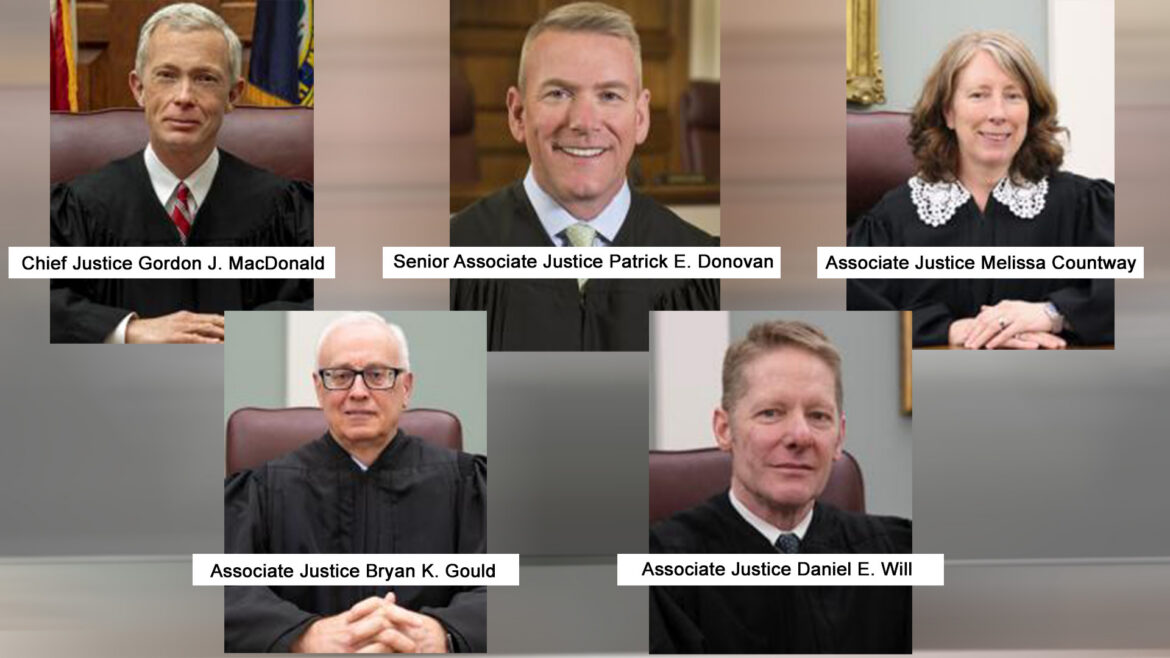
By NANCY WEST, InDepthNH.org
Governors Chris Sununu and Kelly Ayotte have broken with the tradition of maintaining a bipartisan balance on the New Hampshire Supreme Court so all five justices are Republicans now instead of a 3 to 2 split along party lines at a time when the court is facing heightened public scrutiny and Chief Justice Gordon MacDonald is out on indefinite medical leave.
Republicans Sununu and now Ayotte have only nominated members of their Republican party to the state Supreme Court, and with a majority of the Executive Council also Republican have been able to assure their confirmation.
With long simmering controversial matters like education funding before the state Supreme Court, some wonder about the wisdom of ending the bipartisan tradition.
Especially with publicity over MacDonald, 64, helping a close colleague at the court obtain a $50,000 benefits payout for being laid off for two days before being hired to a new position, and allegations by a fellow justice that he told her she could meet with the governor when her husband was under criminal investigation, which MacDonald denied.
“The rumblings are, what’s going on up there? Who is this court now? The court’s authority, moral authority, is being questioned because of all the weird stuff that’s happened,” said Albert “Buzz” Scherr, who has served as a public defender, appellate defender and now teaches constitution law at University of New Hampshire Franklin Pierce School of Law.
He pointed to alleged conversations between MacDonald and Supreme Court Justice Anna Barbara Hantz Marconi in which she says MacDonald told her she had a right to meet with then-Gov. Chris Sununu and separately with PDA chairman Steve Duprey when her husband Geno Marconi was under criminal investigation. Hantz Marconi was indicted because of the meetings alleging she was seeking special favors, pleaded no contest to a minor misdemeanor, was convicted, fined and returned to the bench until she retired six months ago.
But on Aug. 6, the Judicial Conduct Committee, which has the authority to discipline judges who violate the Code of Judicial Conduct, charged Hantz Marconi with ethical violations so what MacDonald told her or didn’t tell her about meeting with Sununu will likely be an issue at a public hearing in December on the JCC allegations.
As to whether MacDonald did or didn’t tell Hantz Marconi she could meet with then-Gov. Sununu when her husband was under criminal investigation, he should have told her she had no right to meet with him in June of 2024, Scherr said.
“It just smelled bad,” Scherr said, “If Hantz Marconi said I’m going to go talk to the governor about what’s going on with my husband, whether she asked him for permission or not, he should have said no no no. There’s no reason other than you wanting to get the governor to influence the outcome of what’s happening. There’s no other reason for you to talk to the governor about that sort of thing. That’s what should have been said to her.”
Her husband Geno Marconi pleaded guilty last Oct. 31 to a misdemeanor charge of providing confidential motor vehicle records to a third party, received a 30-day suspended jail sentence, was fined $2,000 and forced to leave his job as director of the State Division of Ports and Harbors.
Court spokesman David Sakowitch hasn’t responded to related questions InDepthNH.org posed to him and the other justices.
MacDonald’s lawyer Jane Young hasn’t responded to request for comment. Ayotte and Sununu also haven’t responded to a request for comment.
Earlier this year, some Republican lawmakers tried to pass House Resolution 38 to investigate whether there was enough evidence to impeach MacDonald, but that effort was tabled. The lawmakers also raised concern that MacDonald’s divorce has been pending in court for almost six years.
And eyebrows were raised when Periklis Karoutas of Legislative Solutions was hired to lobby for the New Hampshire Judicial Branch for $10,000 a month in the wake of publicity over the $50,000 payout scandal.
For at least in recent memory, governors, who have the authority to nominate judges in New Hampshire, have tried to maintain a 3 to 2 balance depending on their party affiliation. In some notable cases, governors have nominated people from the opposing political party to maintain bipartisanship.
“Republican Gov. Steve Merrill nominated (Democrat) John Broderick to the Supreme Court,” Scherr said. Broderick and Merrill were law partners and best friends.
“There’s always been a swing between Republicans and Democrats depending on the political party of the governor appointing them,” Scherr said.
Richard Hesse, professor emeritus of University of New Hampshire Franklin Pierce School of Law, said he still pays attention to the court appointments, but hasn’t done a study relative to the political balance on the court.
Still, he has noticed the Supreme Court has not seemed bipartisan in recent memory especially in the last 20 years.
“I don’t have a sense that the justices are entirely free of the influence of their past connections to their clients, their law firms, etc.,” Hesse said.
There is a lack of diversity in the appointments, Hesse said, noting that people of different backgrounds are overlooked, pointing to outstanding lawyers in the criminal defense bar and various civil rights organization who do not get considered.
By executive order, Ayotte has also made the Judicial Selection Commission all-Republican as well. Lawyers interested in serving as a judge can fill out a form on the commission’s website. The names of applicants are only made public if they end up being nominated by the governor.
“The history of the Supreme Court for a long time has been that there were Democrats and Republicans on the court regardless of the political persuasion of governor,” Scherr said. “That history stopped when Chris Sununu became governor and since then we had Gov. Ayotte just appoint Republicans to the court. So it is no longer a court with Republicans and Democrats.”
Why does that matter?
“One never knows. On the one hand speaking like a lawyer we want our Supreme Court justices to rule the objectively correct way regardless of whether they are registered Republicans or registered Democrats. One would hope that wouldn’t matter.
“And when there was a bipartisan Supreme Court they developed a body of law creating state constitutional rights that were more protective of people than were the same rights and privileges under the federal constitution. They did it under the New Hampshire Constitution,” he said.
“That’s gone,” Scherr said. “The current Supreme Court does not appear to be anywhere near as attentive to states’ rights as the prior iterations of the court had been.”
There seem to be more demonstrable partisan appointees, Scherr said, referring to Gov. Ayotte’s recent appointment of Bryan Gould, 66, who was a long-time lawyer for the Republican party. He was appointed to the court with less than four years before he must retire at age 70.
“That’s not a good appointment whatever his political persuasion but its ugly and seems like an untoward gift,” Scherr said.
Gould’s appointment fed speculation that the Supreme Court was going to do away the Claremont I and Claremont II school funding decisions.
On Friday Attorney General John Formella argued in a filing to the Supreme Court that the Claremont decisions should be overturned in whole or in part in his appeal of the Superior Court’s Rand decision.
The Claremont decisions have been the foundation of the state’s education system since they were issued by the Supreme Court three decades ago. Claremont I found the state has a constitutional duty to provide an adequate education for the state’s children and to pay for it, while Claremont II found the education funding system dependent on widely varying local property taxes was unconstitutional.
The Rand decision found that the state has failed to meet its obligation to provide an adequate education as well as special education services, to fund both, and the funding system is still unconstitutional. Formella argued the Supreme Court’s decisions and those following it are “wrong as a matter of constitutional text, structure, purpose, history and tradition, are poorly reasoned, and, as a result, have led to the impractical and unworkable state of affairs that exists today in our education funding law.”
The Attorney General filed the brief Friday with the State Supreme Court, which had been expected to hold oral arguments by the end of the year, although that may change as Chief Justice Gordon MacDonald is on medical leave leaving four justices to decide cases.
Earlier the plaintiffs had asked four of the five justices — including MacDonald — to recuse themselves citing prior involvement in either the original Claremont case or subsequent ones, including ConVal or prior statements about the original Claremont decisions.
The four justices – MacDonald, and Associate Justices Patrick Donovan, Bryan Gould, and Daniel Will refused to take themselves off the appeal of Rand.
Scherr said one can never say the justices are ruling the way they are ruling because they are Republican.
“It’s impossible to say that. It’s also impossible to say with any confidence that they are not ruling the way they are ruling because they are Republicans,” Scherr said.
“It’s situation where it is impossible to know what the truth is because they are not available for interviews, and because they don’t want to show their hand, one never knows why they are appointed and what was expected of them when they were appointed.
“Courts have the patina of inscrutability by their nature. Society wants to believe that courts are objective…Most judges I know try be as objective as they can be. Some try harder than others,” Scherr said.