By ZACH LAIRD, InDepthNH.org
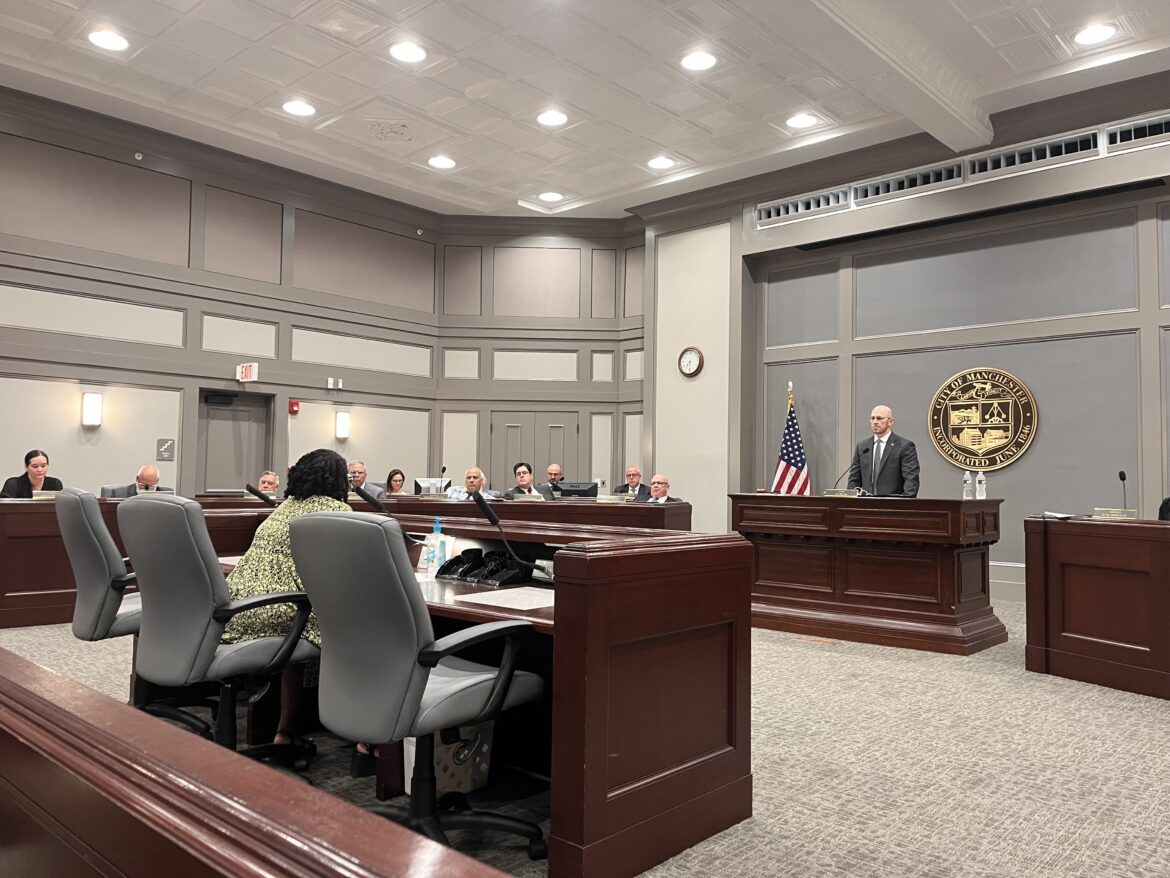
MANCHESTER — Community members and advocates for Nickenley Turenne, who was killed by three police officers in December 2025, united at Tuesday’s Board of Mayor and Aldermen meeting, urging city officials to change policies regarding officer-involved shootings.
Turenne was ultimately shot several times after attempting to flee on foot following a short police chase near the Green Acres Elementary School area on the night of Dec. 6, 2025. Moments before his death, he pulled out a flashlight and aimed it at the officers which made them believe he was armed, according to a report issued by the New Hampshire Attorney General’s Office. In the report, the three officers involved in the shooting were found to be legally justified.
Prior to people voicing their opinions during the meeting, a rally was held outside City Hall which saw a group of about a dozen people. The event was organized by local advocacy groups such as American Friends Service Committee, Black Lives Matter NH, and the New Hampshire Center for Justice and Equity.
Healing Justice Program Associate Ophelia Burnett spoke to city officials during the public comment segment of Tuesday evening’s meeting. She encouraged the city to establish a guaranteed victim and family advocate for “every family impacted by police-involved shootings through the entire process, and not only until charges are pressed.” She also advocated to change the five-day return to duty policy for an officer involved in a shooting.
“Families deserve someone in their corner from day one; someone to help them navigate one of the most traumatic experiences of their lives with dignity, transparency, and passion… When a life has been taken and an investigation is still active, officers involved should remain on administrative leave until the investigation is complete. This is not about assigning guilt before the facts are known; it’s about protecting the integrity of the investigation and maintaining public confidence in the process,” Burnett said.
The advocacy groups also noted their full list of demands.
- Modification of Manchester Police Department’s five-day return to work policy
- Statewide universal use of force policy
- Statewide crisis intervention programs and increased behavioral health partnerships
- Victim and family advocates for families impacted by police-involved shootings
- A fully resourced statewide accreditation and oversight agency for law enforcement
- Review and revision of police policies and training as related to bias, de-escalation, and mental health response.
In a follow-up interview, Alderman Ross Terrio said it’s a very unfortunate situation and that he feels for the Turenne family. He continued that having read the Attorney General’s report, he referenced the fact that Turenne pulled out the flashlight and aimed it at the officers — giving them the impression he was armed — and said he felt that he couldn’t second-guess the officers involved who thought he had a gun under the circumstances.
“It’s super unfortunate and sad for the family, I just can’t read minds, or understand the young man’s (Turenne) frame of mind to do what he did. Whether he was depressed or suicidal, I just don’t know. That type of behavior obviously scared the police, it would have scared me… I think the Attorney General came to the right conclusion — and even though he didn’t have a gun — it looked like he had a gun,” Terrio said.
Per the report from the Attorney General’s office, Turenne was with his girlfriend, Nikki Murray, the night he was killed. Murray, who had filed a protection order against him, had been previously assaulted and threatened by Turenne, though they later met up again on Dec. 6, 2025. They had been drinking and smoked cannabis before he eventually parked the car to rest.
The report states: “Before the shooting, Mr. Turenne had no less than four active court orders preventing him from having contact with Mr. Murray: two suspended sentences, one current bail order, and Ms. Murray’s civil order of protection,” the report states. “He believed the police were searching for him, and stated that he had a plan for how to kill himself. According to Ms. Murray, Mr. Turenne seemed calm and ‘like he had [his] decision made up and [she] wasn’t going to change his mind.’ Despite Ms. Murray saying, ‘please don’t do this’, he reiterated ‘I’m fucked, I’m fucked,’ ‘they’re looking for me, right?’ and how he ‘was not going back to jail.’”
The report also noted that Turenne had “no less than four active court orders preventing him from having contact with Ms. Murray: two suspended sentences, one current bail order, and Ms. Murray’s civil order of protection,” and that “Mr. Turenne could have been found in
violation of all four of those conditions/orders if he was found with Ms. Murray that night.”
Neither Mayor Jay Ruais nor the Manchester Police Department could be reached for comment.
According to a previous interview with Michael Garrity, director of communications for the New Hampshire Department of Justice (DOJ), returning an officer to duty is a decision made by their specific department; it is not a New Hampshire DOJ determination.
Manchester resident Jon Blanchette also spoke during public comment. He said he read the Attorney General’s report on Turenne’s death and concluded that Turenne “did not need to die that day.” He also said that the officers involved “aren’t adequately trained to deal with somebody having a crisis.”
He also said he thinks it’s crazy how the three officers involved in the shooting were allowed to return to duty five days after Turenne’s death. However, the official report that stated the officers were justified in shooting Turenne was not released until seven months later.
Another Manchester resident, Rolf Vanbibber, urged his fellow community members to question the government on “why it takes about five days for them to come to the conclusion that these police should be back out on the streets, but it takes seven months for them to actually release the report actually justifying the killing.”
Attendee Billie Dal Molin decried Manchester Police officers as “thugs.”
“A private army recruited from the populace in which they oppress, on your behalf, whose only differentiation from the militias like the Proud Boys — the white nationalist groups — is that one side is sanctioned by the state and one isn’t. There will be those who say we can reform our way out of this system of inherent violence, that we can take away their weapons or give them more training (or) try to change our policies. But you cannot reform the rabies out of a dog,” Dal Molin said.
Earlier at the rally outside City Hall, Grace Kindeke, director of projects for the New Hampshire Center for Justice and Equality said, “Regardless of that thin blue line, PD are part of our community, and our hope and our goal is to ensure that we’re creating the type of policy changes the type of community, where there is no thin blue line. There is no separation between us and them. There is only us. And so anytime one of us is harmed, any one time, any one of us’ lives is taken, it impacts and it changes the way we do things. There’s no more time for the status quo.”