By NHFPI
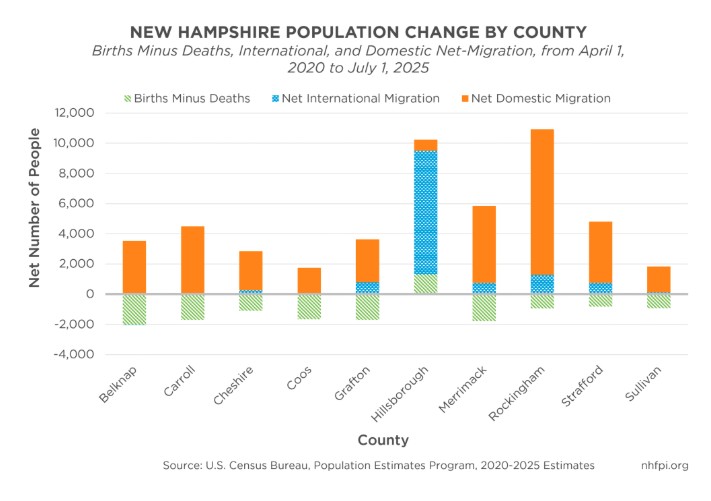
Concord, N.H. – A new analysis from the New Hampshire Fiscal Policy Institute found that New Hampshire added approximately 36,600 residents between 2020 and 2025, but that growth was not distributed evenly across the state. Smaller towns in southeastern and central New Hampshire, along with several regional economic hubs, experienced some of the fastest growth, while population growth rates in the state’s largest cities remained relatively modest.
The analysis, authored by NHFPI Senior Policy Analyst Jessica Williams, includes an interactive map that allows readers to explore population changes in every New Hampshire municipality and download the underlying data.
The analysis suggests that housing availability and access to jobs are playing an important role in determining where people settle. Communities that added housing and are located near employment centers generally saw stronger growth, while affordability challenges and housing shortages may be limiting growth in some larger cities and certain towns.
Key takeaways:
- New Hampshire’s population grew, but growth was uneven. New Hampshire’s population increased by about 36,590 residents (2.7%) from 2020 to 2025. However, 31 communities lost population, 98 grew more slowly than the state average, and 105 municipalities matched or exceeded the statewide growth rate.
- Smaller towns near major economic centers saw some of the fastest growth. Epping recorded the fastest population growth rate in the state, adding about 820 residents (11.5%) between 2020 and 2025. Other fast-growing communities included Brentwood, Dunbarton, Boscawen, Salisbury, Chichester, and Auburn. Many of these towns are located near Manchester, Concord, or the Seacoast and offer access to jobs.
- Merrimack added more residents than any other municipality. Merrimack gained approximately 2,864 residents between 2020 and 2025, the largest numerical increase of any New Hampshire community. Londonderry, Dover, and Lebanon also experienced substantial population gains, highlighting continued demand for communities with strong employment opportunities and regional economic activity.
- Growth continued in the Lakes Region and White Mountains, but at a slower pace. Natural amenity-rich communities such as Brookfield, Tuftonboro, Moultonborough, New Durham, Thornton, Croydon, and Newbury continued to grow at a faster rate that the state overall, likely benefiting from retirees, second-home owners establishing themselves permanently in the communities, and remote workers. However, population growth in many of these areas has slowed compared to the height of the COVID-19 pandemic-era migration surge.
- The state’s largest cities grew more slowly. Manchester and Nashua remained the state’s largest cities but saw relatively modest growth, about 1.1% and 1.4% respectively, between 2020 and 2025. Housing costs and limited inventory may be pushing some residents toward smaller communities where homes are more available or affordable. However, these lower growth rates still resulted in added residents, with an estimated 1,311 more residents in Manchester and 1,240 in Nashua between 2020 and 2025.
- Most residents remain concentrated in southeastern New Hampshire. The state’s ten largest municipalities remained unchanged in 2025 compared to the prior year, and nearly three-quarters of New Hampshire residents live in Hillsborough, Merrimack, Rockingham, and Strafford counties. More than half of all residents live in Hillsborough or Rockingham counties alone.
The analysis concludes that housing availability will likely play a key role in shaping New Hampshire’s future growth. As Jessica Williams writes, “New Hampshire’s uneven population growth suggests that while more people may be moving to economic hubs for employment opportunities and certain smaller towns for preferred amenities, broader affordability challenges and housing constraints may be slowing growth in some of the state’s larger communities.”
She adds that “policy approaches aimed at increasing the availability of housing, including regulatory changes and financial investments which could help spur housing development, could attract younger families and influence future population growth across New Hampshire.”
You can read the full analysis at https://nhfpi.org/blog/smaller-southeastern-towns-lead-new-hampshires-population-growth-while-movement-to-lakes-and-mountains-slows-post-pandemic/.
###
About the New Hampshire Fiscal Policy Institute
The New Hampshire Fiscal Policy Institute is a nonpartisan, independent research nonprofit organization that examines issues related to the state budget, the economy, policy decisions, and the financial security of Granite Staters, centering on issues relevant to people and families with low and moderate incomes. Learn more at www.nhfpi.org.