By GARRY RAYNO, InDepthNH.org
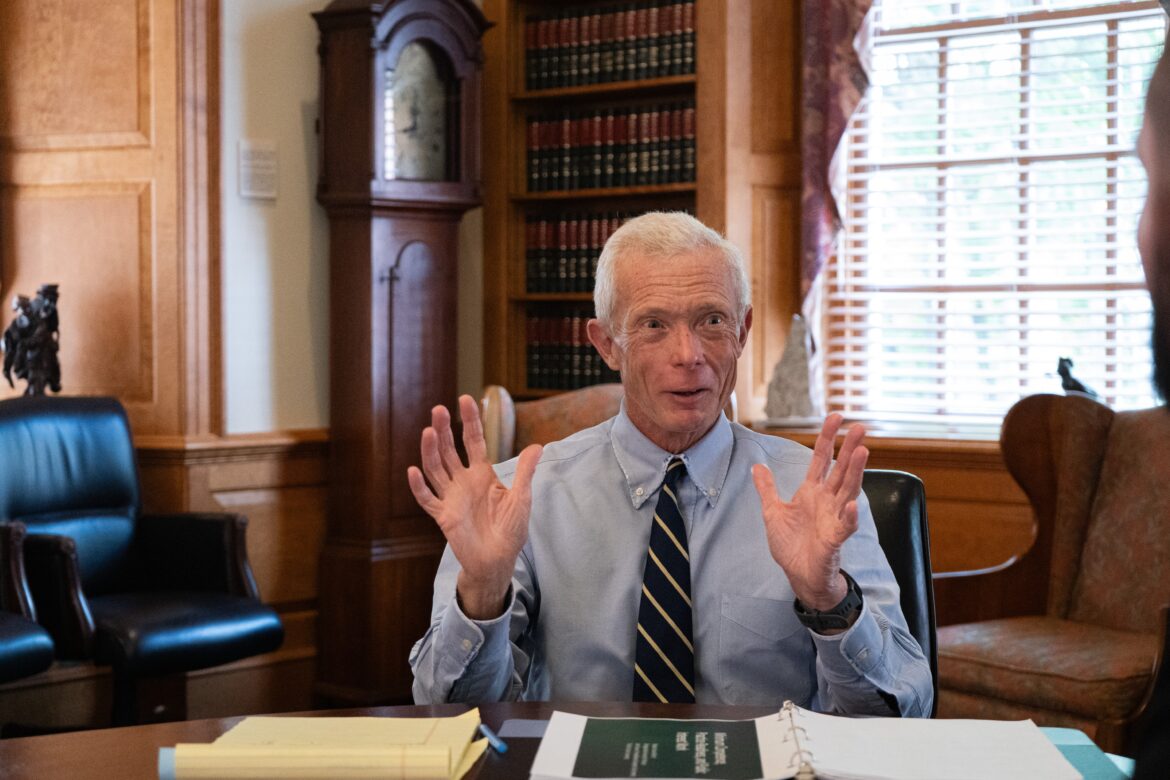
CONCORD — Supreme Court Chief Justice Gordon MacDonald will not recuse himself from deciding the appeal of the Rand education funding lawsuit now before the court.
His refusal to recuse himself is the second for the state’s appeals of the two Rand decisions issued by Rockingham County Superior Court Judge David Ruoff.
In March, the plaintiffs’ attorneys asked four of the five supreme court justices to recuse themselves from the latest appeal saying the public could have a reasonable assumption that the four have some bias in the case.
The four justices are MacDonald, and associate justices Bryan Gould, Patrick Donovan, and Daniel Will. MacDonald was attorney general and Will the solicitor general in defending the state against the ConVal lawsuit on education funding, while Donovan was one of the state’s attorney in the Claremont education lawsuit, and Gould has been an attorney for the state Republican Party, which has long opposed the original Claremont education decisions.
Earlier Donovan and Gould declined to recuse themselves form hearing the Rand appeal.
In the Rand case, Ruoff determined the state has failed to meet its obligation to provide and pay for an adequate education for the state’s students and for special education services, and instead uses local property taxes to meet its obligation which is unconstitutional because the rates vary widely and state taxes have to be proportional and reasonable under the state’s constitution.
The plaintiffs claimed the ConVal and Rand suits are nearly identical in that they both concern the state’s failure to met its constitutional obligation to provide an adequate education for the state’s children and to pay for it.
MacDonald and Will were involved in developing the strategy for the state’s defense in the ConVal suit.
In MacDonald’s order denying the plaintiffs’ motion for his recusal issued June 4, he said he is constitutionally required to sit on cases unless there is good reason to recuse himself, but does not cite case law to back that statement as he does for other contentions.
And he says judges are sworn to be be fair and impartial therefore “a judge is presumed to be fair and impartial: ‘the law will not suppose a possibility of bias or favor in a judge, who is already sworn to administer impartial justice, and whose authority greatly depends upon that presumption and idea.’ Hutchinson v. Railway, 73 N.H. 271, 275 (1905).”
In his order, MacDonald says “it is perfectly appropriate for plaintiffs’ counsel to argue the facts and law surrounding whether this is the same ‘matter in controversy’ or that I should not be sitting on a matter involving the potential overruling of a case from which I was just disqualified.”
But he takes exception to the plaintiffs’ claim that if he does not disqualify himself from the Rand case, the integrity of the court, the public’s confidence in the court, and the rule of law itself will be undermined.
“It has been a highly unfortunate development in our recent national history for public officials to attack judges and courts based on outcomes in cases,” MacDonald writes. “Here, the plaintiffs’ arguments are of a similar ilk: if their motion is denied, the court will necessarily lack integrity.”
Such attacks by public officials are not appropriate and threaten judicial independence, he says.
MacDonald contends that there is no case in which he has sat on or been involved with that is associated with the Rand case.
He writes the two cases do not contain the same “matter in controversy,” in that he has not litigated any case or issue that is associated with the Rand case nor has he been involved in a non-litigating process.
“Accepting that an appearance of bias could conceivably arise in situations involving something other than the exact case in which a judge had previously served as a lawyer, this is not such a circumstance,” MacDonald writes. “The procedural history in this case conclusively bears that out.”
He said he had left the Attorney General position before the Rand suit was filed in 2022 and he notes the superior court judge declined to approve the plaintiffs’ motion that the ConVal and Rand cases be consolidated, which used the same argument of identical factual and legal issues.
Of the 28 witnesses that testified in the ConVal case, only two testified in the Rand case, MacDonald argued, and notes the plaintiffs in the ConVal case were school districts, while the plaintiffs in the Rand case are property owners.
He also notes the court’s recent history establishes that prior education funding cases comprising Claremont’s progeny do not constitute the same “matter in controversy” as ConVal or Rand.
“In sum, because the Rand and ConVal cases are not the same ‘matter in controversy,’ there is no appearance of bias to warrant disqualification. Moreover, there is no actual bias, no violation of RSA 492:1, and no constitutional grounds to warrant disqualification,” MacDonald wrote.
His conclusion was a copy of what he wrote for his conclusion for denying the plaintiffs’ motion to recuse himself from the first appeal of the other Rand decision dealing with the statewide property tax and negative local education tax rates to offset the payment of the statewide education property tax in unincorporated places.
“As reflected in our constitution, the issue of disqualification lies at the heart of the integrity of the judicial system. The record of my judicial service reflects that, when required, I have concluded that my duty to sit must yield. For the foregoing reasons, this is not such a case. A reasonable person, fully informed of the facts and the legal principles applicable to judicial disqualification, would not question my impartiality. I affirm that I have no bias in this case and will decide it on the facts and the law. The motion for my recusal is denied,” MacDonald wrote in his May 31, 2024 order denying the plaintiffs’ prior recusal request.
In seeking MacDonald’s recusal from the current Rand appeal, the Plaintiffs argued that MacDonald was involved in the state’s defense in the ConVal case which contained many of the same contentions of what constitutes an adequate education and if the state was paying for it, while the Rand case also goes to whether the state education funding system is constitutional when it uses local property taxes to fund the balance of what it does not provide through adequacy aid.
MacDonald recused himself as chief justice from hearing the ConVal appeal, and because the contentions will be largely the same, he should recuse himself from the Rand appeal, the attorneys argue.
They also claim the two state attorneys who will argue the Rand case were on the team of attorneys supervised by MacDonald that oversaw the state’s defense of the ConVal case.
“For the Chief Justice to recuse himself from ruling on ConVal because of his involvement in that litigation as Attorney General, but fail to recuse himself here in Rand—the same matter in controversy—on an appeal would lead to a preposterous result that surely creates an appearance of impropriety and undermines the rule of law,” the attorneys wrote in their motion filed in March.
The state has a July 10 deadline to file its brief in the appeal, and the Plaintiffs have until Aug. 24 to respond.
The state has already indicated it will ask the court to overturn the two original Claremont education decisions that have been the foundation for the state education funding system for three decades.
Oral arguments are likely before the end of the year.
Garry Rayno may be reached at garry.rayno@yahoo.com.