By ZACH LAIRD, InDepthNH.org
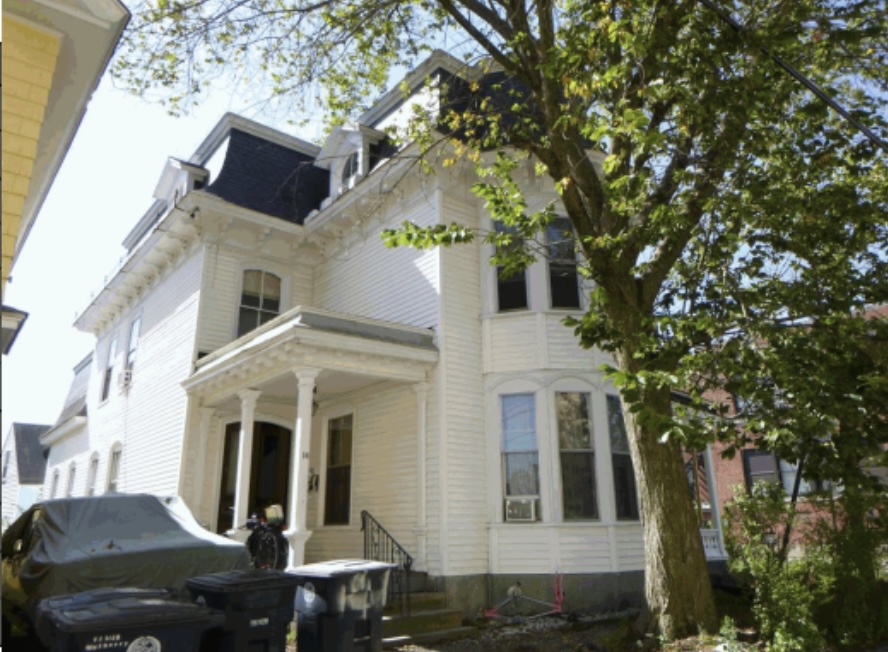
NASHUA — The Board of Aldermen will vote during Wednesday’s meeting whether to purchase and renovate a property on 14 Mulberry Street into a homeless resource center, though critics say the plan is rushed, overly expensive, and lacks transparency.
Mayor Jim Donchess explained that the proposal aims to appropriate $900,000 through a bond issue to purchase a three-unit, multi-family property that sits across from the City Health Department, as well as draft designs for the building regarding improvements. He noted that ultimately the project could cost around $4.5 million.
At a public hearing on April 15, town officials and some community members expressed their opposition to the proposal. That same evening, during an emergency Planning Board meeting, the board voted 3-2 not to support the project, though the Board of Aldermen still has final authority to purchase the property.
Planning Board member Lawrence Hirsch said during the hearing that the project doesn’t make sense, and that “it’s almost like we’re rushing to something that hasn’t really been thought out completely.”
Community Development Division Director Matt Sullivan said, “We’ve waived many of the contingencies that would customarily be associated with a property like this. We cannot even fully speak to the adequacy of things like the sewer service, the electrical service, the gas meter.”
Transparency advocate Laurie Ortolano said she was opposed to the proposal because of a lack of transparency and information about the plan.
“It’s a building of only 3,000 square feet in a pretty blighted neighborhood, and they want to bond $900,000 for it. Then, it wasn’t until (last) Wednesday night when they told us in the hearing that they anticipated spending another $4.5 million to renovate that building… When you look at a 3,000 square foot building, and a renovation cost of $4.5 million, that comes out to $1,500 a square foot, and that’s insane.”
Ortolano said the city waived the inspection on the building, which was constructed during the Civil War, without considering aspects like sewer, electrical, or gas services for it to be used as housing.
Ortolano said: “It just doesn’t make sense. I discovered that property had a lead abatement grant in 2024 for $75,000. The Housing and Urban Development (HUD) rules require that the property not be sold for three years. If the property is sold, you have to rebate the money back to the city… In 2024, they finished a lead abatement, but they never filed in the registry of deeds the paperwork that put the restriction on the recapture (of the money).”
Donchess responded in a follow-up conversation that the $4.5 is an estimate of the total cost for the
project which includes the $900,000. And said while the city waived the inspection, the city’s building inspector and fire marshal inspected the space. He noted that since the proposal aims to convert the space from residential to commercial use, those systems would need to be upgraded regardless of what’s there.
Donchess said the city operates a lead abatement program under a federal grant. He said the property owner was provided with $75,000 to do the abatement, and that as an obligation, the property is to include affordable units for three years beyond the date of completion, which would be May 2027.
Ortolano said she filed a Right-to-Know request last week to obtain a copy of any document that shows the recapture was held to the property owner because “potentially, this property owner owes $75,000 back to the city.”
She said if the city didn’t disclose that to the property owner, then the taxpayers would effectively owe the money to HUD. Ortolano added this was never disclosed during the previous public hearing on the matter.
Donchess said: “Usually, these things get recorded, but that’s simply to put other people on notice. It’s valid whether or not it’s recorded,” he said. “There are various ways this could be dealt with… There could be a reimbursement to the lead program of $75,000. Number two, were the city to buy the property, I believe we could hold it until May of next year and leave the tenants there and provide them with affordable units for the remaining years of the three-year period. Or, number three, HUD could wave this. We’re going to be talking to HUD about this tomorrow (Tuesday) to get their thinking behind it.”
Donchess added, “The proposal here is to create a resource center to enable the community to engage with the homeless population, and potentially provide a little bit of transitional housing. The city has been working to try and adopt a plan for the resource center for quite some time. There was an idea that it could be located on East Hollis Street, but that didn’t work. Then, there was a plan, as a temporary measure, to put two portable classrooms on a city parking lot.”
Donchess said the first floor of the space would be used as a day-time resource center, while the
upstairs could be used for transitional housing. While he couldn’t immediately recall how many
individuals the facility would be able to serve at once, he said the city needs to determine the legal
occupancy of the building once the design is completed.
“I don’t know the number, but it’s not going to be 100 (people), but it also won’t be five,” he said. “It’ll be a decent number of people,” Donchess said. He noted the city would have the opportunity to invite all of its community partners to meet with potential clients, which involves mental health providers, those who treat addiction and substance abuse, and others in the community who play similar roles to help those in need.
Donchess added that the city will “involve a lot of organizations in the effort to help stabilize peoples’ lives.”
While the city doesn’t yet have a precise figure on what estimated operating costs will look like,
Donchess said it could be around $300,000, which would come from the city’s budget, though the city
would be able to use grant funding to mitigate the cost.
“This resource center is not going to solve the problem of homelessness in Nashua without federal help at a very significant level. Building housing for people is not going to happen without a federal commitment to do so, because the costs of building housing are very large. This is something that will help people stabilize their lives, get mental health treatment, and housing when they need it… but it’s certainly not going to solve homelessness,” Donchess said.
If the vote passes, Donchess said the resource center would be open and operational some time in 2027.
The Board of Aldermen meeting will be held on Wednesday evening at 7 p.m. on 229 Main Street, Nashua.