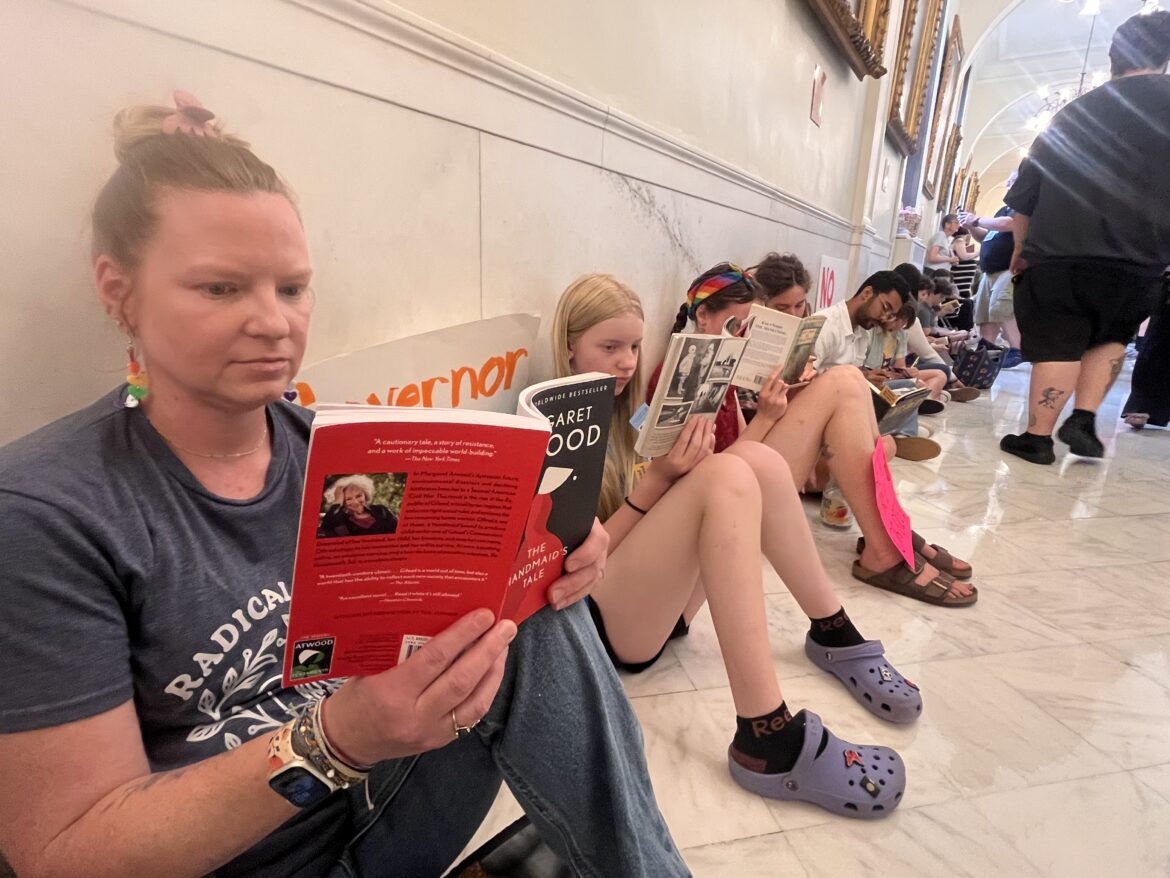
By GARRY RAYNO, InDepthNH.org
CONCORD — The New Hampshire Legislature’s latest attempt to ban books and materials from public schools and libraries failed once again this year.
Educators and their advocates, booksellers, publishers, journalists and free speech promoters are celebrating Banned Books Week this week underscoring the importance of protecting the freedom to read at every level of government and the rejection of another book banning bill.
Earlier this year, Gov. Kelly Ayotte vetoed Senate Bill 434, which would have enacted a statewide book ban and undermined local control.
The bill would have established a procedure for parents or anyone else to challenge material in schools, or libraries that they believe is harmful to minors, although school districts are currently required to have policies in place that determine if challenged material is appropriate for certain age levels.
In vetoing the bill the governor said the restrictions need to be much narrower and the government should not determine what is art or something else.
Bill advocates said it would ensure that all school districts have a clear, compliant process, including appropriate appeals, for parents who find materials in public school libraries they believe are harmful to minors.
Opponents said the bill would interfere with students’ first amendment rights to access materials and would allow a single parent or person to decide what other children could read or access.
Ayotte’s veto followed her veto of House Bill 324 in 2025.
First Amendment advocates called the defeat of both bills victories for academic freedom and local control.
MacKenzie Nicholson, Senior Director of MomsRising New Hampshire, said “(The defeat) is a win for moms, families, educators, librarians, and every child who deserves the freedom to read and learn. We’re proud of what we accomplished together, and grateful our kids still have access to books and materials that help them grow, learn, and become amazing humans.”
Anthony Poore, Executive Director, NH Center for Justice, said the week is a reminder of why access to a wide range of stories and perspectives matter.
“Books help students see themselves reflected, understand people whose lives are different from their own, and think more deeply about the world around them,” he said. “When those books are restricted, Granite State students lose opportunities to build empathy, ask questions, think critically, and better understand one another’s lived experience(s).”
Megan Tuttle, President of NEA-New Hampshire, said books are windows into the world, opening young minds to new ideas, perspectives, and possibilities.
“When students are given a choice in what they read, as well as support and time to read, they thrive,” Tuttle said. “Efforts to limit those choices and censor books written by mostly Black, brown, and LGBTQ+ authors—whether in Congress, at the State House, or in our local schools and libraries—deny students the ability to see themselves and understand our similarities and our differences.”
Former House Education Policy and Administration Committee Chair, Rep. Glenn Cordelli, R-Tuftonboro, has led the charge in the House the past four or five years to allow parents more say over what materials are in school libraries or used in public schools, although school boards are required to have policies in place to address those issues.
Some of his proposals would have left the final decision to the State Board of Education instead of the local school districts and with a broad definition of what would be inappropriate material for certain age groups.
He gave several contentious speeches on the House floor reading graphic sections of several books dealing with rape or forced sexual encounters.
Cordelli resigned in November 2025 and moved to Texas.
Opponents of book bans said they violate students’ first amendment rights and give one parent or person the power to decide what others can read.
“New Hampshire should be a state that encourages learning, not censorship — and our state’s politicians must protect free speech and stop the rinse and repeat of new school censorship bills each year,” said Amanda Azad, Policy Director at the ACLU of New Hampshire. “Let’s all pick up a book for banned book week and reflect on why such a week needs to exist. In the Granite State, we have long valued learning, local control, and living free – book bans have no place here.”
Deb Howes, President of American Federation of Teachers-NH, said: Public school libraries should open doors, not close them.
“Banned Books Week reminds us that censorship limits opportunities for students and undermines local decision-making,” she said. “Protecting the freedom to read protects every public school student’s constitutional right to a robust education.”
Heidi Carrington Heath, Executive Director, NH Outright, said all people’s stories need to be told, celebrated and freely expressed.
“We have seen multiple efforts this year to limit access to books in our schools, and attempts to limit access to ideas, or concepts that may challenge us,” she said. “We are stronger together when we can celebrate diverse stories, multiple viewpoints, and our expanding horizons through books, and literature. All New Hampshire young people deserve to be seen, be heard, and be themselves inside, and outside of the classroom.”
John Chrastka, Executive Director of EveryLibrary, said his group recognizes that censorship efforts have not gone away.
“New Hampshire has sent a clear message that families do not need the state deciding what anyone’s child is allowed to read,” he said. “The veto of SB 434 is an endorsement of local control and of every family’s freedom to make its own choices.”
Garry Rayno may be reached at garry.rayno@yahoo.com.